












Differences in electroactive terpolymers based on VDF, TrFE and 2,3,3,3-tetrafluoropropene prepared by batch solution and semi-continuous aqueous suspension polymerizations
文献情報
出版日
2016-12-14
DOI
10.1039/C6PY01874B
インパクトファクター
5.582
著者
Vincent Ladmiral, Thierry Lannuzel, Fabrice Domingues Dos Santos, Bruno Améduri
原文を見る
要旨
In the search for new fluorinated electroactive copolymers, 0–8 mol% of 2,3,3,3-tetrafluoropropene (1234yf) was terpolymerized with vinylidene fluoride (VDF) and trifluoroethylene (TrFE). The reactivity in batch solution polymerization of 1234yf was evaluated. First, reactivity ratio measurements showed that homopropagation of 1234yf is favored compared to cross propagation with VDF or TrFE (rVDF-1234yf = 0.079, r1234yf-VDF = 2.6; and rTrFE-1234yf = 0.089, r1234yf-TrFE = 4.9, at 48 °C). Then, the study of a typical batch solution polymerization revealed that the polymerization time was not affected by the initial amount of 1234yf and that polymer chains with strong compositional heterogeneity were obtained. Based on these results, a semi-continuous aqueous suspension polymerization process was used for the synthesis of terpolymers with a more homogeneous composition. Calculation of addition probabilities exemplified the changes in the drift of composition. The monomer sequences in the poly(VDF-ter-TrFE-ter-1234yf) terpolymers, carefully studied by 19F NMR spectroscopy, were not affected by the polymerization process and were dominated by VDF-TrFE and VDF-1234yf dyads. Finally, the thermal and ferroelectric (FE) properties of the homogeneous and heterogeneous terpolymers were characterized and compared. In the case of heterogeneous terpolymers, increasing the 1234yf content from 0 to 6 mol% slightly decreased the crystal size and the overall crystallinity (Tm = 60 °C and ΔHm = 144 J g−1 for a poly(VDF66-ter-TrFE26-ter-1234yf8) terpolymer). On the contrary, for homogeneous terpolymers, 5 mol% of 1234yf strongly affected both the Curie and melting transitions at TCurie = 37 °C and Tm = 107 °C. The reduced coercive field (Ec = 40 MV m−1) and remnant polarization (Pr = 22 mC m−2) for the homogeneous terpolymer compared to a reference poly(VDF65-co-TrFE35) (Ec = 62 MV m−1 and Pr = 45 mC m−2) transcribed modifications of the FE domains.
おすすめジャーナル
関連文献
Allosteric modulation of the sarcoplasmic reticulum Ca2+ ATPase by thapsigargin via decoupling of functional motions
Noureldin Saleh, Yong Wang, Poul Nissen, Kresten Lindorff-Larsen
2019-09-17
Paper
DOI: 10.1039/C9CP04736K
Dissociative chemisorption of O2 on Agn and Agn−1Ir (n = 3–26) clusters: a first-principle study
Chuangchuang Wang, Yongpeng Yang, Xiaojing Liu, Yuanjie Li, Dandan Song, Yun Tian, Zhaojun Zhang
2020-04-06
Paper
DOI: 10.1039/D0CP01005G
Charge separation, recombination and intersystem crossing of directly connected perylenemonoimide–carbazole electron donor/acceptor dyads
Xue Zhang, Ayhan Elmali, Ruomeng Duan, Qingyun Liu, Wei Ji, Chen Li, Ahmet Karatay
2020-02-24
Paper
DOI: 10.1039/C9CP06914C
Linking structure to performance of Li1.2Mn0.54Ni0.13Co0.13O2 (Li and Mn rich NMC) cathode materials synthesized by different methods
N. Leifer, T. Penki, R. Nanda, J. Grinblat, S. Luski, D. Aurbach, G. Goobes
2020-04-02
Paper
DOI: 10.1039/D0CP00400F
A unique pentagonal network structure of the NiS2 monolayer with high stability and a tunable bandgap
2020-03-07
Paper
DOI: 10.1039/D0CP00434K
Hysteresis in graphene nanoribbon field-effect devices
Akimitsu Narita, Hai I. Wang
2020-02-18
Paper
DOI: 10.1039/D0CP00298D
Effect of graphene between photoanode and sensitizer on the intramolecular and intermolecular electron transfer process
Xiaofei Wang, Yuanzuo Li, Peng Song, Fengcai Ma, Yanhui Yang
2020-02-28
Paper
DOI: 10.1039/C9CP06543A
The tetracapped truncated tetrahedron in 16-vertex tetrametallaborane structures: spherical aromaticity with an isocloso rather than a closo skeletal electron count
Amr A. A. Attia, Alexandru Lupan, R. Bruce King, Sundargopal Ghosh
2019-09-20
Paper
DOI: 10.1039/C9CP04263F
Systematic modification of the indium tin oxide work function via side-chain modulation of an amino-acid functionalization layer
Naomi Kramer, Soumyajit Sarkar, Leeor Kronik, Nurit Ashkenasy
2019-09-23
Paper
DOI: 10.1039/C9CP04079J
Effect of mild nanoscopic confinement on the dynamics of ionic liquids
Daria Noferini, Olaf Holderer, Henrich Frielinghaus
2020-04-09
Paper
DOI: 10.1039/C9CP05200C
こちらもおすすめ
28770-01-62-(2-Isopropyl-1,3-o...
化合物よくある質問
「邻羟基阿托伐他汀内酯标准品」に適用される法規ガイドelinesは何ですか?
CAS番号163217-74-1の「邻羟基阿托伐他汀内酯标准品」は、GHS分類では危険物に分類されず、主にREACH規則とFDA/EPAの管理対象となります。R...
163217-74-1ortho-Hydroxy Atorva...
化合物よくある質問
メチル(3R)-3-アミノ-2,3-ジヒドロ-1-ベンゾファンラニン-5-カルボイル酸塩塩酸塩の主な用途は何ですか?
メチル(3R)-3-アミノ-2,3-ジヒドロ-1-ベンゾファンラニン-5-カルボイル酸塩塩酸塩は、医薬品や合成化学の研究に広く用いられます。また、特定の薬物の前...
2241594-15-8Methyl (3R)-3-amino-...
化合物よくある質問
トランス-4-メチルピロリジン-3-オール塩酸塩はどのように合成されますか?
トランス-4-メチルピロリジン-3-オール塩酸塩は、4-メチルピロリジンの塩酸塩化によって合成されます。一般的な合成方法では、4-メチルピロリジンを塩酸に加えて...
265108-42-7trans-4-Methylpyrrol...
化合物よくある質問
硫雜環丁烷-1,1-二氧化物は安全ですか?
硫雜環丁烷-1,1-二氧化物は安全ではありません。毒性は報告されていませんが、高温下で分解し、可燃性があるため、高圧ガスは注意が必要です。密閉した容器で保管し、...
5687-92-3Thietane 1,1-dioxide
6054-10-02H, 8H-Benzo[1,2-b
化合物よくある質問
9-ヒドロキシエリプチシネ塩酸塩はどのように合成されますか?
9-ヒドロキシエリプチシネ塩酸塩は、エリプチシネから塩酸を添加することで合成されます。選択性は高いですが、収率は約70%です。
52238-35-49-Hydroxyellipticine...
化合物よくある質問
5-塩素-2-(メチルアミノ)フェニル-(2-塩素フェニル)メタン酮の物理化学的性質は何ですか?
5-塩素-2-(メチルアミノ)フェニル-(2-塩素フェニル)メタン酮のCAS番号は5621-86-3です。この化合物は白色の結晶性粉末で、分子量は415.03で...
5621-86-3[5-Chloro-2-(methyla...
化合物よくある質問
1-[2-(4-甲氧基-苯氧基)-乙基]-哌嗪はどのように保存すればよいですか?
1-[2-(4-甲氧基-苯氧基)-乙基]-哌嗪は、直射日光を避けて暗所に、室温(15-25℃)で保管し、密閉容器に入れることで安定性を保つことができます。
117132-44-21-[2-(4-Methoxy-phen...
化合物よくある質問
2-[3-(4-甲氧基フェニル)プロピル]-4,4,5,5-四メチル-1,3,2-ドイボロロールアンの主な用途は何ですか?
2-[3-(4-甲氧基フェニル)プロピル]-4,4,5,5-四メチル-1,3,2-ドイボロロールアンは、医薬品の合成、有機合成化学、および新材料の研究で使用され...
1073371-72-82-[3-(4-Methoxypheny...
掲載誌
Polymer Chemistry

CiteScore:
8.6
自己引用率:
7.3%
年間論文数:
457
Polymer Chemistry welcomes submissions in all areas of polymer science that have a strong focus on macromolecular chemistry. Manuscripts may cover a broad range of fields, yet no direct application focus is required.
おすすめ化合物
![[(1S,2S,3R,4S,7R,9S,10S,12R,15S)-4,12-Diacetyloxy-15-[(2R,3S)-3-benzamido-3-phenyl-2-(2,2,2-trichloroethoxycarbonyloxy)propanoyl]oxy-1,9-dihydroxy-10,14,17,17-tetramethyl-11-oxo-6-oxatetracyclo[11.3.1.03,10.04,7]heptadec-13-en-2-yl] benzoate structure](https://static.chemtradehub.com/structs/100/100431-55-8-7104.webp "[(1S,2S,3R,4S,7R,9S,10S,12R,15S)-4,12-Diacetyloxy-15-[(2R,3S)-3-benzamido-3-phenyl-2-(2,2,2-trichloroethoxycarbonyloxy)propanoyl]oxy-1,9-dihydroxy-10,14,17,17-tetramethyl-11-oxo-6-oxatetracyclo[11.3.1.03,10.04,7]heptadec-13-en-2-yl] benzoate structure")
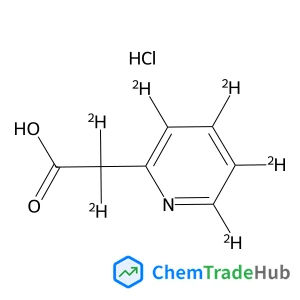
2,2-dideuterio-2-(3,4,5,6-tetradeuterio-2-pyridyl)acetic acid;hydrochloride
CAS番号:
1329799-67-8
分子式:
C7H2ClD6NO2

おすすめサプライヤー




免責事項
このページに表示される学術雑誌情報は、参考および研究目的のみを目的としています。当社は雑誌出版社とは提携しておらず、投稿の取り扱いも行っておりません。出版に関するお問い合わせは、各雑誌出版社に直接ご連絡ください。
表示されている情報に誤りがある場合は、support@chemtradehub.com までご連絡ください。迅速に確認し、対応いたします。