












A scaffold hopping strategy to generate new aryl-2-amino pyrimidine MRSA biofilm inhibitors
文献情報
出版日
2020-12-08
DOI
10.1039/D0MD00238K
インパクトファクター
0
著者
Alexander W. Weig, Samantha L. Barlock, Patrick M. O'Connor, Orry M. Marciano, Richard Smith, Robert K. Ernst, Roberta J. Melander, Christian Melander
原文を見る
要旨
Infections that stem from bacterial biofilms are difficult to eradicate. Within a biofilm state, bacteria are upwards of 1000-fold more resistant to conventional antibiotics, necessitating the development of alternative approaches to treat biofilm-based infections. One such approach is the development of small molecule adjuvants that can inhibit/disrupt bacterial biofilms. When such molecules are paired with conventional antibiotics, these dual treatments present a combination approach to eradicate biofilm-based infections. Previously, we have demonstrated that small molecules containing either a 2-amino pyrimidine (2-AP) or a 2-aminoimidazole (2-AI) heterocycle are potent anti-biofilm agents. Herein, we now report a scaffold hopping strategy to generate new aryl 2-AP analogs that inhibit biofilm formation by methicillin-resistant Staphylococcus aureus (MRSA). These molecules also suppress colistin resistance in colistin resistant Klebsiella pneumoniae, lowering the minimum inhibitory concentration (MIC) by 32-fold.
関連文献
Effect of pH on the chemical modification of quercetin and structurally related flavonoids characterized by optical (UV-visible and Raman) spectroscopy
Z. Jurasekova, C. Domingo, J. V. Garcia-Ramos, S. Sanchez-Cortes
2014-04-25
Paper
DOI: 10.1039/C4CP00864B
In situ fabrication of graphene–carbon nanochain webs as anodes for Li-ion batteries
Youlan Zou, Xiangyang Zhou, Juan Yang
2014-04-10
Communication
DOI: 10.1039/C4CP01137F
Recent aspects of self-oscillating polymeric materials: designing self-oscillating polymers coupled with supramolecular chemistry and ionic liquid science
Takeshi Ueki, Ryo Yoshida
2014-04-03
Perspective
DOI: 10.1039/C4CP00980K
Strain engineering the properties of graphene and other two-dimensional crystals
Mark A. Bissett, Masaharu Tsuji, Hiroki Ago
2014-04-25
Perspective
DOI: 10.1039/C3CP55443K
Improved efficiency of bulk heterojunction hybrid solar cells by utilizing CdSe quantum dot–graphene nanocomposites
Martin Neukom, Dorothea Scheunemann, Emre Erdem, Stefan Weber, Holger Borchert
2014-04-24
Paper
DOI: 10.1039/C4CP01566E
Local structure and lithium mobility in intercalated Li3AlxTi2−x(PO4)3 NASICON type materials: a combined neutron diffraction and NMR study
K. Arbi, M. Hoelzel, A. Kuhn, F. García-Alvarado, J. Sanz
2014-07-14
Paper
DOI: 10.1039/C4CP02938K
こちらもおすすめ
化合物よくある質問
2-ヒドロキシ-5-ニトロベンジンブロモイドの代替品はありますか?
2-ヒドロキシ-5-ニトロベンジンブロモイドは特定の化学反応に適しているため、代替品は限られています。しかし、同様の構造を持つ2-ヒドロキシ-4-ニトロベンジン...
772-33-82-(Bromomethyl)-4-ni...
化合物よくある質問
N-(2-ブロモフェニル)-1-チロール-3-オキソ-3-(ピペリジニル)プロペン-2-イル)ベンゼンアミドを取り扱う際の実験室安全事項は何ですか?
N-(2-ブロモフェニル)-1-チロール-3-オキソ-3-(ピペリジニル)プロペン-2-イル)ベンゼンアミドは有毒で、皮膚や粘膜に刺激を与える可能性があります。...
1800044-77-2N-[(1Z)-1-(2-Bromoph...
化合物よくある質問
1,3プロパンジオール,2-[2-(2アミノ-6クロロ-9Hピリミジン-9-イル)エチル-1,1,2,2-D4]-2,3-ジアセタートの市場動向や研究トレンドはどうですか?
この化合物は、新規治療薬の開発に注目されています。市場では、その有効性と安全性が評価され、研究分野では、分子生物学と医薬化学の新たな発見が期待されています。
1020718-81-31,3-Propanediol, 2-[...
579-44-2Ethanone, 2-hydroxy-...
化合物よくある質問
Succinimidyl-alanyl-phenylalanyl-prolyl-phenylalanine 4-nitroanilide はどの業界で使用されていますか?
Succinimidyl-alanyl-phenylalanyl-prolyl-phenylalanine 4-nitroanilide は主に医薬品開発やポ...
128802-73-3succinimidyl-alanyl-...
化合物よくある質問
メチル6-アミノ-5-クロロピリジン-2-カーボイル酸について、適用される法規ガイドラインは何ですか?
メチル6-アミノ-5-クロロピリジン-2-カーボイル酸(CAS番号: 1256794-05-4)の使用には、GHS( Globally Harmonized S...
1256794-05-4Methyl 6-amino-5-chl...
化合物よくある質問
エチル4-(シクロ Pentagonyl)アミノ-2-メチル硫化基ピリミジン-5-カルボキシレートを取り扱う際の実験室安全事項は何ですか?
取り扱いには、耐薬品性の容器を使用し、通気性の良い場所で操作することを推奨します。漏れ時は、SDS(安全データシート)を参照して適切な措置を取ること。手洗いと洗...
211245-62-4ethyl 4-(cyclopentyl...
化合物よくある質問
(S)-3-ベンZYルピペリジン塩酸塩とは何ですか?
(S)-3-ベンZYルピペリジン塩酸塩は、CAS番号1258940-00-9で表される化合物です。これは、(S)-3-苯基哌啶的盐酸盐であり、主に医薬品の原料と...
1258940-00-9(S)-3-Phenylpiperidi...
化合物よくある質問
3,5-二甲基金剛胺の主な用途は何ですか?
3,5-二甲基金剛胺は、主に医薬品の原料として使用され、また抗うつ薬や抗アルツハイマー薬の開発に利用されます。さらに、化粧品や食品添加物の製造でも重要な役割を果...
19988-45-52-(2,3-Dihydroxyphen...
化合物よくある質問
ビス(4-メチル-2-ペンチル)フェニルカルボン酸エステルの代替品はありますか?
ビス(4-メチル-2-ペンチル)フェニルカルボン酸エステル (CAS番号: 1398066-13-1) の代替品には、ビス(2-エチルヘキシル)フェノールカルボ...
1398066-13-1Bis(4-methyl-2-penty...
掲載誌
おすすめ化合物
![4-Chloro-3-(trifluoromethyl)-1H-pyrrolo[2,3-b]pyridine structure](https://static.chemtradehub.com/structs/869/869335-75-1-a9d0.webp "4-Chloro-3-(trifluoromethyl)-1H-pyrrolo[2,3-b]pyridine structure")
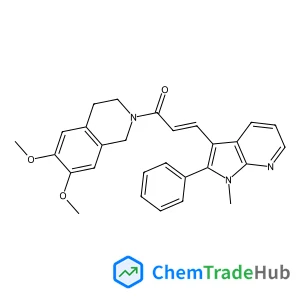
おすすめサプライヤー







免責事項
このページに表示される学術雑誌情報は、参考および研究目的のみを目的としています。当社は雑誌出版社とは提携しておらず、投稿の取り扱いも行っておりません。出版に関するお問い合わせは、各雑誌出版社に直接ご連絡ください。
表示されている情報に誤りがある場合は、support@chemtradehub.com までご連絡ください。迅速に確認し、対応いたします。