












Polarization induced water molecule dissociation below the first-order electronic-phase transition temperature
文献情報
出版日
2011-07-21
DOI
10.1039/C1CP20138G
インパクトファクター
3.676
著者
Andrew Das Arulsamy, Zlatko Kregar, Kristina Eleršič, Martina Modic, Uma Shankar Subramani
原文を見る
要旨
Hydrogen produced from the photocatalytic splitting of water is one of the reliable alternatives to replace the polluting fossil and the radioactive nuclear fuels. Here, we provide unequivocal evidence for the existence of blue- and red-shifting O–H covalent bonds within a single water molecule adsorbed on the MgO surface as a result of asymmetric displacement polarizabilities. The adsorbed H–O–H on MgO gives rise to one weaker H–O bond, while the other O–H covalent bond from the same adsorbed water molecule compensates this effect with a stronger bond. The weaker bond (nearest to the surface), the interlayer tunneling electrons and the silver substrate are shown to be the causes for the smallest dissociative activation energy on the MgO monolayer. The origin that is responsible to initiate the splitting mechanism is proven to be due to the changes in the polarizability of an adsorbed water molecule, which are further supported by the temperature-dependent static dielectric constant measurements for water below the first-order electronic-phase transition temperature.
関連文献
Deglycase-activity oriented screening to identify DJ-1 inhibitors
Efrat Finkin-Groner, Yoshiyuki Fukase, Qingfei Zheng, Shan Sun, Mayako Michino, Robert W. Myers
2021-06-02
Research Article
DOI: 10.1039/D1MD00062D
Shifting the paradigm in treating multi-factorial diseases: polypharmacological co-inhibitors of HDAC6
Alexandria M. Chan
2020-12-11
Review Article
DOI: 10.1039/D0MD00286K
Insights into the modular design of kinase inhibitors and application to Abl and Axl
Sameer Phadke, Lluis Lopez-Barcons, Nathalie Vandecan, Zhifen Wu, Taylor K. Johnson, Eric J. Lachacz, Sofia D. Merajver, Matthew B. Soellner
2021-11-05
Research Article
DOI: 10.1039/D1MD00296A
Progress in mechanistically novel treatments for schizophrenia
James Neef, Daniel S. Palacios
2021-06-29
Review Article
DOI: 10.1039/D1MD00096A
Collaborative virtual screening to elaborate an imidazo[1,2-a]pyridine hit series for visceral leishmaniasis
Yuichiro Akao, Stacie Canan, Yafeng Cao, Kevin Condroski, Ola Engkvist, Sachiko Itono, Rina Kaki, Chiaki Kimura, Thierry Kogej, Kazuya Nagaoka, Akira Naito, Hiromi Nakai, Garry Pairaudeau, Constantin Radu, Ieuan Roberts, Mitsuyuki Shimada, David Shum, Nao-aki Watanabe, Huanxu Xie, Shuji Yonezawa, Osamu Yoshida, Ryu Yoshida, Charles Mowbray, Benjamin Perry
2021-01-21
Research Article
DOI: 10.1039/D0MD00353K
Hit-to-lead optimization of a benzene sulfonamide series for potential antileishmanial agents
Paul J. Koovits, Marco A. Dessoy, An Matheeussen, Louis Maes, Guy Caljon, Leonardo L. G. Ferreira, Rafael C. Chelucci, Simone Michelan-Duarte, Adriano D. Andricopulo, Simon Campbell, Jadel M. Kratz, Charles E. Mowbray, Luiz C. Dias
2020-08-25
Research Article
DOI: 10.1039/D0MD00165A
Nanoscale, automated, high throughput synthesis and screening for the accelerated discovery of protein modifiers
Kai Gao, Shabnam Shaabani, Ruixue Xu, Tryfon Zarganes-Tzitzikas, Li Gao, Maryam Ahmadianmoghaddam, Matthew R. Groves, Alexander Dömling
2021-05-05
Research Article
DOI: 10.1039/D1MD00087J
A scaffold hopping strategy to generate new aryl-2-amino pyrimidine MRSA biofilm inhibitors
Alexander W. Weig, Samantha L. Barlock, Patrick M. O'Connor, Orry M. Marciano, Richard Smith, Robert K. Ernst, Roberta J. Melander, Christian Melander
2020-12-08
Research Article
DOI: 10.1039/D0MD00238K
Formulation and clinical translation of [177Lu]Lu-trastuzumab for radioimmunotheranostics of metastatic breast cancer
Mohini Guleria, Rohit Sharma, Jeyachitra Amirdhanayagam, Haladhar D. Sarma, Venkatesh Rangarajan
2020-11-14
Research Article
DOI: 10.1039/D0MD00319K
こちらもおすすめ
化合物よくある質問
2-ヒドロキシ-5-ニトロベンジンブロモイドの代替品はありますか?
2-ヒドロキシ-5-ニトロベンジンブロモイドは特定の化学反応に適しているため、代替品は限られています。しかし、同様の構造を持つ2-ヒドロキシ-4-ニトロベンジン...
772-33-82-(Bromomethyl)-4-ni...
化合物よくある質問
N-(2-ブロモフェニル)-1-チロール-3-オキソ-3-(ピペリジニル)プロペン-2-イル)ベンゼンアミドを取り扱う際の実験室安全事項は何ですか?
N-(2-ブロモフェニル)-1-チロール-3-オキソ-3-(ピペリジニル)プロペン-2-イル)ベンゼンアミドは有毒で、皮膚や粘膜に刺激を与える可能性があります。...
1800044-77-2N-[(1Z)-1-(2-Bromoph...
化合物よくある質問
1,3プロパンジオール,2-[2-(2アミノ-6クロロ-9Hピリミジン-9-イル)エチル-1,1,2,2-D4]-2,3-ジアセタートの市場動向や研究トレンドはどうですか?
この化合物は、新規治療薬の開発に注目されています。市場では、その有効性と安全性が評価され、研究分野では、分子生物学と医薬化学の新たな発見が期待されています。
1020718-81-31,3-Propanediol, 2-[...
579-44-2Ethanone, 2-hydroxy-...
化合物よくある質問
Succinimidyl-alanyl-phenylalanyl-prolyl-phenylalanine 4-nitroanilide はどの業界で使用されていますか?
Succinimidyl-alanyl-phenylalanyl-prolyl-phenylalanine 4-nitroanilide は主に医薬品開発やポ...
128802-73-3succinimidyl-alanyl-...
化合物よくある質問
メチル6-アミノ-5-クロロピリジン-2-カーボイル酸について、適用される法規ガイドラインは何ですか?
メチル6-アミノ-5-クロロピリジン-2-カーボイル酸(CAS番号: 1256794-05-4)の使用には、GHS( Globally Harmonized S...
1256794-05-4Methyl 6-amino-5-chl...
化合物よくある質問
エチル4-(シクロ Pentagonyl)アミノ-2-メチル硫化基ピリミジン-5-カルボキシレートを取り扱う際の実験室安全事項は何ですか?
取り扱いには、耐薬品性の容器を使用し、通気性の良い場所で操作することを推奨します。漏れ時は、SDS(安全データシート)を参照して適切な措置を取ること。手洗いと洗...
211245-62-4ethyl 4-(cyclopentyl...
化合物よくある質問
(S)-3-ベンZYルピペリジン塩酸塩とは何ですか?
(S)-3-ベンZYルピペリジン塩酸塩は、CAS番号1258940-00-9で表される化合物です。これは、(S)-3-苯基哌啶的盐酸盐であり、主に医薬品の原料と...
1258940-00-9(S)-3-Phenylpiperidi...
化合物よくある質問
3,5-二甲基金剛胺の主な用途は何ですか?
3,5-二甲基金剛胺は、主に医薬品の原料として使用され、また抗うつ薬や抗アルツハイマー薬の開発に利用されます。さらに、化粧品や食品添加物の製造でも重要な役割を果...
19988-45-52-(2,3-Dihydroxyphen...
化合物よくある質問
ビス(4-メチル-2-ペンチル)フェニルカルボン酸エステルの代替品はありますか?
ビス(4-メチル-2-ペンチル)フェニルカルボン酸エステル (CAS番号: 1398066-13-1) の代替品には、ビス(2-エチルヘキシル)フェノールカルボ...
1398066-13-1Bis(4-methyl-2-penty...
掲載誌
Physical Chemistry Chemical Physics

CiteScore:
5.5
自己引用率:
10.3%
年間論文数:
3036
Physical Chemistry Chemical Physics (PCCP) is an international journal co-owned by 19 physical chemistry and physics societies from around the world. This journal publishes original, cutting-edge research in physical chemistry, chemical physics and biophysical chemistry. To be suitable for publication in PCCP, articles must include significant innovation and/or insight into physical chemistry; this is the most important criterion that reviewers and Editors will judge against when evaluating submissions. The journal has a broad scope and welcomes contributions spanning experiment, theory, computation and data science. Topical coverage includes spectroscopy, dynamics, kinetics, statistical mechanics, thermodynamics, electrochemistry, catalysis, surface science, quantum mechanics, quantum computing and machine learning. Interdisciplinary research areas such as polymers and soft matter, materials, nanoscience, energy, surfaces/interfaces, and biophysical chemistry are welcomed if they demonstrate significant innovation and/or insight into physical chemistry. Joined experimental/theoretical studies are particularly appreciated when complementary and based on up-to-date approaches.
おすすめ化合物
![2,6-Di(thiophen-2-yl)dithieno[3,2-b:2',3'-d]thiophene structure](https://static.chemtradehub.com/structs/910/910788-24-8-5b70.webp "2,6-Di(thiophen-2-yl)dithieno[3,2-b:2',3'-d]thiophene structure")
![6-Benzyl-4,5,6,7-tetrahydro-1H-pyrazolo[3,4-c]pyridin-3(2H)-one structure](https://static.chemtradehub.com/structs/909/909187-64-0-f54f.webp "6-Benzyl-4,5,6,7-tetrahydro-1H-pyrazolo[3,4-c]pyridin-3(2H)-one structure")
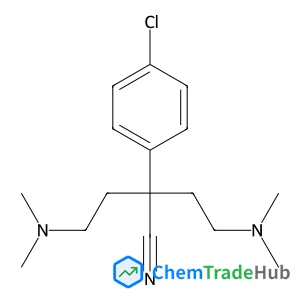
2-(4-Chlorophenyl)-4-(dimethylamino)-2-(2-(dimethylamino)ethyl)butanenitrile
CAS番号:
1246816-57-8
分子式:
C16H24ClN3
おすすめサプライヤー






免責事項
このページに表示される学術雑誌情報は、参考および研究目的のみを目的としています。当社は雑誌出版社とは提携しておらず、投稿の取り扱いも行っておりません。出版に関するお問い合わせは、各雑誌出版社に直接ご連絡ください。
表示されている情報に誤りがある場合は、support@chemtradehub.com までご連絡ください。迅速に確認し、対応いたします。