












Controlled/living radical polymerization in nanoreactors: compartmentalization effects
文献情報
出版日
2010-10-04
DOI
10.1039/C0PY00247J
インパクトファクター
5.582
著者
Per B. Zetterlund
原文を見る
要旨
Compartmentalization in nanoreactors, i.e. the confinement of reactants to monomer droplets or polymer particles with diameters in the approximate range 20–200 nm, may have a marked beneficial effect on the progression of a controlled/living radical polymerization based on the persistent radical effect such as nitroxide-mediated radical polymerization and atom transfer radical polymerization. Compartmentalization effects comprise the confined space effect, which acts to improve the control over the molecular weight distribution (narrower) and the segregation effect which results in increased livingness (end-functionality). Exploitation of nanoreactors thus offers novel means of improving the performance of controlled/living radical polymerizations.
関連文献
Towards high-level theoretical studies of large biodiesel molecules: an ONIOM/RRKM/Master-equation approach to the isomerization and dissociation kinetics of methyl decanoate radicals
Yicheng Chi, Lidong Zhang, Peng Zhang, Liusi Sheng
2019-02-06
Paper
DOI: 10.1039/C8CP05593A
Understanding dissolution process of chitin crystal in ionic liquids: theoretical study
Takuya Uto, Satoshi Idenoue, Kazuya Yamamoto, Jun-ichi Kadokawa
2018-07-30
Paper
DOI: 10.1039/C8CP02749H
Infrared spectroscopic characterization of phosphate binding at the goethite–water interface
Stella Gypser, Peter Leinweber, Dirk Freese
2019-01-24
Paper
DOI: 10.1039/C8CP07168C
Interaction of liquid water with the p-GaInP2(100) surface covered with submonolayer oxide
Andreas Hajduk, Mikhail V. Lebedev, Bernhard Kaiser, Wolfram Jaegermann
2018-07-31
Paper
DOI: 10.1039/C8CP03337D
The energy level of the Fe2+/3+-transition in BaTiO3 and SrTiO3 single crystals
Issei Suzuki, Leonard Gura, Andreas Klein
2019-02-26
Paper
DOI: 10.1039/C8CP07872F
Magnetic-field-tuned phase transition of a molecular material from the isolated-spin to the coupled-spin regime
Ana M. Plutín, Eduardo E. Castellano, Alzir A. Batista, Rafael Calvo, Otaciro R. Nascimento
2019-02-07
Paper
DOI: 10.1039/C8CP06719H
Deep core photoionization of iodine in CH3I and CF3I molecules: how deep down does the chemical shift reach?
Nacer Boudjemia, Kari Jänkälä, Kenji Tamasaku, Marko Huttula, Masaki Oura
2019-02-11
Paper
DOI: 10.1039/C8CP07307D
Extending the scope of the carbonyl facilitated triplet excited state towards visible light excitation
Shinaj K. Rajagopal, Nagaraj K., Somadrita Deb, Vinayak Bhat, Devika Sasikumar, Ebin Sebastian, Mahesh Hariharan
2018-06-18
Paper
DOI: 10.1039/C8CP01023D
Band alignment in quantum wells from automatically tuned DFT+U
Chungwei Lin, Andrew Knyazev, Keisuke Kojima, Joseph Katz, Koichi Akiyama, Eiji Nakai, Hiroyuki Kawahara
2019-02-22
Paper
DOI: 10.1039/C9CP00122K
Analysis of the interfacial characteristics of BiVO4/metal oxide heterostructures and its implication on their junction properties
Sebastián Murcia-López, Andreas Klein, Roel van de Krol, Teresa Andreu, Joan Ramón Morante, Thierry Toupance, Wolfram Jaegermann
2019-01-29
Paper
DOI: 10.1039/C8CP07483F
こちらもおすすめ
化合物よくある質問
3-(2-オキサプロピル)ベンzoic酸はどのように合成されますか?
3-(2-オキサプロピル)ベンzoic酸は、ベンzoic酸とプロパノ酸をヒドロキシム化合物として反応させて生成します。具体的には、ベンzoic酸とプロパノ酸を反...
205927-63-53-(2-Oxopropyl)benzo...
114873-01-73-Fluoro-N-{[(2-meth...
化合物よくある質問
4-メチル-4-ピペリジニル-1-ピロリドイン甲酸の主な用途は何ですか?
4-メチル-4-ピペリジニル-1-ピロリドイン甲酸は、主に医薬品の合成材料や研究用物質として使用されます。さらに、一部の薬理学的研究にも応用されています。
885523-47-7(4-Methyl-4-piperidi...
化合物よくある質問
Biotin-PEG3-oxyamine HCl塩について、適切な化合物名称に適用される法規ガイドラインは何ですか?
Biotin-PEG3-oxyamine HCl塩は、GHS( Globally Harmonized System of Classification and...
1786206-22-1Biotin-PEG3-oxyamine...
化合物よくある質問
N-(4-イソチオシアネートフェニル)-2-メトキシアリニンはどのように合成されますか?
N-(4-イソチオシアネートフェニル)-2-メトキシアリニンは、4-イソチオシアノフェノールと2-メトキシアリニルアミンのアミニド反応を用いて合成されます。この...
915919-57-2N-(4-Isothiocyanatop...
化合物よくある質問
金粉蕨亭2'-O-葡萄糖甙の主な用途は何ですか?
金粉蕨亭2'-O-葡萄糖甙は主に薬理研究や医薬品製造に使用され、抗炎症作用や抗がん作用などがあります。また、その構造や性質から、合成化学や化学生理学の研究にも用...
76947-60-92-(7-Hydroxy-2,2,4,6...
化合物よくある質問
2-(2-ニトロフェニル)酢酸ヒドライドの物理化学的性質は何ですか?
2-(2-ニトロフェニル)酢酸ヒドライドのCAS番号は114953-81-0です。この化合物は白色結晶性粉末で、分子量は244.12です。水溶性は限られており、...
114953-81-02-(2-Nitrophenyl)ace...
化合物よくある質問
5-(ヒドロキシメチル)-2-チオキソ-2,3-ジヒドロピリミジン-4(1H)-オンを取り扱う際の実験室安全事項は何ですか?
この化合物は高活性のため、取り扱いには注意が必要です。PPE(個人保護具)としてゴーグル、ガントリー、および防滴シールドを着用することが推奨されます。ドラフトチ...
93185-31-05-(Hydroxymethyl)-2-...
化合物よくある質問
11-脱氢血栓烷 b2の市場動向や研究トレンドはどうですか?
11-脱氢血栓烷 b2は、血栓溶解・抗凝固作用に関する研究で注目を集めています。特に心血管疾患の治療法開発において、市場の需要が高まっています。研究トレンドとし...
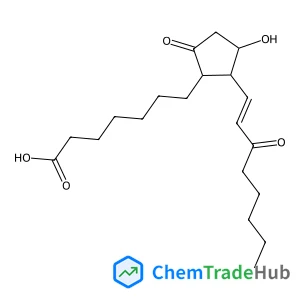
67910-12-77-{(2R,3S,4S)-4-Hydr...
化合物よくある質問
3,3-二甲基哌啶-4-酮はどのように保存すればよいですか?
3,3-二甲基哌啶-4-酮は避光、常温、乾燥した場所で保存してください。容器は密閉し、遠くから火源を離して保管することを確認してください。
150668-82-93,3-Dimethyl-4-piper...
掲載誌
Polymer Chemistry

CiteScore:
8.6
自己引用率:
7.3%
年間論文数:
457
Polymer Chemistry welcomes submissions in all areas of polymer science that have a strong focus on macromolecular chemistry. Manuscripts may cover a broad range of fields, yet no direct application focus is required.
おすすめ化合物
![2-Methyl-2-propanyl [(2S)-1-hydroxy-3-(4-hydroxyphenyl)-2-propanyl]carbamate structure](https://static.chemtradehub.com/structs/833/83345-46-4-eec2.webp "2-Methyl-2-propanyl [(2S)-1-hydroxy-3-(4-hydroxyphenyl)-2-propanyl]carbamate structure")
おすすめサプライヤー






免責事項
このページに表示される学術雑誌情報は、参考および研究目的のみを目的としています。当社は雑誌出版社とは提携しておらず、投稿の取り扱いも行っておりません。出版に関するお問い合わせは、各雑誌出版社に直接ご連絡ください。
表示されている情報に誤りがある場合は、support@chemtradehub.com までご連絡ください。迅速に確認し、対応いたします。