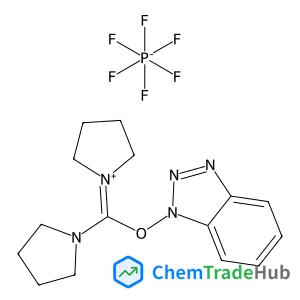
(1H-Benzotriazol-1-yloxy)(di-1-pyrrolidinyl)methylium hexafluorophosphate
CAS番号:
105379-24-6
分子式:
C15H21F6N5OP
Dirk Hoffmann, Barbara Weigert, Paolo Barzaghi, Hartmut Herrmann
Radicals and radical anions such as OH, NO3 and SO4− can act as important oxidants in aqueous solutions, e.g. as a part of the tropospheric multiphase system. In the present study the aqueous phase kinetics of OH, NO3 and SO4− radical reactions with the following ten aliphatic poly-alcohols 1,2-ethanediol, 1,2-propanediol, 1,3-propanediol, 1,2,3-propanetriol, 1,2-butanediol, 1,4-butanediol, 1,5-pentanediol, (2R,3S)-butane-1,2,3,4-tetraol (meso-erythritol), (2R,4R)-pentane-1,2,3,4,5-pentol (arabitol) and (2R,3R,4R,5R)-hexane-1,2,3,4,5,6-hexol (mannitol) were investigated. These alcohols are both of anthropogenic and of biogenic origin and all are highly water soluble. All rate constants throughout this study were determined as a function of the temperature between 278 ≤T [K] ≤ 328. OH radical reactions with poly-alcohols (k2nd = 1.6–4.7 × 10⁹ L mol−1 s−1) are the fastest among the three investigated radicals. The corresponding NO3 radical (k2nd = 0.66–1.5 × 10⁷ L mol−1 s−1) and SO4− radical (k2nd = 2.7–5.3 × 10⁷ L mol−1 s−1) reactions are on average two orders of magnitude slower. All three radicals react by an H-abstraction mechanism preferably at the α-carbon atom of the investigated alcohols. Kinetic measurements were performed using laser flash photolysis-long path absorption (LFP-LPA). Rate constants were measured either directly following the NO3 and SO4− concentration–time profile or by a competition kinetics method using a well characterized reference reaction (SCN−) for OH radicals. Furthermore, obtained kinetic data are used to extend existing reactivity correlations for H-abstraction reactions with bond dissociation energies in aqueous solution and to calculate the tropospheric lifetimes of the alcohols.
Ivan O. Antonov, Leonid Sheps, John D. Savee, David L. Osborn, Craig A. Taatjes
DOI: 10.1039/C7CP01366C
DOI: 10.1039/C7CP01263B
Jorge Royes, Víctor Polo, Santiago Uriel, Luis Oriol, Milagros Piñol, Rosa M. Tejedor
DOI: 10.1039/C7CP01739A
Leigh Weston, A. Janotti, X. Y. Cui, C. Stampfl, C. G. Van de Walle
DOI: 10.1039/C7CP01471F
Haiying He, Yesukhei Jagvaral
DOI: 10.1039/C7CP00915A
DOI: 10.1039/C7CP02220D
Lhoussain Khrouz, Yi Zhou, Bin Shen, Chunyang Dong, Mingyang Xing, Shashank Mishra, Stéphane Daniele, Jinlong Zhang
DOI: 10.1039/C7CP01212H
Khaleel I. Assaf, Abdussalam K. Qaroush, Ala'a F. Eftaiha
DOI: 10.1039/C7CP02087B
Arseniy A. Otlyotov, Jan-Hendrik Lamm, Sebastian Blomeyer, Norbert W. Mitzel, Vladimir V. Rybkin, Yuriy A. Zhabanov, Natalya V. Tverdova, Nina I. Giricheva, Georgiy V. Girichev
DOI: 10.1039/C7CP01781B
Richard J. Mandle, S. J. Cowling, J. W. Goodby
DOI: 10.1039/C7CP00456G
2-メトキシ-4-(メチルスルフィニル)アミンは、主に医薬品および農薬の製造に使用されます。また、合成化学の一部として研究用材料としても利用されます。
代替品としては、4,6-二クロロピラミジンアミンや他のピラミジン系化合物が考えられます。ただし、目的と用途によって最適な代替品は異なります。
6-氯-4-甲基-1H-吲哚の廃棄物は、適切な容器に収集し、密閉して保管します。温度は常温、湿度は低く、直射日光を避けて保管することを推奨します。廃棄処理は専門...
2-フローユロ-4-(トリフルオロメチル)ベンゾイドのCAS番号は207974-08-1です。この化合物はGHS分類で毒性物質と有害な反応物質として分類されます...
4-ニトロフェニルN-[(ベンゼルオキシルカーボンイル]グリシングリシングリシン酸は、室温で暗所に保管し、乾燥した環境で保存することを推奨します。容器は密閉性の...
イソデスロラタドリンの代替品としては、デスロラタドリンや他の抗ヒスタミン薬が挙げられます。具体的には、デスロラタドリン、ラセカミド、フェルタドリンなどが、症状や...
5-甲氧基-1,2,3,4-四氢异喹啉盐酸盐の一般的な合成方法は、メタノール中で5-メトキシ-1,2,3,4-四ヒュドロイソキシンを塩酸で塩化します。この反応で...
CAS番号6471-78-9の4-アミノ-5-メトキシ-2-トルエンサルホニック酸は、GHS分類では corrosive(腐食性)と識別されます。EUのREAC...
甲基孕酮の取り扱いは、PPE(個人保護具)の使用が必要な重要な安全事項を伴います。防塵マスク、ゴーグル、手袋を着用することが推奨されます。ドラフトチャンバーを使...

Physical Chemistry Chemical Physics (PCCP) is an international journal co-owned by 19 physical chemistry and physics societies from around the world. This journal publishes original, cutting-edge research in physical chemistry, chemical physics and biophysical chemistry. To be suitable for publication in PCCP, articles must include significant innovation and/or insight into physical chemistry; this is the most important criterion that reviewers and Editors will judge against when evaluating submissions. The journal has a broad scope and welcomes contributions spanning experiment, theory, computation and data science. Topical coverage includes spectroscopy, dynamics, kinetics, statistical mechanics, thermodynamics, electrochemistry, catalysis, surface science, quantum mechanics, quantum computing and machine learning. Interdisciplinary research areas such as polymers and soft matter, materials, nanoscience, energy, surfaces/interfaces, and biophysical chemistry are welcomed if they demonstrate significant innovation and/or insight into physical chemistry. Joined experimental/theoretical studies are particularly appreciated when complementary and based on up-to-date approaches.
![[4-(Heptyloxy)phenyl]boronic acid structure](https://static.chemtradehub.com/structs/136/136370-19-9-ad33.webp "[4-(Heptyloxy)phenyl]boronic acid structure")