












In situ detection of pterins by SERS
文献情報
出版日
2009-05-20
DOI
10.1039/B905562B
インパクトファクター
4.616
著者
Ross Stevenson, Robert J. Stokes, Donna MacMillan, David Armstrong, Karen Faulds, Roger Wadsworth, Suma Kunuthur, Colin J. Suckling, Duncan Graham
原文を見る
要旨
Surface enhanced Raman scattering (SERS) has been used to detect specific pterin molecules at sub-nanomolar concentrations. SERS is fast becoming a widely used technique for the sensitive and specific detection of multiple analytes. The information-rich and concentration-dependent spectra obtained from SERS make the technique ideally placed for high speed, low cost analysis of almost any analyte. Further, to show the feasibility of SERS in the detection of biologically relevant targets, a synthetic pterin analogue of the naturally occurring pterin cofactor, tetrahydrobiopterin, has been detected at a series of concentrations and the method used for the successful detection of the synthetic pterin in mouse serum. In this analysis, spectroscopic collection was optimized for water-based pteridine derivatives using two visible wavelengths of excitation (514.5 and 632.8 nm) and differing mesoscopic metal nanoparticles allowing the limits of detection to be calculated.
関連文献
Mesoporous silica anchored Ru catalysts for highly enantioselective hydrogenation of β-ketoesters
Banu Kesanli, Wenbin Lin
2004-08-25
Communication
DOI: 10.1039/B406697A
An enantioselective imprinted receptor for Z-glutamate exhibiting a binding induced color change
Panagiotis Manesiotis, Andrew J. Hall, Marco Emgenbroich, Milena Quaglia, Ersilia De Lorenzi, Börje Sellergren
2004-09-09
Communication
DOI: 10.1039/B407870E
Ring-closing metathesis in biphasic BMI·PF6ionic liquid/toluene medium: a powerful recyclable and environmentally friendly process
Hervé Clavier, Nicolas Audic, Marc Mauduit, Jean-Claude Guillemin
2004-08-25
Communication
DOI: 10.1039/B407964G
Bond energy, aromatic stabilization energy and strain in IPR fullerenes
Michał K. Cyrański, Siân T. Howard, Michał L. Chodkiewicz
2004-09-21
Communication
DOI: 10.1039/B408903K
Desymmetrization of meso-dienyne by asymmetric Pauson–Khand type reaction catalysts
Nakcheol Jeong, Dong Hoon Kim, Jun Hun Choi
2004-04-08
Communication
DOI: 10.1039/B401288G
A novel supramolecular assembly in an iron(iii) compound exhibiting magnetic ordering at 70 K
Donatella Armentano, Giovanni De Munno, Teresa F. Mastropietro, Miguel Julve, Francesc Lloret
2004-04-21
Communication
DOI: 10.1039/B402055C
Site-specific oxidative cleavage of DNA by metallosalen–DNA conjugates
Jennifer L. Czlapinski, Terry L. Sheppard
2004-09-24
Communication
DOI: 10.1039/B410493E
A new (63)·(69.81) non-interpenetrated paramagnetic network with helical nanochannels based on a tricarboxylic perchlorotriphenylmethyl radical
Daniel Maspoch, Daniel Ruiz-Molina, Klaus Wurst, Concepció Rovira, Jaume Veciana
2004-04-22
Communication
DOI: 10.1039/B315147F
Continuous preparation of functionalised calcium phosphatenanoparticles with adjustable crystallinity
Thea Welzel, Wolfgang Meyer-Zaika, Matthias Epple
2004-04-20
Communication
DOI: 10.1039/B402521K
Controlled proteinassembly on a switchable surface
Ying Liu, Li Mu, Baohong Liu, Song Zhang, Pengyuan Yang, Jilie Kong
2004-04-14
Communication
DOI: 10.1039/B400776J
こちらもおすすめ
化合物よくある質問
2,3-スチオエポキシマドルを取り扱う際の実験室安全事項は何ですか?
取り扱いにはPPE(プロテクティブ・パーソナル・エイド)が必要で、防ぐ手袋と保護眼鏡を着用してください。ドラフトチャンバーの使用を推奨します。漏洩した場合は、適...
4267-80-52,3-Thioepoxy Madol
53981-25-22-Amino-6-fluorophen...
化合物よくある質問
BOC-S-3-アミニ-4-(4-メチオキシベンチル)-ブタン酸の代替品はありますか?
この化合物の代替品としては、BOC保護基を有さないアミノ酸やその他の保護基化合物が考えられます。また、メチオキシ基を有しない他の芳香族アミノ酸も代替品として挙げ...
126800-59-7(3S)-4-(4-Methoxyphe...
化合物よくある質問
Methyl 2-(chloromethyl)-3-nitrobenzoate(1218910-61-2)の代替品はありますか?
Methyl 2-(chloromethyl)-3-nitrobenzoate(1218910-61-2)の代替品としては、化学組成を変えることで効果を達成する...
1218910-61-2Methyl 2-(chlorometh...
化合物よくある質問
(2R)-2-アミノ-N-ベンジル-3-ヒドロキシプロパナミドを含む廃棄物はどのように処理すべきですか?
(2R)-2-アミノ-N-ベンジル-3-ヒドロキシプロパナミドを含む廃棄物は、適切な廃棄物管理ガイドラインに基づき処理する必要があります。まず、廃棄物を適切に収...
175481-39-7(2R)-2-amino-N-benzy...
化合物よくある質問
6,7-二氢-咪唑並[1,2-a]ピリドイン-8(5h)-酮はどのように合成されますか?
6,7-二氢-咪唑並[1,2-a]ピリドイン-8(5h)-酮は、2-ブロモフェニルアセトインとリン酸ハロゲン化物を反応させることで合成できます。この反応は高温で...
457949-09-66,7-Dihydroimidazo[1...
化合物よくある質問
エチル(3R)-3-ピロリジニル酢酸水和塩とは何ですか?
エチル(3R)-3-ピロリジニル酢酸水和塩は、CAS番号1332459-32-1の化合物で、(R)-乙基2-(ピロリジン-3-基)酢酸塩水和塩と呼ばれます。この...
1332459-32-1Ethyl (3R)-3-pyrroli...
化合物よくある質問
(2S)-{[(2-メチルエチルオキシ]カルボニル}アミノ)[2-(トリアフルオロメチルフェニル]エチカシック酸の物理化学的性質は何ですか?
(2S)-{[(2-メチルエチルオキシ]カルボニル}アミノ)[2-(トリアフルオロメチルフェニル]エチカシック酸のCAS番号は1203454-45-8です。この...
1203454-45-8(2S)-({[(2-Methyl-2-...
化合物よくある質問
2-ブロモ-1-(2-メチル-2-プロパニル)-4-ニトロベンゼンはどのように保存すればよいですか?
2-ブロモ-1-(2-メチル-2-プロパニル)-4-ニトロベンゼンは、直射日光を避けて暗所で、室温(約15℃〜25℃)、乾燥した場所に保存する必要があります。ま...
6310-17-42-Bromo-1-(2-methyl-...
化合物よくある質問
1-[(4-硝基フェニル)スルホニル]-1H-1,2,4-三唑の市場動向や研究トレンドはどうですか?
市場動向としては、1-[(4-硝基フェニル)スルホニル]-1H-1,2,4-三唑は主に農業用除草剤や合成化学製品の原料として利用されています。研究トレンドとして...
57777-84-11-[(4-Nitrophenyl)su...
掲載誌
Analyst

CiteScore:
7.8
自己引用率:
5.6%
年間論文数:
653
Analyst publishes analytical and bioanalytical research that reports premier fundamental discoveries and inventions, and the applications of those discoveries, unconfined by traditional discipline barriers.
おすすめ化合物
![[(2R)-6,6-Dimethyl-2-morpholinyl]methanol hydrochloride (1:1) structure](https://static.chemtradehub.com/structs/141/1416444-88-6-e06a.webp "[(2R)-6,6-Dimethyl-2-morpholinyl]methanol hydrochloride (1:1) structure")
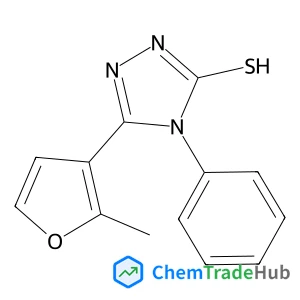
5-(2-Methyl-3-furyl)-4-phenyl-2,4-dihydro-3H-1,2,4-triazole-3-thione
CAS番号:
346464-59-3
分子式:
C13H11N3OS
![8-Bromo-6-fluoro[1,2,4]triazolo[1,5-a]pyridin-2-amine structure](https://static.chemtradehub.com/structs/125/1257705-51-3-9f4a.webp "8-Bromo-6-fluoro[1,2,4]triazolo[1,5-a]pyridin-2-amine structure")
おすすめサプライヤー



免責事項
このページに表示される学術雑誌情報は、参考および研究目的のみを目的としています。当社は雑誌出版社とは提携しておらず、投稿の取り扱いも行っておりません。出版に関するお問い合わせは、各雑誌出版社に直接ご連絡ください。
表示されている情報に誤りがある場合は、support@chemtradehub.com までご連絡ください。迅速に確認し、対応いたします。