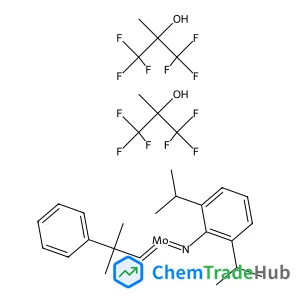
2,6-Diisopropylphenylimidoneophylidene molybdenum(VI) bis(hexafluoro-t-butoxide)
CAS番号:
139220-25-0
分子式:
C30H37F12MoNO2
I. U. Goldschleger, G. Kerenskaya, V. Senekerimyan, K. C. Janda, V. A. Apkarian
We report transient grating measurements carried out on single crystals of bromine clathrate hydrates and on bromine dissolved in water. In all cases, excitation into the B-state of Br2 leads to prompt predissociation, followed by cage-induced recombination on the A/A′ electronic surfaces. In liquid water, the vibrationally incoherent recombinant population peaks at t = 1 ps and decays with a time constant of 1.8 ps. In the hydrate crystals, the recombination is sufficiently impulsive to manifest coherent oscillations of the reformed bond. In tetragonal TS-I crystals, with the smaller cages, the recombination is fast, t = 360 fs, and the bond oscillation period is 240 fs. In cubic CS-II crystals, the recombination is slower, t = 490 fs, and the visibility of the vibrational coherence, which shows a period of 290 fs, is significantly reduced due to the larger cages and the looser fit around bromine. The mechanical cage effect is quantified in terms of the recombination time-distribution, the first three moments of which are associated with size, structural rigidity, and anelasticity of the cage. In the crystalline cages, the distribution is symmetric about the mean: mean time tm = 300 fs, 400 fs and standard deviation σ = 70 fs, 100 fs, in TS-I and CS-II, respectively. The finding is consistent with the assignment of occupied cages: principally 51262 polyhedra in TS-I and 51264 polyhedra in CS-II. In liquid water, with diffuse cages, the distribution characterized by tm = 555 fs and σ = 400 fs, is strongly skewed (γ1 = 1.88) toward delayed recombination—the effective liquid phase hydration shell is larger than that in a hydrate phase, structurally disordered, and anelastic. Information about dipolar disorder, comparable in all three media, is extracted from electronic predissociation rates of the B-state, which is sensitive to the symmetry in the guest–host interaction.
Kang-Jie Bian, David Nemoto, Jr, Xiao-Wei Chen, Shih-Chieh Kao, James Hooson, Julian G. West
DOI: 10.1039/D3SC05231A
Ana Alcalde-Ordóñez, Natalia Barreiro-Piñeiro, Bríonna McGorman, Jacobo Gómez-González, David Bouzada, Francisco Rivadulla, M. Eugenio Vázquez, Andrew Kellett, José Martínez-Costas, Miguel Vázquez López
DOI: 10.1039/D3SC03303A
Hirotaka Inoue, Hongyao Zhou, Hideo Ando, Sakuya Nakagawa, Teppei Yamada
DOI: 10.1039/D3SC04955H
Xiang Liu, Zixuan Hao, Chen Fang, Kun Pang, Jiaying Yan, Yingping Huang, Di Huang
DOI: 10.1039/D3SC05275C
Jing Cao, Joshua L. Zhu, Karl A. Scheidt
DOI: 10.1039/D3SC05162E
Dmitry L. Lipilin, Mikhail O. Zubkov, Mikhail D. Kosobokov, Alexander D. Dilman
DOI: 10.1039/D3SC05513B
Maria Chiara Storer, Katarzyna J. Zator, Derek P. Reynolds, Christopher A. Hunter
DOI: 10.1039/D3SC05690B
Roman M. Mironenko
DOI: 10.1039/D3SC04691E
Clement G. Collins Rice, Louis J. Morris, Jean-Charles Buffet, Zoë R. Turner, Dermot O'Hare
DOI: 10.1039/D3SC04861F
四氢-3-呋喃羧酰胺を含む廃棄物の処理は、まず安全に収集し、化学的処理または専門廃棄処理を行うことが推奨されます。高温焼却は一般的な選択肢ですが、環境保護の観点...
DIMETHYL 3-AMINO-2,5-THIOPHENEDICARBOXYLATE(CAS番号: 785803-74-9)は、GHS( Globally H...
5-フェニル-2,2'-ビピリジンは、ピリジン環とフェニル基を有する化合物から合成されます。一般的な合成方法は、4-ブロミノ苯と2,2'-ビピリジンの窒素上的ウ...
三溴甲基苯砜はCAS番号17025-47-7の化合物で、(Tribromomethyl)sulfonyl]benzeneと呼ばれています。この物質は、芳香族化合...
四氢吡喃-4,4-二甲酸二甲酯の廃棄物は、専門の廃棄処理業者に委託して安全に処理することが推奨されます。具体的には、反応性の点から常温で保存し、容器は密閉状態で...
N-叔丁氧羰基-N-甲乙二胺は、N-叔丁氧羰基アミンとプロピニルアミンのジアミン反応により合成されます。反応は無機触媒なしで行え、選択性と収率は良好です。
1,2-プロパンジオール-D6は、プロパン-1,2-ジオールをD6同位体と交換反応を行うことで合成されます。この反応は触媒を必要とし、選択性と収率が良好です。
4,4'-異プロピルジキレートは、CAS番号7418-16-8の化合物で、4,4'-(2,2-プロパネディイル)ジシクロヘキサンカーボン酸は、白色の粉末またはク...
この化合物は主に医薬品の開発に関与しており、特に抗炎症薬や神経保護剤の研究に利用されます。また、有機合成の中間体として工業製品の製造にも応用されることがあります...
ナトリウム5'-O-{ヘキシロキシ[(ヘキシロキシフォスフィニルオキシ)フィロホスフィル]アデノシン}を含む廃棄物は、適切な化学廃棄処理施設に引き渡す必要があり...

Physical Chemistry Chemical Physics (PCCP) is an international journal co-owned by 19 physical chemistry and physics societies from around the world. This journal publishes original, cutting-edge research in physical chemistry, chemical physics and biophysical chemistry. To be suitable for publication in PCCP, articles must include significant innovation and/or insight into physical chemistry; this is the most important criterion that reviewers and Editors will judge against when evaluating submissions. The journal has a broad scope and welcomes contributions spanning experiment, theory, computation and data science. Topical coverage includes spectroscopy, dynamics, kinetics, statistical mechanics, thermodynamics, electrochemistry, catalysis, surface science, quantum mechanics, quantum computing and machine learning. Interdisciplinary research areas such as polymers and soft matter, materials, nanoscience, energy, surfaces/interfaces, and biophysical chemistry are welcomed if they demonstrate significant innovation and/or insight into physical chemistry. Joined experimental/theoretical studies are particularly appreciated when complementary and based on up-to-date approaches.