













Theoretical study on mechanisms of the high-temperature reactions C2H3 + H2O and C2H4 + OH
文献情報
出版日
2002-02-15
DOI
10.1039/B109758J
インパクトファクター
3.676
著者
Gui-xia Liu, Yi-hong Ding, Ze-sheng Li, Qiang Fu, Xu-ri Huang, Chia-chung Sun, Au-chin Tang
原文を見る
要旨
The potential energy surface of the radical-molecule reaction C2H3 + H2O in the gas phase is explored at the 6-31G(d,p) and 6-311G(d,p) B3LYP and single-point QCISD(T)/6-311G(2df,p) levels. The most favorable channel is the direct H-abstraction from H2O to C2H3 leading to product P1 C2H4 + OH, whereas the other channels leading to the products P2 CH3 + CH2O, P3 CH3CHO + H, P4cis-CH2CHOH + H and P4′ trans-CH2CHOH + H are kinetically much less competitive. For the direct H-abstraction channel, high-level energetic calculations at the QCISD(T)/6-311G(2df,p), QCISD(T)/6-311+G(2df,2p) and G2 levels using the B3LYP/6-31G(d,p) and QCISD/6-31G(d,p) optimized geometries are further performed to estimate the thermal rate constants over a wide temperature range 200–5000 K for comparison with future laboratory measurements. The calculated barrier heights at the QCISD(T)/6-311+G(2df,2p) and G2 levels based on the QCISD/6-31G(d,p) geometries with zero-point vibrational energy (ZPVE) correction are 12.6 and 13.0 kcal mol−1, respectively. The results indicate that the C2H3 + H2O reaction might play an important role at high temperatures (T > 1800 K) in the presence of gaseous water and should be incorporated in the C2H3-modeling of hydrocarbon-fuel combustion processes. Discussions are also made in comparison with the analogous reactions C2H3 + H2 and C2H + H2O. While the addition-elimination mechanism of another important radical-molecule reaction C2H4 + OH has been the subject of extensive theoretical and experimental studies, its H-abstraction process leading to C2H3 + H2O has received little attention. For the C2H4 + OH → C2H3 + H2O channel, our calculations predict ZPVE-corrected barriers, 5.6 and 5.4 kcal mol−1, respectively, at the QCISD(T)/6-311+G(2df,2p)//QCISD/6-31G(d,p) and G2//QCISD/6-31G(d,p) levels, and reveal its importance at high temperatures (T > 560 K). In the range 720–1173 K, the calculated high-level rate constants are quantitatively in good agreement with the measured values. However, our calculated activation energy, 9.5 and 9.3 kcal mol−1 at the QCISD(T)/6-311+G(2df,2p)//QCISD/6-31G(d,p) and G2//QCISD/6-31G(d,p) levels with ZPVE correction, respectively, suggests that the experimentally determined value 4–5 kcal mol−1 may be underestimated and future rate constant measurements over a wide temperature range including T > 1200 K may be desirable.
関連文献
Formic acid electrooxidation on thallium-decorated shape-controlled platinum nanoparticles: an improvement in electrocatalytic activity
Carlos Busó-Rogero, Juan V. Perales-Rondón, Manuel J. S. Farias, Francisco J. Vidal-Iglesias, Jose Solla-Gullon, Enrique Herrero, Juan M. Feliu
2014-02-27
Paper
DOI: 10.1039/C4CP00304G
Coupled organic–inorganic nanostructures (COIN)
W. Brütting
2014-11-05
Perspective
DOI: 10.1039/C4CP03094J
Electrocatalytic oxygen reduction kinetics on Fe-center of nitrogen-doped graphene
Jing Sun, Zhi-Pan Liu
2014-02-27
Paper
DOI: 10.1039/C4CP00037D
Full cLR-PCM calculations of the solvatochromic effects on emission energies
Siwar Chibani, Šimon Budzák, Miroslav Medved', Benedetta Mennucci
2014-10-13
Paper
DOI: 10.1039/C4CP03919J
Spectroscopic and ab initio investigation of 2,6-difluorophenylacetylene–amine complexes: coexistence of C–H⋯N and lone-pair⋯π complexes and intermolecular coulombic decay
Sohidul Islam Mondal, Arghya Dey, Saumik Sen, G. Naresh Patwari, Debashree Ghosh
2014-10-31
Paper
DOI: 10.1039/C4CP03445G
Modulating triphenylamine-based organic dyes for their potential application in dye-sensitized solar cells: a first principle theoretical study
Narendra Nath Ghosh, Arnab Chakraborty, Sougata Pal, Anup Pramanik, Pranab Sarkar
2014-09-24
Paper
DOI: 10.1039/C4CP03621B
Multi-responsive cellulose nanocrystal–rhodamine conjugates: an advanced structure study by solid-state dynamic nuclear polarization (DNP) NMR
Li Zhao, Wei Li, Andreas Plog, Yeping Xu, Gerd Buntkowsky, Torsten Gutmann, Kai Zhang
2014-10-24
Paper
DOI: 10.1039/C4CP04096A
A density functional theory study of catalytic sites for oxygen reduction in Fe/N/C catalysts used in H2/O2 fuel cells
Csaba E. Szakacs, Michel Lefèvre, Jean-Pol Dodelet, François Vidal
2014-03-14
Paper
DOI: 10.1039/C3CP55331K
The photoformation of a phthalide: a ketene intermediate traced by FSRS
Sascha Fröbel, Laura Buschhaus, Torben Villnow, Oliver Weingart, Peter Gilch
2014-11-12
Paper
DOI: 10.1039/C4CP03351E
Spectroscopic and microscopic studies of self-assembled nc-Si/a-SiC thin films grown by low pressure high density spontaneous plasma processing
Debajyoti Das, Debjit Kar
2014-10-03
Paper
DOI: 10.1039/C4CP03374D
こちらもおすすめ
化合物よくある質問
2-ヒドロキシ-5-ニトロベンジンブロモイドの代替品はありますか?
2-ヒドロキシ-5-ニトロベンジンブロモイドは特定の化学反応に適しているため、代替品は限られています。しかし、同様の構造を持つ2-ヒドロキシ-4-ニトロベンジン...
772-33-82-(Bromomethyl)-4-ni...
化合物よくある質問
N-(2-ブロモフェニル)-1-チロール-3-オキソ-3-(ピペリジニル)プロペン-2-イル)ベンゼンアミドを取り扱う際の実験室安全事項は何ですか?
N-(2-ブロモフェニル)-1-チロール-3-オキソ-3-(ピペリジニル)プロペン-2-イル)ベンゼンアミドは有毒で、皮膚や粘膜に刺激を与える可能性があります。...
1800044-77-2N-[(1Z)-1-(2-Bromoph...
化合物よくある質問
1,3プロパンジオール,2-[2-(2アミノ-6クロロ-9Hピリミジン-9-イル)エチル-1,1,2,2-D4]-2,3-ジアセタートの市場動向や研究トレンドはどうですか?
この化合物は、新規治療薬の開発に注目されています。市場では、その有効性と安全性が評価され、研究分野では、分子生物学と医薬化学の新たな発見が期待されています。
1020718-81-31,3-Propanediol, 2-[...
579-44-2Ethanone, 2-hydroxy-...
化合物よくある質問
Succinimidyl-alanyl-phenylalanyl-prolyl-phenylalanine 4-nitroanilide はどの業界で使用されていますか?
Succinimidyl-alanyl-phenylalanyl-prolyl-phenylalanine 4-nitroanilide は主に医薬品開発やポ...
128802-73-3succinimidyl-alanyl-...
化合物よくある質問
メチル6-アミノ-5-クロロピリジン-2-カーボイル酸について、適用される法規ガイドラインは何ですか?
メチル6-アミノ-5-クロロピリジン-2-カーボイル酸(CAS番号: 1256794-05-4)の使用には、GHS( Globally Harmonized S...
1256794-05-4Methyl 6-amino-5-chl...
化合物よくある質問
エチル4-(シクロ Pentagonyl)アミノ-2-メチル硫化基ピリミジン-5-カルボキシレートを取り扱う際の実験室安全事項は何ですか?
取り扱いには、耐薬品性の容器を使用し、通気性の良い場所で操作することを推奨します。漏れ時は、SDS(安全データシート)を参照して適切な措置を取ること。手洗いと洗...
211245-62-4ethyl 4-(cyclopentyl...
化合物よくある質問
(S)-3-ベンZYルピペリジン塩酸塩とは何ですか?
(S)-3-ベンZYルピペリジン塩酸塩は、CAS番号1258940-00-9で表される化合物です。これは、(S)-3-苯基哌啶的盐酸盐であり、主に医薬品の原料と...
1258940-00-9(S)-3-Phenylpiperidi...
化合物よくある質問
3,5-二甲基金剛胺の主な用途は何ですか?
3,5-二甲基金剛胺は、主に医薬品の原料として使用され、また抗うつ薬や抗アルツハイマー薬の開発に利用されます。さらに、化粧品や食品添加物の製造でも重要な役割を果...
19988-45-52-(2,3-Dihydroxyphen...
化合物よくある質問
ビス(4-メチル-2-ペンチル)フェニルカルボン酸エステルの代替品はありますか?
ビス(4-メチル-2-ペンチル)フェニルカルボン酸エステル (CAS番号: 1398066-13-1) の代替品には、ビス(2-エチルヘキシル)フェノールカルボ...
1398066-13-1Bis(4-methyl-2-penty...
掲載誌
Physical Chemistry Chemical Physics

CiteScore:
5.5
自己引用率:
10.3%
年間論文数:
3036
Physical Chemistry Chemical Physics (PCCP) is an international journal co-owned by 19 physical chemistry and physics societies from around the world. This journal publishes original, cutting-edge research in physical chemistry, chemical physics and biophysical chemistry. To be suitable for publication in PCCP, articles must include significant innovation and/or insight into physical chemistry; this is the most important criterion that reviewers and Editors will judge against when evaluating submissions. The journal has a broad scope and welcomes contributions spanning experiment, theory, computation and data science. Topical coverage includes spectroscopy, dynamics, kinetics, statistical mechanics, thermodynamics, electrochemistry, catalysis, surface science, quantum mechanics, quantum computing and machine learning. Interdisciplinary research areas such as polymers and soft matter, materials, nanoscience, energy, surfaces/interfaces, and biophysical chemistry are welcomed if they demonstrate significant innovation and/or insight into physical chemistry. Joined experimental/theoretical studies are particularly appreciated when complementary and based on up-to-date approaches.
おすすめ化合物

![4-Chloro-3-(trifluoromethyl)-1H-pyrrolo[2,3-b]pyridine structure](https://static.chemtradehub.com/structs/869/869335-75-1-a9d0.webp "4-Chloro-3-(trifluoromethyl)-1H-pyrrolo[2,3-b]pyridine structure")
![1-[3-(4-Morpholinylsulfonyl)phenyl]methanamine structure](https://static.chemtradehub.com/structs/933/933989-32-3-51af.webp "1-[3-(4-Morpholinylsulfonyl)phenyl]methanamine structure")
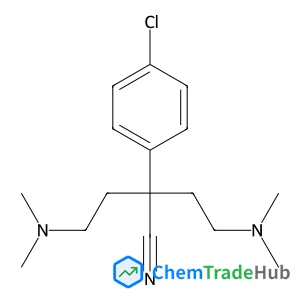
2-(4-Chlorophenyl)-4-(dimethylamino)-2-(2-(dimethylamino)ethyl)butanenitrile
CAS番号:
1246816-57-8
分子式:
C16H24ClN3
おすすめサプライヤー



免責事項
このページに表示される学術雑誌情報は、参考および研究目的のみを目的としています。当社は雑誌出版社とは提携しておらず、投稿の取り扱いも行っておりません。出版に関するお問い合わせは、各雑誌出版社に直接ご連絡ください。
表示されている情報に誤りがある場合は、support@chemtradehub.com までご連絡ください。迅速に確認し、対応いたします。