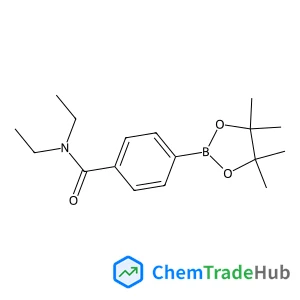
N,N-Diethyl-4-(4,4,5,5-tetramethyl-1,3,2-dioxaborolan-2-yl)benzamide
CAS番号:
325142-99-2
分子式:
C17H26BNO3
Carlos Busó-Rogero, Juan V. Perales-Rondón, Manuel J. S. Farias, Francisco J. Vidal-Iglesias, Jose Solla-Gullon, Enrique Herrero, Juan M. Feliu
Thallium modified shape-controlled Pt nanoparticles were prepared and their electrocatalytic activity towards formic acid electrooxidation was evaluated in 0.5 M sulfuric acid. The electrochemical and in situ FTIR spectroscopic results show a remarkable improvement in the electrocatalytic activity, especially in the low potential region (around 0.1–0.2 V vs. RHE). Cubic Pt nanoparticles modified with Tl were found to be more active than the octahedral Pt ones in the entire range of Tl coverages and potential windows. In situ FTIR spectra indicate that the promotional effect produced by Tl results in the inhibition of the poisoning step leading to COads, thus improving the onset potential for the complete formic acid oxidation to CO2. Chronoamperometric experiments were also performed at 0.2 V to evaluate the stability of the electrocatalysts at constant potential. Finally, experiments with different concentrations of formic acid (0.05–1 M) were also carried out. In all cases, Tl-modified cubic Pt nanoparticles result to be the most active. All these facts reinforce the importance of controlling the surface structure of the electrocatalysts to optimize their electrocatalytic properties.
Remy F. Lalisse, Radoslav Z. Pavlović, Christopher M. Hadad, Jovica D. Badjić
DOI: 10.1039/D1CP05253E
Yi-Ting Tsai, Cong-Wei Huang
DOI: 10.1039/D1CP03243G
Krista G. Steenbergen, Nicola Gaston, Beate Paulus
DOI: 10.1039/D1CP05008G
Václav Pokorný, Vojtěch Štejfa, Květoslav Růžička, Ctirad Červinka
DOI: 10.1039/D1CP03717J
Riku Okamoto, Mikas Remeika, Imane Abdellaoui, Muhammad M. Islam, Takashi Harada, Ryu Abe, Takeaki Sakurai
DOI: 10.1039/D1CP04075H
P. H. Shi, B. D. Yao, L. Wu, X. Y. Wu, Y. X. Wang
DOI: 10.1039/D1CP04151G
Krishna Gopal Chattaraj, Sandip Paul
DOI: 10.1039/D1CP03695E
Gurudutt Dubey, Nutan Mahawar, Tejender Singh, Nirjhar Saha, Subash C. Sahoo, Prasad V. Bharatam
DOI: 10.1039/D1CP04732A
Tomer Y. Burshtein, Denial Aias, Jin Wang, Matan Sananis, Eliyahu M. Farber, Oz M. Gazit, Ilya Grinberg, David Eisenberg
DOI: 10.1039/D1CP03650E
2-ヒドロキシ-5-ニトロベンジンブロモイドは特定の化学反応に適しているため、代替品は限られています。しかし、同様の構造を持つ2-ヒドロキシ-4-ニトロベンジン...
N-(2-ブロモフェニル)-1-チロール-3-オキソ-3-(ピペリジニル)プロペン-2-イル)ベンゼンアミドは有毒で、皮膚や粘膜に刺激を与える可能性があります。...
この化合物は、新規治療薬の開発に注目されています。市場では、その有効性と安全性が評価され、研究分野では、分子生物学と医薬化学の新たな発見が期待されています。
Succinimidyl-alanyl-phenylalanyl-prolyl-phenylalanine 4-nitroanilide は主に医薬品開発やポ...
メチル6-アミノ-5-クロロピリジン-2-カーボイル酸(CAS番号: 1256794-05-4)の使用には、GHS( Globally Harmonized S...
取り扱いには、耐薬品性の容器を使用し、通気性の良い場所で操作することを推奨します。漏れ時は、SDS(安全データシート)を参照して適切な措置を取ること。手洗いと洗...
(S)-3-ベンZYルピペリジン塩酸塩は、CAS番号1258940-00-9で表される化合物です。これは、(S)-3-苯基哌啶的盐酸盐であり、主に医薬品の原料と...
3,5-二甲基金剛胺は、主に医薬品の原料として使用され、また抗うつ薬や抗アルツハイマー薬の開発に利用されます。さらに、化粧品や食品添加物の製造でも重要な役割を果...
ビス(4-メチル-2-ペンチル)フェニルカルボン酸エステル (CAS番号: 1398066-13-1) の代替品には、ビス(2-エチルヘキシル)フェノールカルボ...

Physical Chemistry Chemical Physics (PCCP) is an international journal co-owned by 19 physical chemistry and physics societies from around the world. This journal publishes original, cutting-edge research in physical chemistry, chemical physics and biophysical chemistry. To be suitable for publication in PCCP, articles must include significant innovation and/or insight into physical chemistry; this is the most important criterion that reviewers and Editors will judge against when evaluating submissions. The journal has a broad scope and welcomes contributions spanning experiment, theory, computation and data science. Topical coverage includes spectroscopy, dynamics, kinetics, statistical mechanics, thermodynamics, electrochemistry, catalysis, surface science, quantum mechanics, quantum computing and machine learning. Interdisciplinary research areas such as polymers and soft matter, materials, nanoscience, energy, surfaces/interfaces, and biophysical chemistry are welcomed if they demonstrate significant innovation and/or insight into physical chemistry. Joined experimental/theoretical studies are particularly appreciated when complementary and based on up-to-date approaches.
![5-Methyl-4,5,6,7-tetrahydropyrazolo[1,5-a]pyrazin-2-amine structure](https://static.chemtradehub.com/structs/122/1227210-33-4-8d64.webp "5-Methyl-4,5,6,7-tetrahydropyrazolo[1,5-a]pyrazin-2-amine structure")