


Recent advancements towards the green synthesis of carbon quantum dots as an innovative and eco-friendly solution for metal ion sensing and monitoring
文献情報
出版日
2023-12-14
DOI
10.1039/D3SU00375B
インパクトファクター
0
著者
Jyoti Dhariwal, Gyandshwar K. Rao, Dipti Vaya
原文を見る
要旨
In recent years, the synthesis of carbon quantum dots (CQDs) through green methods for environmental remediation has gained significant interest owing to their benefits of reducing toxic by-products and minimising the usage of hazardous chemicals. CQDs are a new type of zero-dimensional carbon nanomaterials having a size less than 10 nm. They have attracted much attention considering their outstanding optical characteristics, non-toxicity, low-cost synthesis, biocompatibility, uniform particle size, high photostability and highly tuneable photoluminescence. The synthesis of CQDs from biodegradable and renewable resources, such as biowastes and biomass, provides an eco-friendly and sustainable alternative to conventional synthesis methods. The synthesized CQDs possess unique optical and electronic properties, including a high selectivity and sensitivity, making them promising for metal ion sensing. This review highlights the recent progress in the green synthesis of CQDs, including their synthesis methods, optical properties and potential use in sensing applications for the detection of heavy metal ions, such as iron(III), copper(II), mercury(II), chromium(IV), lead(II), silver(I), arsenic(III) and gold(III), which are considered as major environmental pollutants. A comparison based on the quantum yield, sensitivity, selectivity, detection limit, linear range concentration and sensing mechanisms is also presented. In addition, the effect of heteroatom doping on CQD performance for heavy metal detection is also discussed. In conclusion, this review emphasizes the importance of employing eco-friendly and sustainable methodologies for CQD synthesis, which not only benefits the environment but also makes these materials more accessible and cost-effective for widespread use in detecting harmful pollutants.
おすすめジャーナル

Herald of the Russian Academy of Sciences

Polycyclic Aromatic Compounds

Atomization and Sprays

Heteroatom Chemistry

Critical Reviews in Solid State and Materials Sciences

Bioorganic & Medicinal Chemistry

Colloid Journal

NDT & E International

Medicinal Chemistry Research

Journal of the Indian Institute of Science
関連文献
In situ magnetic resonance imaging of electrically-induced water diffusion in a Nafion ionic polymer film
Richard T. Baker, Leila Naji, Karen Lochhead, John A. Chudek
2003-03-18
Communication
DOI: 10.1039/B301039B
Palladium catalysed cyclisation–carbonylation of enynes to give cyclic γ,δ-unsaturated acids
Varinder K. Aggarwal, Mike Butters, Paul W. Davies
2003-04-02
Communication
DOI: 10.1039/B300719G
Highly efficient bromination of aromatic compounds using 3-methylimidazolium tribromide as reagent/solvent
Cinzia Chiappe, Elsa Leandri, Daniela Pieraccini
2004-09-30
Communication
DOI: 10.1039/B410796A
Crystallography and magnetism of radicals with hindered hydroxyl groups: 2-(3,5-di-tert-butyl-4-hydroxyphenyl)-4,4,5,5-tetramethyl-4,5-dihydro-1H-imidazole-3-oxide-1-oxyl and 2-(3,5-di-tert-butyl-4-hydroxyphenyl)-4,4,5,5-tetramethyl-4,5-dihydro-1H-imidazole-1-oxyl
Patrick Taylor, Paul M. Lahti
2004-10-27
Communication
DOI: 10.1039/B411574K
Synthesis and structure of [{Sn(μ–PCy)}3(Na·PMDETA)2], containing an electron-deficient [{Sn(μ–PCy)}3]2− dianion
Paula Alvarez-Bercedo, Andrew D. Bond, Robert Haigh, Alexander D. Hopkins, Gavin T. Lawson, Mary McPartlin, David Moncrieff, Marta E. Gonzalez Mosquera, Jeremy M. Rawson, Anthony D. Woods, Dominic S. Wright
2003-05-06
Communication
DOI: 10.1039/B300522D
Total synthesis of (+)-belactosin A
Alan Armstrong, James N. Scutt
2004-01-27
Communication
DOI: 10.1039/B316142K
A new type of bromide anion conducting solid
Nobuhito Imanaka, Yasuhiro Kato
2003-05-02
Communication
DOI: 10.1039/B300691C
Influence of EDA-π interactions in drug encapsulation using nanospheres
Sumit Kumar, Ravi Mosurkal, Virinder S. Parmar, Lynne A. Samuelson, Arthur C. Watterson, Jayant Kumar
2004-10-20
Communication
DOI: 10.1039/B408993F
Coordination polymers with macrocyclic cages and pockets within their backbones
Moonhyun Oh, Charlotte L. Stern, Chad A. Mirkin
2004-10-08
Communication
DOI: 10.1039/B408084J
こちらもおすすめ
化合物よくある質問
環戊烷-1,3-二甲酸甲酯はどのように合成されますか?
環戊烷-1,3-二甲酸甲酯は、環戊烷と塩酸によるヒンデンブルク反応を経由して合成されます。この反応では、環戊烷が塩酸と作用し、1,3-ジカルボキシ基が導入されま...
2435-36-1Dimethyl 1,3-cyclope...
化合物よくある質問
4-メトキシ-1,2,3-スチアゼ-3,5-ジオンとは何ですか?
4-メトキシ-1,2,3-スチアゼ-3,5-ジオンは、CAS番号107843-77-6の化合物で、(E)-ベンジル3-(3,4-ジヒドロキシフェニル) acry...
107843-77-6(E)-Benzyl 3-(3,4-di...
化合物よくある質問
プロスタグランジンA2について「に適用される法規ガイドラインは何ですか?'
プロスタグランジンA2 (CAS番号: 41691-92-3) は、化学物質の安全管理に関する規制として、GHS (危険物質の国際的ハザード分類・ラベル付けシス...
41691-92-316,16-DIMETHYL PROST...
化合物よくある質問
4-アミノ-1-ナフタレン sulfonic 酸についての物理化学的性質は何ですか?
4-アミノ-1-ナフタレン sulfonic 酸のCAS番号は84-86-6です。この化合物は結晶性で、分子量は212.15 g/molです。アルコールや水など...
84-86-64-Amino-1-naphthalen...
化合物よくある質問
N-GlcNAc-生物素を取り扱う際の実験室安全事項は何ですか?
N-GlcNAc-生物素は吸収性があり、皮膚や目への接触を避けることが重要です。PPE(個体保護具)は使用し、ドラフトチャンバーは必要に応じて使用します。漏洩時...
1272755-69-72-Acetamido-2-deoxy-...
化合物よくある質問
3-アミノメチルフローラノピペリジン-1-カルボニル酸テルブチルエステルとは何ですか?
CAS番号1209781-11-2の3-アミノメチルフローラノピペリジン-1-カルボニル酸テルブチルエステルは、有機化合物の一種で、化学式はC10H17FNO3...
1209781-11-22-Methyl-2-propanyl ...
化合物よくある質問
6-溴-1-甲基-1H-ベンゾ[d][1,2,3]三氮唑はどのように合成されますか?
6- bromo-1-methyl-1H-benzotriazoleは、ブロモフリオリンと1-メチル-1H-ベンゾ[d][1,2,3]三氮唑の反応により合成され...
944718-32-56-Bromo-1-methyl-1H-...
化合物よくある質問
4-硫代尿苷はどのように合成されますか?
4-硫代尿苷は、尿素とD-リボシルヒドロキシアルデヒドを用いてスルホン化反応を経て合成されます。通常は塩酸ヒドロキシチオニルスルホン酸などの触媒を使用し、選択性...
6741-73-71-(4-thio-beta-D-rib...
化合物よくある質問
ブレインナトリユリックペプチド32ラットとは何ですか?
ブレインナトリユリックペプチド32ラット(CAS番号: 133448-20-1)は、心臓で作られるホルモンの一つで、心不全の診断や予後評価に使用されます。
133448-20-1Brain Natriuretic Pe...
化合物よくある質問
1-(3-氮杂啶)-4-羟基哌啶双盐酸盐の物理化学的性質は何ですか?
CAS番号810680-60-5の1-(3-氮杂啶)-4-羟基哌啶双盐酸盐は、白色の結晶性粉末である。分子量は360.84 g/molで、水に溶けやすい。反応活...
810680-60-51-(3-Azetidinyl)-4-p...
掲載誌
おすすめ化合物


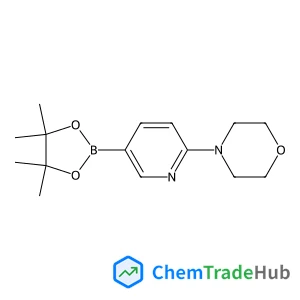
4-(5-(4,4,5,5-tetramethyl-1,3,2-dioxaborolan-2-yl)pyridin-2-yl)morpholine
CAS番号:
485799-04-0
分子式:
C15H23BN2O3
おすすめサプライヤー





免責事項
このページに表示される学術雑誌情報は、参考および研究目的のみを目的としています。当社は雑誌出版社とは提携しておらず、投稿の取り扱いも行っておりません。出版に関するお問い合わせは、各雑誌出版社に直接ご連絡ください。
表示されている情報に誤りがある場合は、support@chemtradehub.com までご連絡ください。迅速に確認し、対応いたします。