


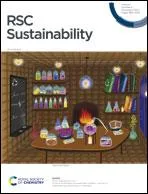
Recovery of palladium from waste fashion items through food waste by-products
文献情報
出版日
2023-10-16
DOI
10.1039/D3SU00242J
インパクトファクター
0
著者
Teresa Cecchi, Zhaojing Gao, Christophe Clement, Yasser Matos Peralta, Olivier Girard, Clara Santato
原文を見る
要旨
Palladium is a non-toxic platinum group metal indispensable for several industrial applications. It is among the 44 endangered elements; hence, its recycling from secondary sources is crucial. Waste plated metal wires from the fashion industry are an important waste stream for this precious metal. We propose a sustainable route for Pd recovery where palladium peels off in its metallic state in a single-step, room-temperature process. At the same time, readily oxidizable base metals are leached under very mild conditions using a green oxidant, hydrogen peroxide, and lactic acid, a food chain byproduct. This strategy is chemically rational, cost-effective, and environmentally friendly. The recovered Pd was successfully recycled to fabricate source and drain electrodes in organic field-effect transistors. Waste wires, recovered palladium flakes, and e-beam evaporated Pd electrodes were characterized by scanning electron microscopy, energy dispersive spectroscopy, X-ray photoelectron spectroscopy, and atomic force microscopy to examine their morphology and (surface) chemical composition.
おすすめジャーナル

Colloid Journal

NDT & E International

Journal of the Indian Institute of Science

Medicinal Chemistry Research

Atomization and Sprays

Critical Reviews in Solid State and Materials Sciences

Chinese Journal of Chemistry

Journal of Chemical Sciences

Biocatalysis and Biotransformation

Bioorganic & Medicinal Chemistry Letters
関連文献
Capturing a metastable chiral polymorph of an achiral molecule—hexa-O-benzoyl-myo-inositol
Rajesh G. Gonnade, Mohan M. Bhadbhade, Mysore S. Shashidhar
2004-09-27
Communication
DOI: 10.1039/B410051D
Phosphinine stabilised gold nanoparticles; synthesis and immobilisation on mesoporous materials
Audrey Moores, Frédéric Goettmann, Clément Sanchez, Pascal Le Floch
2004-10-27
Communication
DOI: 10.1039/B412553C
Silica coated fullerenols: seeded growth of silica spheres under acidic conditions
Elizabeth A. Whitsitt, Andrew R. Barron
2003-04-04
Communication
DOI: 10.1039/B212808J
Poly(9,9′-spirobifluorene-manganese porphyrin): a new catalytic material for oxidation of alkenes by iodobenzene diacetate and iodosylbenzene
Cyril Poriel, Yann Ferrand, Paul le Maux, Joëlle Raul-Berthelot, Gerard Simonneaux
2003-04-02
Communication
DOI: 10.1039/B301717F
A sequential highly stereoselective hydroboration and Suzuki–Miyaura cross-coupling reaction of fluoroalkylated internal acetylenes: a practical one-pot synthesis of fluoroalkylated trisubstituted alkenes
Tsutomu Konno, Jungha Chae, Tomoo Tanaka, Takashi Ishihara, Hiroki Yamanaka
2004-02-12
Communication
DOI: 10.1039/B316065C
Direct intramolecular arylation of unactivated arenes: application to the synthesis of aporphine alkaloids
Marc Lafrance, Nicole Blaquière, Keith Fagnou
2004-10-25
Communication
DOI: 10.1039/B410394G
Synthesis of monodisperse chromium nanoparticles from the thermolysis of a Fischer carbene complex
Seung Uk Son, Youngjin Jang, Ki Youl Yoon, Changhua An, Yosun Hwang, Je-Geun Park, Han-Jin Noh, Jae-Young Kim, Jae-Hoon Park, Taeghwan Hyeon
2004-11-26
Communication
DOI: 10.1039/B411656A
Al(OPri)3-catalysed halogen exchange processes of relevance to atom transfer radical polymerization: the effect depends on the metal electronic structure
François Stoffelbach, Rinaldo Poli
2004-10-13
Communication
DOI: 10.1039/B409992C
The role of isomorphism in synthetic analysis. Pruning the search tree by finding disjoint isomorphic substructures
Steven H. Bertz, Toby J. Sommer
2003-03-25
Communication
DOI: 10.1039/B300935A
CoII5(OH)6(SO4)2(H2O)4: the first ferromagnet based on a layered cobalt–hydroxide pillared by inorganic ⋯OSO3–Co(H2O)4–O3SO⋯
Serge Vilminot, Mireille Richard-Plouet, Gilles André, Tahar Mhiri, Mohamedally Kurmoo
2004-10-06
Communication
DOI: 10.1039/B411304G
こちらもおすすめ
化合物よくある質問
環戊烷-1,3-二甲酸甲酯はどのように合成されますか?
環戊烷-1,3-二甲酸甲酯は、環戊烷と塩酸によるヒンデンブルク反応を経由して合成されます。この反応では、環戊烷が塩酸と作用し、1,3-ジカルボキシ基が導入されま...
2435-36-1Dimethyl 1,3-cyclope...
化合物よくある質問
4-メトキシ-1,2,3-スチアゼ-3,5-ジオンとは何ですか?
4-メトキシ-1,2,3-スチアゼ-3,5-ジオンは、CAS番号107843-77-6の化合物で、(E)-ベンジル3-(3,4-ジヒドロキシフェニル) acry...
107843-77-6(E)-Benzyl 3-(3,4-di...
化合物よくある質問
プロスタグランジンA2について「に適用される法規ガイドラインは何ですか?'
プロスタグランジンA2 (CAS番号: 41691-92-3) は、化学物質の安全管理に関する規制として、GHS (危険物質の国際的ハザード分類・ラベル付けシス...
41691-92-316,16-DIMETHYL PROST...
化合物よくある質問
4-アミノ-1-ナフタレン sulfonic 酸についての物理化学的性質は何ですか?
4-アミノ-1-ナフタレン sulfonic 酸のCAS番号は84-86-6です。この化合物は結晶性で、分子量は212.15 g/molです。アルコールや水など...
84-86-64-Amino-1-naphthalen...
化合物よくある質問
N-GlcNAc-生物素を取り扱う際の実験室安全事項は何ですか?
N-GlcNAc-生物素は吸収性があり、皮膚や目への接触を避けることが重要です。PPE(個体保護具)は使用し、ドラフトチャンバーは必要に応じて使用します。漏洩時...
1272755-69-72-Acetamido-2-deoxy-...
化合物よくある質問
3-アミノメチルフローラノピペリジン-1-カルボニル酸テルブチルエステルとは何ですか?
CAS番号1209781-11-2の3-アミノメチルフローラノピペリジン-1-カルボニル酸テルブチルエステルは、有機化合物の一種で、化学式はC10H17FNO3...
1209781-11-22-Methyl-2-propanyl ...
化合物よくある質問
6-溴-1-甲基-1H-ベンゾ[d][1,2,3]三氮唑はどのように合成されますか?
6- bromo-1-methyl-1H-benzotriazoleは、ブロモフリオリンと1-メチル-1H-ベンゾ[d][1,2,3]三氮唑の反応により合成され...
944718-32-56-Bromo-1-methyl-1H-...
化合物よくある質問
4-硫代尿苷はどのように合成されますか?
4-硫代尿苷は、尿素とD-リボシルヒドロキシアルデヒドを用いてスルホン化反応を経て合成されます。通常は塩酸ヒドロキシチオニルスルホン酸などの触媒を使用し、選択性...
6741-73-71-(4-thio-beta-D-rib...
化合物よくある質問
ブレインナトリユリックペプチド32ラットとは何ですか?
ブレインナトリユリックペプチド32ラット(CAS番号: 133448-20-1)は、心臓で作られるホルモンの一つで、心不全の診断や予後評価に使用されます。
133448-20-1Brain Natriuretic Pe...
化合物よくある質問
1-(3-氮杂啶)-4-羟基哌啶双盐酸盐の物理化学的性質は何ですか?
CAS番号810680-60-5の1-(3-氮杂啶)-4-羟基哌啶双盐酸盐は、白色の結晶性粉末である。分子量は360.84 g/molで、水に溶けやすい。反応活...
810680-60-51-(3-Azetidinyl)-4-p...
掲載誌
おすすめ化合物
![N-[(5,6-Dichloro-1H-benzimidazol-2-yl)methyl]-9-(1-methyl-1H-pyrazol-4-yl)-2-(4-morpholinyl)-9H-purin-6-amine structure](https://static.chemtradehub.com/structs/238/2387704-62-1-25f4.webp "N-[(5,6-Dichloro-1H-benzimidazol-2-yl)methyl]-9-(1-methyl-1H-pyrazol-4-yl)-2-(4-morpholinyl)-9H-purin-6-amine structure")
おすすめサプライヤー



免責事項
このページに表示される学術雑誌情報は、参考および研究目的のみを目的としています。当社は雑誌出版社とは提携しておらず、投稿の取り扱いも行っておりません。出版に関するお問い合わせは、各雑誌出版社に直接ご連絡ください。
表示されている情報に誤りがある場合は、support@chemtradehub.com までご連絡ください。迅速に確認し、対応いたします。