












![1-{3-[4-Amino-3-(4-phenoxyphenyl)-1H-pyrazolo[3,4-d]pyrimidin-1-yl]-1-piperidinyl}-2,3-dihydroxy-1-propanone structure](https://static.chemtradehub.com/structs/122/1226872-27-0-e037.webp "1-{3-[4-Amino-3-(4-phenoxyphenyl)-1H-pyrazolo[3,4-d]pyrimidin-1-yl]-1-piperidinyl}-2,3-dihydroxy-1-propanone structure")
Thermoresponsive property of poly(N,N-bis(2-ethoxyethyl)acrylamide) and its multiblock copolymers with poly(N,N-dimethylacrylamide) prepared by hydrosilylation-promoted group transfer polymerization
文献情報
出版日
2023-10-30
DOI
10.1039/D3PY01032E
インパクトファクター
5.582
著者
Xiangming Fu, Yanqiu Wang, Liang Xu, Atsushi Narumi, Shin-ichiro Sato, Xiaoran Yang
原文を見る
要旨
Poly(N,N-bis(2-ethoxyethyl)acrylamide) (PEOEAm), a new thermoresponsive polyacrylamide, has been studied from the perspectives of synthesis and thermal phase transition. PEOEAm without any initiator residue at the chain end was synthesized via hydrosilylation-promoted group transfer polymerization (GTP) to exclude the effect of polymer end groups on the thermoresponsive properties of the polymer. To extend thermoresponsive PEOEAm to its copolymer systems, the GTP tendency of EOEAm was evaluated and compared with that of N,N-dimethylacrylamide (DMAm). There exists a significant difference between the polymerization reactivities of EOEAm and DMAm, and this difference was applied to realize the random group transfer copolymerization (GTcoP) of EOEAm (“A” unit) and DMAm (“B” unit) for the one-pot synthesis of a BA-block copolymer. A series of block copolymer architectures, such as AB-, ABA-, BAB-, and BABA-block copolymers, were similarly prepared. The thermoresponsive properties of the block copolymers were evaluated by measuring the cloud-point temperature and hydrodynamic radius of their aqueous solutions.
関連文献
Single-molecule assays for investigating protein misfolding and aggregation
Armin Hoffmann, Krishna Neupane
2013-04-18
Perspective
DOI: 10.1039/C3CP44564J
Adsorption of N/S heterocycles in the flexible metal–organic framework MIL-53(FeIII) studied by in situ energy dispersive X-ray diffraction
Ben Van de Voorde, Alexis S. Munn, Nathalie Guillou, Franck Millange, Dirk E. De Vos, Richard I. Walton
2013-02-14
Paper
DOI: 10.1039/C3CP44349C
Assessment of density functional methods with correct asymptotic behavior
Chen-Wei Tsai, Yu-Chuan Su, Guan-De Li
2013-03-28
Paper
DOI: 10.1039/C3CP50441G
Free volume in ionic liquids: a connection of experimentally accessible observables from PALS and PVT experiments with the molecular structure from XRD data‡
Yang Yu, Günter Dlubek, Reinhard Krause-Rehberg, Jürgen Pionteck, Dirk Pfefferkorn, Safak Bulut, Dana Bejan, Christian Friedrich
2013-04-10
Paper
DOI: 10.1039/C3CP43306D
An all-cotton-derived, arbitrarily foldable, high-rate, electrochemical supercapacitor
Jiangli Xue, Yang Zhao, Huhu Cheng, Chuangang Hu, Yue Hu, Yuning Meng, Huibo Shao, Zhipan Zhang, Liangti Qu
2013-04-15
Communication
DOI: 10.1039/C3CP51571K
Strong-pump strong-probe spectroscopy: effects of higher excited electronic states
Maxim F. Gelin, Dassia Egorova, Wolfgang Domcke
2013-03-22
Paper
DOI: 10.1039/C3CP44454F
Pair distribution function (PDF) analysis of mesoporous α-Fe2O3 and Cr2O3
Adrian H. Hill, Mattia Allieta
2013-04-17
Paper
DOI: 10.1039/C3CP44322A
Local electronic structure of aqueous zinc acetate: oxygen K-edge X-ray absorption and emission spectroscopy on micro-jets
Edlira Suljoti, Kai F. Hodeck, Kathrin M. Lange, Mikhail A. Soldatov
2013-04-17
Communication
DOI: 10.1039/C3CP50686J
An ab initio investigation of Li2M0.5N0.5SiO4 (M, N = Mn, Fe, Co Ni) as Li-ion battery cathode materials
Sirous Asgari, Doretta Capsoni, Piercarlo Mustarelli
2013-04-23
Communication
DOI: 10.1039/C3CP51481A
こちらもおすすめ
化合物よくある質問
3-イチチルビフェニルはどのように合成されますか?
3-イチチルビフェニルは、ビフェニルとイチプロピオニトリルを回収率約90%で反応させて合成されます。触媒は通常、亜リチウムホウ素を用います。
5668-93-93-Ethylbiphenyl
化合物よくある質問
8-溴-5-三氟甲基喹啉はどのように合成されますか?
8-溴-5-三氟甲基喹啉は、5-トリフルオロメチル-2-メチル-1,3-ベンゼンジオールをブロモエタノールと反応させて生成します。この反応は塩基性条件下で行われ...
917251-92-48-Bromo-5-(trifluoro...
化合物よくある質問
ジメチル4-(4,4,5,5-テトラメチル-1,3,2-ドioxaborolan-2-基)-2,6-ピリジンジカルボイル酸フェニルアミニドの代替品はありますか?
ジメチル4-(4,4,5,5-テトラメチル-1,3,2-ドioxaborolan-2-基)-2,6-ピリジンジカルボイル酸フェニルアミニドの代替品としては、4-...
741709-66-0Dimethyl 4-(4,4,5,5-...
化合物よくある質問
N-(3,5-ヘキサクロロ-4-ピリドインイル)-8-メチオキシ-5-キノリンカーボン酸の市場動向や研究トレンドはどのようなものでしょうか?
N-(3,5-ヘキサクロロ-4-ピリドインイル)-8-メチオキシ-5-キノリンカーボン酸の市場動向は、主に産業用途での需要により影響を受けます。研究トレンドとし...
199871-63-1N-(3,5-Dichloro-4-py...
化合物よくある質問
イソステアロイルグリセリルは安全ですか?
イソステアロイルグリセリルは一般的に安全性が高いとされていますが、過度な使用や個人差により皮�owsん炎などの反応が起こる可能性があります。使用前に医師に相談す...
222723-55-92-[(5Z,8Z,11Z,14Z)-5...
化合物よくある質問
1-(二苯甲基)-3,3-二氟-氮杂环丁烷の市場動向や研究トレンドはどうですか?
1-(二苯甲基)-3,3-二氟-氮杂环丁烷の市場動向は、医薬品や合成化学の研究分野で注目を集めています。新興研究は、該当化合物の合成改良と生体内での作用メカニズ...
288315-02-61-Benzhydryl-3,3-dif...
化合物よくある質問
3-チオフェンスチオールの物理化学的性質は何ですか?
3-チオフェンスチオールのCAS番号は7774-73-4です。結晶性の白色粉末で、分子量は122.17です。この化合物は水に微溶解し、エタノールやジクロロメタン...
7774-73-43-Thiophenethiol
化合物よくある質問
2-Methyl-2-propanyl (2S)-2-(aminomethyl)-1-piperidinecarboxylateは安全ですか?
2-Methyl-2-propanyl (2S)-2-(aminomethyl)-1-piperidinecarboxylateは一定の安全性基準を満たしていま...
475105-35-22-Methyl-2-propanyl ...
化合物よくある質問
CAS番号1316822-90-8の化合物は安全ですか?
CAS番号1316822-90-8の化合物は安全性に関しては評価が不足していますが、一般的には生物学的に活性な物質であり、取り扱いには適切な安全防護措置が必要で...
1316822-90-8Gal beta(1-3)[Neu5Ac...
化合物よくある質問
Tert-butyl 2-(2-羟基乙基)哌嗪-1-羧酸はどのように保存すればよいですか?
Tert-butyl 2-(2-羟基乙基)哌嗪-1-羧酸は、冷暗所で保存し、直射日光から遠ざけてください。容器は密閉し、高湿度や高温を避けて保管してください。
517866-79-4Tert-butyl 2-(2-hydr...
掲載誌
Polymer Chemistry

CiteScore:
8.6
自己引用率:
7.3%
年間論文数:
457
Polymer Chemistry welcomes submissions in all areas of polymer science that have a strong focus on macromolecular chemistry. Manuscripts may cover a broad range of fields, yet no direct application focus is required.
おすすめ化合物
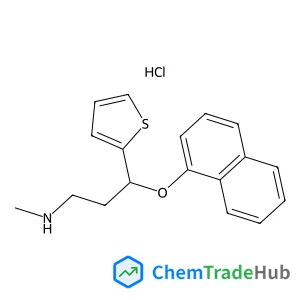
N-Methyl-3-(1-naphthyloxy)-3-(2-thienyl)-1-propanamine hydrochloride (1:1)
CAS番号:
1188266-11-6
分子式:
C18H20ClNOS
![(2R,6S)-6-[(Benzyloxy)methyl]-4-{[(2-methyl-2-propanyl)oxy]carbonyl}-2-morpholinecarboxylic acid structure](https://static.chemtradehub.com/structs/109/1093085-91-6-3382.webp "(2R,6S)-6-[(Benzyloxy)methyl]-4-{[(2-methyl-2-propanyl)oxy]carbonyl}-2-morpholinecarboxylic acid structure")
おすすめサプライヤー





免責事項
このページに表示される学術雑誌情報は、参考および研究目的のみを目的としています。当社は雑誌出版社とは提携しておらず、投稿の取り扱いも行っておりません。出版に関するお問い合わせは、各雑誌出版社に直接ご連絡ください。
表示されている情報に誤りがある場合は、support@chemtradehub.com までご連絡ください。迅速に確認し、対応いたします。