












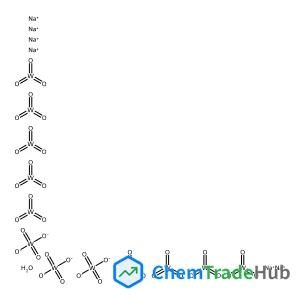
Tailored ternary hetero-interfaces with in situ formed CNTs for effective electromagnetic coupling at low/mid-frequency
文献情報
出版日
2023-12-05
DOI
10.1039/D3NJ05319A
インパクトファクター
3.591
著者
Jing Chen, Hong-Han Wang‡, Qing-Da An, Zuo-Yi Xiao, Xiao-Ling Dong, Kai-Ruo Zhu, Shang-Ru Zhai
原文を見る
要旨
With the rapid development of 5G wireless communication technology, the main working ranges of civilian fields are gradually concentrating at low-frequency; however, ternary component modulation engineering, which can optimize the decoupling effect between impedance matching and strong attenuation capability at low-frequency, remains challenging. Herein, Co/MnO@NC-X with tailored ternary hetero-interfaces was prepared by the solvothermal method and subsequent high-temperature pyrolysis, and the modulation of the absorption band was achieved by adjusting the doping ratio of melamine. The minimum reflection loss (RLmin) value of the Co/MnO@NC-3 nanocomposite reaches −41.19 dB at low-frequency (3.6 GHz). The RLmin value of the Co/MnO@NC-5 nanocomposite is −40.6 dB at low-frequency (6.0 GHz) and −47.4 dB at mid-frequency (8.8 GHz). In addition, more than 90% of the electromagnetic waves (EMWs) can be absorbed in the 2–18 GHz range by adjusting the thickness of the composites (1.0–5.5 mm). The prominent performance results from the synergy between the magnetic/dielectric/conductive triad. Cobalt provides magnetic loss and effectively catalyzes the in situ growth of CNTs, which construct a conductive network to promote the conductive loss and regulate the impedance matching, while MnO regulates the dielectric loss. Low-frequency absorption is achieved by building a reasonable structure and controlling the degree of graphitization to maximize the attenuation constant while ensuring impedance matching. This strategy provides a simple argument for the development of high-efficiency low/mid-frequency EMW absorbing materials with ternary components.
関連文献
Dual stimuli-responsive supramolecular hydrogel of bionanoparticles and hyaluronan
Limin Chen, Xia Zhao, Yuan Lin, Zhaohui Su
2014-08-07
Paper
DOI: 10.1039/C4PY00819G
Synthesis and properties of CO2-switchable Dex-g-PAHMA copolymers
Hongliang Kang, Ruigang Liu, Zhuang Li, Xiaozhong Qu
2014-09-02
Paper
DOI: 10.1039/C4PY00987H
Synthesis and photovoltaic properties of thieno[3,2-b]thiophenyl substituted benzo[1,2-b:4,5-b′]dithiophene copolymers
Zeyun Xiao, Jegadesan Subbiah, Kuan Sun, David J. Jones, Andrew B. Holmes, Wallace W. H. Wong
2014-08-19
Paper
DOI: 10.1039/C4PY00827H
Silicone dendrons and dendrimers from orthogonal SiH coupling reactions
John B. Grande, Tomas Urlich, Tara Dickie, Michael A. Brook
2014-08-20
Paper
DOI: 10.1039/C4PY00680A
Facile preparation of electrochromic poly(amine–imide) films from diimide compounds with terminal triphenylamino groups via electrochemical oxidative coupling reactions
Sheng-Huei Hsiao, Jun-Wen Lin
2014-08-11
Paper
DOI: 10.1039/C4PY00610K
One-pot controllable synthesis of oligo(carbonate-ether) triol using a Zn-Co-DMC catalyst: the special role of trimesic acid as an initiation-transfer agent
Yusheng Qin, Xuesi Chen, Xianhong Wang, Fosong Wang
2014-06-30
Paper
DOI: 10.1039/C4PY00578C
Photodegradable poly(ester amide)s for indirect light-triggered release of paclitaxel
Abdolrasoul Soleimani, Aneta Borecki
2014-09-09
Paper
DOI: 10.1039/C4PY00996G
こちらもおすすめ
化合物よくある質問
3-(5-フェニル-2-ファイル)-プロパン酸の市場動向や研究トレンドはどうですか?
この化合物の市場動向は不明ですが、類似化合物の需要は化学繊維、医薬品、農薬分野で安定しています。研究トレンドとしては、該当化合物の生物学的活性の評価や、その他の...
3465-61-03-(5-Phenyl-2-furyl)...
化合物よくある質問
3- Chloro-1H-indazol-5-olはどのように保存すればよいですか?
3- チロロ-1H-吲唑-5-醇は遮光し、直射日光を避けて、温度は室温を推奨し、密閉容器に保存してください。
885519-34-63-Chloro-1H-indazol-...
849924-76-11,2,3,4,5-Cyclopenta...
化合物よくある質問
L-(1-~13~C)メチオニンの市場動向や研究トレンドはどうですか?
L-(1-~13~C)メチオニンは、医薬品やバイオテクノロジー分野での研究が増加しており、その価格は安定しています。新興研究分野では、代謝解析や遺伝子機能解析で...
81202-04-2L-(1-~13~C)Methionin...
化合物よくある質問
1,3-フェニレンビスメチレンビスアクリレートは安全ですか?
1,3-フェニレンビスメチレンビスアクリレートは一般的に安全ですが、直接皮膚に触れる場合は保護用具を使用することを推奨します。高濃度の蒸気が吸入された場合は呼吸...
22757-16-01,3-Phenylenebis(met...
化合物よくある質問
丹参醇Aはどのように保存すればよいですか?
丹参醇Aは、直射日光を避けて室温で保存し、密栓容器に入れることをお勧めします。適切な保存条件は、安定性を保ち、安全性を確保する上で重要です。
189308-08-5Danshenol A
化合物よくある質問
4-メチル-2-(1,1,1-三フロロ-2-メチルプロパニル)ピリドインとは何ですか?
CAS番号1378865-93-0の4-メチル-2-(1,1,1-三フロロ-2-メチルプロパニル)ピリドインは、合成化学分野で用いられる有機化合物の一種です。こ...
1378865-93-04-Methyl-2-(1,1,1-tr...
化合物よくある質問
N-フェニルベンジル-2-クロロ酢氨を取り扱う際の実験室安全事項は何ですか?
N-フェニルベンジル-2-クロロ酢氨は毒性があり、皮膚や粘膜に刺激を与えます。取り扱う際には、保護眼鏡、手袋、ゴーグルを着用することを強く推奨します。ドラフトチ...
2653-14-7N-benzyl-2-chloro-N-...
化合物よくある質問
UCN-02を取り扱う際の実験室安全事項は何ですか?
UCN-02は毒性は低いですが、人体への直接的な接触は避けるべきです。PPE要件はグローブと顔面保護具を着用することです。ドラフトチャンバーを使用して漏洩を処理...
121569-61-7UCN-02
化合物よくある質問
N-[3-[2-(二甲基氨基)乙氧基]-4-甲氧基苯基]-2'-甲基-4'-(5-甲基-1,2,4-恶二唑-3-基)-[1,1'-联苯]-4-甲酰胺を取り扱う際の実験室安全事項は何ですか?
手袋と保護眼鏡を着用し、漏洩時には吸気防止装置を使用してください。室温、乾燥した場所に保管し、直日光から隔離してください。SDS(安全データシート)を参照してく...
170230-39-4N-{3-[2-(Dimethylami...
掲載誌
New Journal of Chemistry

CiteScore:
5.3
自己引用率:
3.7%
年間論文数:
2153
NJC (New Journal of Chemistry) is a broad-based primary journal encompassing all branches of chemistry and its sub-disciplines. It contains full research articles, communications, perspectives and focus articles. This well-established journal, owned by the Centre National de la Recherche Scientifique (CNRS) of France, has been co-published with the Royal Society of Chemistry since January 1998. NJC is the forum for the publication of high-quality, original and significant work that opens new directions in chemistry or other scientific disciplines. In addition to having a significant chemical component, work published in NJC must demonstrate that it will have an impact on areas of research other than that of the reported work.
おすすめ化合物
おすすめサプライヤー




免責事項
このページに表示される学術雑誌情報は、参考および研究目的のみを目的としています。当社は雑誌出版社とは提携しておらず、投稿の取り扱いも行っておりません。出版に関するお問い合わせは、各雑誌出版社に直接ご連絡ください。
表示されている情報に誤りがある場合は、support@chemtradehub.com までご連絡ください。迅速に確認し、対応いたします。