












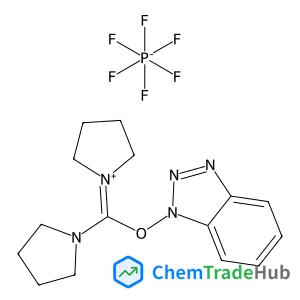
(1H-Benzotriazol-1-yloxy)(di-1-pyrrolidinyl)methylium hexafluorophosphate
CAS番号:
105379-24-6
分子式:
C15H21F6N5OP
Joshua Arámbula, Somayeh Mohammadi, Amirhossein Mahdaviarab, Daryoush Sanaei, Rajendra P. Patil, Hamidreza Sharifan
Nanomaterials are promising candidates to overcome the water quality issues caused by dye consuming industries. However, their restricted efficiency in water treatment hinders their practical applications, particularly in the case of dispersed nanomaterials used in water systems. This study presents a novel approach for immobilizing ferromagnetic nanocomposites on a polymeric microporous structure. 100 mg L−1 Zn0.5Mn0.5Fe2O4 nanocomposites (NCPs) were embedded into poly(methyl methacrylate) (PMMA), eliminating the need to retrieve the dispersed nanomaterials after water treatment. The developed Zn0.5Mn0.5Fe2O4–PMMA nanocomposite was characterized by scanning electron microscopy (SEM) and Fourier transform infrared (FTIR) spectroscopy. The removal of two commercial dyes (Brilliant Blue and Allura Red) at concentration levels of (0, 25, 35, 50, 70, and 100 mg L−1) was examined by batch adsorption studies followed by ultraviolet-visible (UV-vis) spectrophotometry quantification. It was observed that the maximum removal percentage was obtained for the embedded Zn0.5Mn0.5Fe2O4 nanoparticles on the PMMA polymer using 100 mg of Zn0.5Mn0.5Fe2O4 NCPs for all the four dye levels in comparison to dispersed Zn0.5Mn0.5Fe2O4 nanocomposites. It was observed that the maximum adsorption of Brilliant Blue and Allura Red was obtained under alkaline conditions, pH 7.32 and 8.37, respectively. It was suggested that Zn0.5Mn0.5Fe2O4–PMMA can be applied as a sustainable material to enhance water treatment efficiency by merging the advantages of a fast preparation technique and a higher adsorption capacity to remove complex organic contaminants.
Madalena C. C. Areias, Kenichi Shimizu, Richard G. Compton
DOI: 10.1039/C6AN00550K
Yuanyuan Wang, Zhaopeng Yu, Zhen Zhang, Shusheng Zhang
DOI: 10.1039/C6AN00160B
Qi Kang, Dazhong Shen, Yunqing Wang
DOI: 10.1039/C9AN01694E
Alain Wuethrich, Aswin Raj Rajkumar, Karthik Balaji Shanmugasundaram, Kamil K. Reza, Shuvashis Dey, Christopher B. Howard
DOI: 10.1039/C9AN01450K
Ishaan Maitra, Camilo L. M. Morais, Katherine M. Ashton, Ravindra S. Date, Francis L. Martin
DOI: 10.1039/C9AN01749F
Yuan Yu, Jie Shen, Jinfang Zhi
DOI: 10.1039/C5AN02478A
Han Zhao, Ying Yan, Mingjian Chen, Tingting Hu, Kefeng Wu, Haisheng Liu, Changbei Ma
DOI: 10.1039/C9AN01659G
Rajeev Yadav, Rajeev Agarwal, Samuel Kadoury, Dominique Trudel, Marie-Christine Guiot, Kevin Petrecca
DOI: 10.1039/C9AN01144G
2-溴-9,9-二苯基芴は、医薬品、工業材料、有機合成の研究分野で応用されます。特に、レーザー材料や機能性ポリマーの合成に使用されることがあります。また、蛍光色...
四氯化铱の市場は研究開発分野で注目されており、特にナノ技術や金属有機框架(MOFs)の分野での需要が増加傾向にあります。価格は安定しており、中国や韓国での生産が...
1-(4-溴-3-氟苯基)-2-氯乙酮 (CAS番号: 1260857-14-4) の廃棄物は専門的な廃棄処理が必要です。まず、廃棄物は密閉された容器に収集し、...
苦参酚Kは、CAS番号101236-49-1を持つ化合物で、主に天然由来の生薬から抽出されます。この化合物は、抗炎症作用や抗癌作用を持つことが報告されています。
POTASSIUM (1-(TERTBUTOXYCARBONYL)AZETIDIN-3-YL)TRIFLUOROBORATE を含む廃棄物は、まず安全なエント...
4-庚基-4’-聯苯羧酸は、特殊化学品や合成化学の分野で用いられる化学物質ですが、市場動向としては、研究開発の進展とともに需要が増加しています。また、環境配慮型...
6-ブロモ-3-メトキシ-1-フェニル-1H-インドゾールを含む廃棄物は、適切な化学廃棄処理が必要です。通常、廃棄物は密閉容器に収集され、専門の廃棄処理業者に引...
4,4-二甲基-2-吡咯烷酮は医薬、ポリマー、センサー、半導体などの業界で広く使用されています。特に溶媒としての性能が高く評価されています。

NJC (New Journal of Chemistry) is a broad-based primary journal encompassing all branches of chemistry and its sub-disciplines. It contains full research articles, communications, perspectives and focus articles. This well-established journal, owned by the Centre National de la Recherche Scientifique (CNRS) of France, has been co-published with the Royal Society of Chemistry since January 1998. NJC is the forum for the publication of high-quality, original and significant work that opens new directions in chemistry or other scientific disciplines. In addition to having a significant chemical component, work published in NJC must demonstrate that it will have an impact on areas of research other than that of the reported work.
![1-Naphthalenesulfonic acid, 2-[(2-hydroxy-1-naphthalenyl)azo]-, bariumsalt (2:1) structure](https://static.chemtradehub.com/structs/110/1103-38-4-0b33.webp "1-Naphthalenesulfonic acid, 2-[(2-hydroxy-1-naphthalenyl)azo]-, bariumsalt (2:1) structure")




