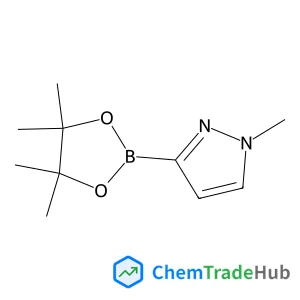
1-Methyl-3-(4,4,5,5-tetramethyl-1,3,2-dioxaborolan-2-yl)-1H-pyrazole
CAS番号:
1020174-04-2
分子式:
C10H17BN2O2
Jieyu Tang, Xi Liu, Xue Zhang, Jianzhang Zhao, Yan Wan
In this study, we synthesized three electron donor–acceptor dyads, NI-PXZ-Ph, NI-PXZ-PhF, and NI-PXZ-PhOCH3, by attaching an electron-donating or withdrawing group to the imide N-position of the naphthalimide (NI) moiety (electron acceptor) to study the effect of the relative energy order of the charge transfer (CT) state and the 3LE (locally excited) state on the photophysical property of the compact electron donor–acceptor dyads, especially their thermally activated delayed fluorescence (TADF) property. The reduction potentials of the NI moieties changed by ca. 0.03–0.05 V by introducing different substituents, while the other features of the dyads remained unchanged. All three dyads showed the TADF property, for example, the prompt and delayed fluorescence lifetimes of NI-PXZ-PhF were determined to be 20.2 ns (99.2%) and 6.4 μs (0.80%), respectively, in deaerated n-hexane. Their lifetimes were found to be much shorter than the previously reported NI-PXZ [16.4 ns (99.2%)/17.0 μs (0.80%)]. Mixed LE and CT states were observed in non-polar solvents (n-hexane) via nanosecond transient absorption spectroscopy. Our experiments showed that in polar solvents (toluene and acetonitrile), although the long-lived 3CT state was populated (0.47 μs), no TADF was observed because of the lower CT state energy (2.10 eV) than the 3LE state energy (2.29 eV). The results suggest that the presence of the 3LE state sharing a similar energy with the CT states is critical for the occurrence of TADF, and the equilibrium between the three states of 3LE and 1CT/3CT favors the efficient TADF process. These experimental results confirm the spin–vibronic coupling mechanism of TADF emitters based on electron donor–acceptor dyad molecular structure motifs.
Maria Barrio, Pol Lloveras, Alain Polian, Jean-Paul Itié, Josep-Lluis Tamarit
DOI: 10.1039/C8CP01813H
Alberto Monteiro Dos Santos, Lorenzo Cianni, Daniela De Vita, Fabiana Rosini, Andrei Leitão, Charles A. Laughton, Jerônimo Lameira, Carlos A. Montanari
DOI: 10.1039/C8CP03320J
Douglas P. Linder, Brett E. Baker, Kenton R. Rodgers
DOI: 10.1039/C8CP03121E
Yu Zhang, Tiejun Yang, Jinrui Zhang, Huafu Pei, Jinglin Zhang, Jinyang Jiang, Tao Li
DOI: 10.1039/C8CP03411G
Matteo Ambrosetti, Giacomo Ruggeri, Chiara Cappelli, Andrea Pucci
DOI: 10.1039/C8CP04450C
Fangyong Yan, Ryohei Kakuchi, Kenji Takahashi, Hyung J. Kim
DOI: 10.1039/C8CP01724G
Xuewen Zhang, Chunjun Liang, Mengjie Sun, Huimin Zhang, Chao Ji, Zebang Guo, Yajun Xu, Fulin Sun, Qi Song, Zhiqun He
DOI: 10.1039/C8CP91812K
Sebastian Schwalbe, Jana Schaber, Simon Krause, Irena Senkovska, Stefan Kaskel, Eike Brunner, Jens Kortus, Gotthard Seifert
DOI: 10.1039/C8CP04025G
2-溴-9,9-二苯基芴は、医薬品、工業材料、有機合成の研究分野で応用されます。特に、レーザー材料や機能性ポリマーの合成に使用されることがあります。また、蛍光色...
四氯化铱の市場は研究開発分野で注目されており、特にナノ技術や金属有機框架(MOFs)の分野での需要が増加傾向にあります。価格は安定しており、中国や韓国での生産が...
1-(4-溴-3-氟苯基)-2-氯乙酮 (CAS番号: 1260857-14-4) の廃棄物は専門的な廃棄処理が必要です。まず、廃棄物は密閉された容器に収集し、...
苦参酚Kは、CAS番号101236-49-1を持つ化合物で、主に天然由来の生薬から抽出されます。この化合物は、抗炎症作用や抗癌作用を持つことが報告されています。
POTASSIUM (1-(TERTBUTOXYCARBONYL)AZETIDIN-3-YL)TRIFLUOROBORATE を含む廃棄物は、まず安全なエント...
4-庚基-4’-聯苯羧酸は、特殊化学品や合成化学の分野で用いられる化学物質ですが、市場動向としては、研究開発の進展とともに需要が増加しています。また、環境配慮型...
6-ブロモ-3-メトキシ-1-フェニル-1H-インドゾールを含む廃棄物は、適切な化学廃棄処理が必要です。通常、廃棄物は密閉容器に収集され、専門の廃棄処理業者に引...
4,4-二甲基-2-吡咯烷酮は医薬、ポリマー、センサー、半導体などの業界で広く使用されています。特に溶媒としての性能が高く評価されています。

NJC (New Journal of Chemistry) is a broad-based primary journal encompassing all branches of chemistry and its sub-disciplines. It contains full research articles, communications, perspectives and focus articles. This well-established journal, owned by the Centre National de la Recherche Scientifique (CNRS) of France, has been co-published with the Royal Society of Chemistry since January 1998. NJC is the forum for the publication of high-quality, original and significant work that opens new directions in chemistry or other scientific disciplines. In addition to having a significant chemical component, work published in NJC must demonstrate that it will have an impact on areas of research other than that of the reported work.