












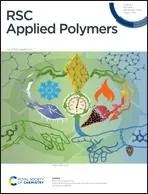
Poly(ionic liquid)s having coumarate counter-anions as corrosion inhibitors in acrylic UV coatings
文献情報
出版日
2023-07-20
DOI
10.1039/D3LP00017F
インパクトファクター
0
著者
Daniela Minudri, Anthony Somers
原文を見る
要旨
Organic inhibitor alternatives to toxic chromium treatments are being sought to protect metal surfaces. One of the limitations of the organic inhibitors is leaching out of the coatings limiting their performance. This work investigates the ionic attachment of coumarate inhibitors into a poly(ionic liquid), polyDADMA coumarate, and its application in a UV-cured acrylic coating. The corrosion protection of the polyDADMA coumarate coating was evaluated by electrochemical techniques including electrochemical impedance spectroscopy (EIS) and surface characterization. The adhesion of the acrylic UV coating formulation onto the steel surface was also investigated. The results showed that the presence of poly(ionic liquid) coumarate in the blend improves the adhesion level as well as providing active corrosion protection.
関連文献
A site-selective spectroscopy of naphthalene and quinoline in TEOS/MTEOS xerogels
C. Crépin, V. Dubois, F. Goldfarb, F. Chaput, J. P. Boilot
2005-03-21
Paper
DOI: 10.1039/B500578G
Electrochemical control of glucose oxidase-catalyzed redox reaction using an oil/water interface
Takayasu Sugihara, Hiroki Hotta, Toshiyuki Osakai
2004-05-06
Paper
DOI: 10.1039/B400338A
Solvation of fluoro and mixed fluoro/chloro complexes of EuIII in the [BMI][PF6] room temperature ionic liquid. A theoretical study
A. Chaumont, G. Wipff
2005-03-29
Paper
DOI: 10.1039/B417598K
A novel long path photolysis cell—application to the reactivity of selected organic compounds toward the nitrate radical (NO3)
Davy Rousse, Christian George
2004-04-14
Paper
DOI: 10.1039/B400175C
The role of surface electrification on the growth and structural features of titania nanoparticles
Tzvetanka Boiadjieva, Giuseppe Cappelletti, Silvia Ardizzone, Sandra Rondinini, Alberto Vertova
2004-05-03
Paper
DOI: 10.1039/B402370F
Dissociative recombination of N2OD+
W. D. Geppert, R. Thomas, F. Hellberg, A. Ehlerding, F. Österdahl, M. af Ugglas, M. Larsson
2004-05-10
Paper
DOI: 10.1039/B403461A
Cation environments and spatial distribution in Na2O–B2O3 glasses: New results from solid state NMR
Jan Dirk Epping, Wenzel Strojek, Hellmut Eckert
2005-05-03
Paper
DOI: 10.1039/B502265G
Computational studies of 13C NMR chemical shifts of saccharides
2005-06-09
Paper
DOI: 10.1039/B505546F
Transitions and loci of solubilization of nutraceuticals in U-type nonionic microemulsions studied by self-diffusion NMR
Nissim Garti, Idit Amar-Yuli, Aviram Spernath, Roy E. Hoffman
2004-05-12
Paper
DOI: 10.1039/B404315B
こちらもおすすめ
化合物よくある質問
3-(5-フェニル-2-ファイル)-プロパン酸の市場動向や研究トレンドはどうですか?
この化合物の市場動向は不明ですが、類似化合物の需要は化学繊維、医薬品、農薬分野で安定しています。研究トレンドとしては、該当化合物の生物学的活性の評価や、その他の...
3465-61-03-(5-Phenyl-2-furyl)...
化合物よくある質問
3- Chloro-1H-indazol-5-olはどのように保存すればよいですか?
3- チロロ-1H-吲唑-5-醇は遮光し、直射日光を避けて、温度は室温を推奨し、密閉容器に保存してください。
885519-34-63-Chloro-1H-indazol-...
849924-76-11,2,3,4,5-Cyclopenta...
化合物よくある質問
L-(1-~13~C)メチオニンの市場動向や研究トレンドはどうですか?
L-(1-~13~C)メチオニンは、医薬品やバイオテクノロジー分野での研究が増加しており、その価格は安定しています。新興研究分野では、代謝解析や遺伝子機能解析で...
81202-04-2L-(1-~13~C)Methionin...
化合物よくある質問
1,3-フェニレンビスメチレンビスアクリレートは安全ですか?
1,3-フェニレンビスメチレンビスアクリレートは一般的に安全ですが、直接皮膚に触れる場合は保護用具を使用することを推奨します。高濃度の蒸気が吸入された場合は呼吸...
22757-16-01,3-Phenylenebis(met...
化合物よくある質問
丹参醇Aはどのように保存すればよいですか?
丹参醇Aは、直射日光を避けて室温で保存し、密栓容器に入れることをお勧めします。適切な保存条件は、安定性を保ち、安全性を確保する上で重要です。
189308-08-5Danshenol A
化合物よくある質問
4-メチル-2-(1,1,1-三フロロ-2-メチルプロパニル)ピリドインとは何ですか?
CAS番号1378865-93-0の4-メチル-2-(1,1,1-三フロロ-2-メチルプロパニル)ピリドインは、合成化学分野で用いられる有機化合物の一種です。こ...
1378865-93-04-Methyl-2-(1,1,1-tr...
化合物よくある質問
N-フェニルベンジル-2-クロロ酢氨を取り扱う際の実験室安全事項は何ですか?
N-フェニルベンジル-2-クロロ酢氨は毒性があり、皮膚や粘膜に刺激を与えます。取り扱う際には、保護眼鏡、手袋、ゴーグルを着用することを強く推奨します。ドラフトチ...
2653-14-7N-benzyl-2-chloro-N-...
化合物よくある質問
UCN-02を取り扱う際の実験室安全事項は何ですか?
UCN-02は毒性は低いですが、人体への直接的な接触は避けるべきです。PPE要件はグローブと顔面保護具を着用することです。ドラフトチャンバーを使用して漏洩を処理...
121569-61-7UCN-02
化合物よくある質問
N-[3-[2-(二甲基氨基)乙氧基]-4-甲氧基苯基]-2'-甲基-4'-(5-甲基-1,2,4-恶二唑-3-基)-[1,1'-联苯]-4-甲酰胺を取り扱う際の実験室安全事項は何ですか?
手袋と保護眼鏡を着用し、漏洩時には吸気防止装置を使用してください。室温、乾燥した場所に保管し、直日光から隔離してください。SDS(安全データシート)を参照してく...
170230-39-4N-{3-[2-(Dimethylami...
掲載誌
おすすめ化合物
![2-{[4-(2-Methoxyethyl)phenoxy]methyl}oxirane structure](https://static.chemtradehub.com/structs/567/56718-70-8-f037.webp "2-{[4-(2-Methoxyethyl)phenoxy]methyl}oxirane structure")
![(2S)-2-({[(2-Methyl-2-propanyl)oxy]carbonyl}amino)-4-pentynoic acid structure](https://static.chemtradehub.com/structs/630/63039-48-5-b66d.webp "(2S)-2-({[(2-Methyl-2-propanyl)oxy]carbonyl}amino)-4-pentynoic acid structure")
おすすめサプライヤー





免責事項
このページに表示される学術雑誌情報は、参考および研究目的のみを目的としています。当社は雑誌出版社とは提携しておらず、投稿の取り扱いも行っておりません。出版に関するお問い合わせは、各雑誌出版社に直接ご連絡ください。
表示されている情報に誤りがある場合は、support@chemtradehub.com までご連絡ください。迅速に確認し、対応いたします。