












Understanding improved capacity retention at 4.3 V in modified single crystal Ni-rich NMC//graphite pouch cells at elevated temperature
文献情報
出版日
2023-09-21
DOI
10.1039/D3LF00093A
インパクトファクター
0
著者
Satish Bolloju, Eleni Fiamegkou, Nickil Shah, Mateusz Jan Zuba, Tien-Lin Lee, Pardeep K. Thakur, Melanie J. Loveridge
原文を見る
要旨
The capacity retention of commercially-sourced pouch cells with single crystal Al surface-doped Ni-rich cathodes (LiNi0.834Mn0.095Co0.071O2) is examined. The degradation-induced capacity fade becomes more pronounced as the upper-cut-off voltage (UCV) increases from 4.2 V to 4.3 V (vs. graphite) at a fixed cycling temperature (either 25 or 40 °C). However, cycles with 4.3 V UCV (slightly below the oxygen loss onset) show better capacity retention upon increasing the cycling temperature from 25 °C to 40 °C. Namely, after 500 cycles at 4.3 V UCV, cycling temperature at 40 °C retains 85.5% of the initial capacity while cycling at 25 °C shows 75.0% capacity retention. By employing a suite of electrochemical, X-ray spectroscopy and secondary ion mass spectrometry techniques, we attribute the temperature-induced improvement of the capacity retention at high UCV to the combined effects of Al surface-dopants, electrochemically resilient single crystal Ni-rich particles, and thermally-improved Li kinetics translating into better electrochemical performance. If cycling remains below the lattice oxygen loss onset, improved capacity retention in industrial cells should be achieved in single crystal Ni-rich cathodes with the appropriate choice of cycling parameter, particle quality, and particle surface dopants.
関連文献
A neutral self-assembled coordination cage organized for inclusion of aromatic guests
Amir H. Mahmoudkhani, Adrien P. Côté, George K. H. Shimizu
2004-10-15
Communication
DOI: 10.1039/B412325E
Synthesis of novel starburst and dendritic polyhedral oligosilsesquioxanes
Kenji Wada, Naoki Watanabe, Koichi Yamada, Teruyuki Kondo, Take-aki Mitsudo
2004-11-29
Communication
DOI: 10.1039/B413921F
Controlled assembly of luminescent racks based on heteroleptic dinuclear lanthanide complexes
M. Margarita Castaño-Briones, Andrew P. Bassett, Linette L. Meason, Peter R. Ashton, Zoe Pikramenou
2004-10-26
Communication
DOI: 10.1039/B412999G
Trimethyltriazacyclohexane as bridging ligand for triangular Cu3 units and C–H hydride abstraction into a Cu6 cluster
Randolf D. Köhn, Zhida Pan, Mary F. Mahon, Gabriele Kociok-Köhn
2003-05-02
Communication
DOI: 10.1039/B302670A
Ring-opening reactions of methylenecyclopropanes with diphenyl diselenide upon heating; formation of 3-phenylselenyl-2,5-dihydrofuran derivatives
Le-Ping Liu, Min Shi
2004-10-25
Communication
DOI: 10.1039/B412823K
A novel catalyst with high activity for polyhydric alcohol oxidation: nanosilver/zeolite film
Jiang Shen, Wei Shan, Yahong Zhang, Junming Du, Hualong Xu, Kangnian Fan, Wei Shen, Yi Tang
2004-11-15
Communication
DOI: 10.1039/B412986E
Coordination polymers with macrocyclic cages and pockets within their backbones
Moonhyun Oh, Charlotte L. Stern, Chad A. Mirkin
2004-10-08
Communication
DOI: 10.1039/B408084J
Influence of substrate on self-assembled photonic crystal
Sachiko I. Matsushita
2004-02-09
Communication
DOI: 10.1039/B313410E
Fabrication of a stable inorganic–organic hybrid multilayer film with uniform and dense inorganic nanoparticle deposition
Xurong Xu, Joong Tark Han, Kilwon Cho
2003-03-18
Communication
DOI: 10.1039/B300581J
Modified micro-space using self-organized nanoparticles for reduction of methylene blue
Xianying Li, Hongzhi Wang, Kouzou Inoue, Masato Uehara, Hiroyuki Nakamura, Masaya Miyazaki, Eiichi Abe, Hideaki Maeda
2003-03-18
Communication
DOI: 10.1039/B300765K
こちらもおすすめ
化合物よくある質問
環戊烷-1,3-二甲酸甲酯はどのように合成されますか?
環戊烷-1,3-二甲酸甲酯は、環戊烷と塩酸によるヒンデンブルク反応を経由して合成されます。この反応では、環戊烷が塩酸と作用し、1,3-ジカルボキシ基が導入されま...
2435-36-1Dimethyl 1,3-cyclope...
化合物よくある質問
4-メトキシ-1,2,3-スチアゼ-3,5-ジオンとは何ですか?
4-メトキシ-1,2,3-スチアゼ-3,5-ジオンは、CAS番号107843-77-6の化合物で、(E)-ベンジル3-(3,4-ジヒドロキシフェニル) acry...
107843-77-6(E)-Benzyl 3-(3,4-di...
化合物よくある質問
プロスタグランジンA2について「に適用される法規ガイドラインは何ですか?'
プロスタグランジンA2 (CAS番号: 41691-92-3) は、化学物質の安全管理に関する規制として、GHS (危険物質の国際的ハザード分類・ラベル付けシス...
41691-92-316,16-DIMETHYL PROST...
化合物よくある質問
4-アミノ-1-ナフタレン sulfonic 酸についての物理化学的性質は何ですか?
4-アミノ-1-ナフタレン sulfonic 酸のCAS番号は84-86-6です。この化合物は結晶性で、分子量は212.15 g/molです。アルコールや水など...
84-86-64-Amino-1-naphthalen...
化合物よくある質問
N-GlcNAc-生物素を取り扱う際の実験室安全事項は何ですか?
N-GlcNAc-生物素は吸収性があり、皮膚や目への接触を避けることが重要です。PPE(個体保護具)は使用し、ドラフトチャンバーは必要に応じて使用します。漏洩時...
1272755-69-72-Acetamido-2-deoxy-...
化合物よくある質問
3-アミノメチルフローラノピペリジン-1-カルボニル酸テルブチルエステルとは何ですか?
CAS番号1209781-11-2の3-アミノメチルフローラノピペリジン-1-カルボニル酸テルブチルエステルは、有機化合物の一種で、化学式はC10H17FNO3...
1209781-11-22-Methyl-2-propanyl ...
化合物よくある質問
6-溴-1-甲基-1H-ベンゾ[d][1,2,3]三氮唑はどのように合成されますか?
6- bromo-1-methyl-1H-benzotriazoleは、ブロモフリオリンと1-メチル-1H-ベンゾ[d][1,2,3]三氮唑の反応により合成され...
944718-32-56-Bromo-1-methyl-1H-...
化合物よくある質問
4-硫代尿苷はどのように合成されますか?
4-硫代尿苷は、尿素とD-リボシルヒドロキシアルデヒドを用いてスルホン化反応を経て合成されます。通常は塩酸ヒドロキシチオニルスルホン酸などの触媒を使用し、選択性...
6741-73-71-(4-thio-beta-D-rib...
化合物よくある質問
ブレインナトリユリックペプチド32ラットとは何ですか?
ブレインナトリユリックペプチド32ラット(CAS番号: 133448-20-1)は、心臓で作られるホルモンの一つで、心不全の診断や予後評価に使用されます。
133448-20-1Brain Natriuretic Pe...
化合物よくある質問
1-(3-氮杂啶)-4-羟基哌啶双盐酸盐の物理化学的性質は何ですか?
CAS番号810680-60-5の1-(3-氮杂啶)-4-羟基哌啶双盐酸盐は、白色の結晶性粉末である。分子量は360.84 g/molで、水に溶けやすい。反応活...
810680-60-51-(3-Azetidinyl)-4-p...
掲載誌
おすすめ化合物

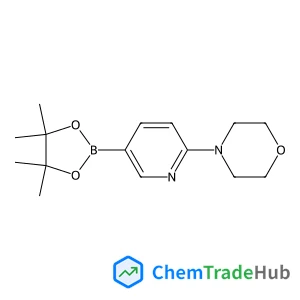
4-(5-(4,4,5,5-tetramethyl-1,3,2-dioxaborolan-2-yl)pyridin-2-yl)morpholine
CAS番号:
485799-04-0
分子式:
C15H23BN2O3
![N-[(5,6-Dichloro-1H-benzimidazol-2-yl)methyl]-9-(1-methyl-1H-pyrazol-4-yl)-2-(4-morpholinyl)-9H-purin-6-amine structure](https://static.chemtradehub.com/structs/238/2387704-62-1-25f4.webp "N-[(5,6-Dichloro-1H-benzimidazol-2-yl)methyl]-9-(1-methyl-1H-pyrazol-4-yl)-2-(4-morpholinyl)-9H-purin-6-amine structure")
おすすめサプライヤー







免責事項
このページに表示される学術雑誌情報は、参考および研究目的のみを目的としています。当社は雑誌出版社とは提携しておらず、投稿の取り扱いも行っておりません。出版に関するお問い合わせは、各雑誌出版社に直接ご連絡ください。
表示されている情報に誤りがある場合は、support@chemtradehub.com までご連絡ください。迅速に確認し、対応いたします。