


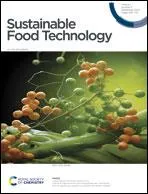
Effect of temperature and packaging materials on the shelf-life stability and in vitro properties of microencapsulated and spray-dried synbiotic legume-based instant beverage powder
文献情報
出版日
2023-10-27
DOI
10.1039/D3FB00094J
インパクトファクター
0
著者
Smriti Chaturvedi, Snehasis Chakraborty
原文を見る
要旨
The aim of the work was to investigate the effect of different packaging materials and storage temperatures on the stability and in vitro properties of microencapsulated spray-dried synbiotic kidney-mung bean beverage (KMB) powder. The formulation for the synbiotic KMB powder has been explored in our previous work. The present study focuses on the evaluation of the shelf-life of the same synbiotic KMB powder. The synbiotic powder was packed in polypropylene and aluminum laminates and stored at 25, 30, and 35 °C. The survivability of probiotic Lacticaseibacillus casei in encapsulated spray-dried powder was studied under simulated gastric conditions for 70 days. At all three storage temperatures, the count remained >108 CFU mL−1 for the first 21 days. Additionally, moisture content increased and color value (L*) decreased with increasing storage time, irrespective of packaging material. The encapsulated synbiotic powder in Al-laminate pouches also showed better prebiotic activity when compared to PP laminates. An acceptable sensory score (6 out of 10) and low microbial load (<106 CFU mL−1) also suggested that the shelf life of synbiotic KMB powder in polypropylene and aluminum laminates was 63, 35, and 35 days at 25, 30, and 35 °C, respectively.
おすすめジャーナル

Colloid Journal

Herald of the Russian Academy of Sciences

Polycyclic Aromatic Compounds

Critical Reviews in Solid State and Materials Sciences

Acta Metallurgica Sinica-English Letters

Electroanalysis

Topics in Catalysis

Bioorganic & Medicinal Chemistry Letters

Journal of Chemical Sciences

Journal of the Indian Institute of Science
関連文献
Development of pyrene-stacked carbon nanotube-based hybrid: measurement of NO3− ions using fluorescence spectroscopy
Beant Kaur Billing, Mayank, Prabhat K. Agnihotri, Narinder Singh
2018-05-29
Paper
DOI: 10.1039/C8AN00286J
Multi-code magnetic beads based on DNAzyme-mediated double-cycling amplification for a point-of-care assay of telomerase activity
Chunxue Liu, Susu Zhang, Wei Jiang
2019-05-31
Paper
DOI: 10.1039/C9AN00589G
Electronically-tuned triarylmethine scaffolds for fast and continuous monitoring of H2S levels in biological samples
Ramshad Kalluruttimmal, Divya Thekke Thattariyil, Archana Panthalattu Parambil, Ashis Kumar Sen, Lakshmi Chakkumkumarath, Muraleedharan Kannoth Manheri
2019-05-28
Paper
DOI: 10.1039/C9AN00522F
Rapid “turn-on” photoluminescence detection of bisulfite in wines and living cells with a formyl bearing bis-cyclometalated Ir(iii) complex
Hongfang Gao, Hetong Qi, Yijin Peng, Honglan Qi, Chengxiao Zhang
2018-06-11
Paper
DOI: 10.1039/C8AN00640G
In vitro FTIR microspectroscopy analysis of primary oral squamous carcinoma cells treated with cisplatin and 5-fluorouracil: a new spectroscopic approach for studying the drug–cell interaction
Elisabetta Giorgini, Simona Sabbatini, Romina Rocchetti, Valentina Notarstefano, Corrado Rubini, Carla Conti, Giulia Orilisi, Elisa Mitri, Diana E. Bedolla, Lisa Vaccari
2018-05-30
Paper
DOI: 10.1039/C8AN00602D
Predictive modelling of the water contact angle of surfaces using attenuated total reflection – Fourier transform infrared (ATR-FTIR) chemical imaging and partial least squares regression (PLSR)
S. Mukherjee, D. P. Dowling, A. A. Gowen
2018-06-19
Paper
DOI: 10.1039/C8AN00320C
Ultrasensitive detection of H. pylori in human feces based on immunomagnetic bead capture and fluorescent quantum dots
Lili Chen, Xiangguang Li, Tongda Zou, Tiantian Wang, Xiping Cui, Yingshan Chen, Chunguo Zhang, Suqing Zhao
2019-05-09
Paper
DOI: 10.1039/C9AN00193J
こちらもおすすめ
化合物よくある質問
環戊烷-1,3-二甲酸甲酯はどのように合成されますか?
環戊烷-1,3-二甲酸甲酯は、環戊烷と塩酸によるヒンデンブルク反応を経由して合成されます。この反応では、環戊烷が塩酸と作用し、1,3-ジカルボキシ基が導入されま...
2435-36-1Dimethyl 1,3-cyclope...
化合物よくある質問
4-メトキシ-1,2,3-スチアゼ-3,5-ジオンとは何ですか?
4-メトキシ-1,2,3-スチアゼ-3,5-ジオンは、CAS番号107843-77-6の化合物で、(E)-ベンジル3-(3,4-ジヒドロキシフェニル) acry...
107843-77-6(E)-Benzyl 3-(3,4-di...
化合物よくある質問
プロスタグランジンA2について「に適用される法規ガイドラインは何ですか?'
プロスタグランジンA2 (CAS番号: 41691-92-3) は、化学物質の安全管理に関する規制として、GHS (危険物質の国際的ハザード分類・ラベル付けシス...
41691-92-316,16-DIMETHYL PROST...
化合物よくある質問
4-アミノ-1-ナフタレン sulfonic 酸についての物理化学的性質は何ですか?
4-アミノ-1-ナフタレン sulfonic 酸のCAS番号は84-86-6です。この化合物は結晶性で、分子量は212.15 g/molです。アルコールや水など...
84-86-64-Amino-1-naphthalen...
化合物よくある質問
N-GlcNAc-生物素を取り扱う際の実験室安全事項は何ですか?
N-GlcNAc-生物素は吸収性があり、皮膚や目への接触を避けることが重要です。PPE(個体保護具)は使用し、ドラフトチャンバーは必要に応じて使用します。漏洩時...
1272755-69-72-Acetamido-2-deoxy-...
化合物よくある質問
3-アミノメチルフローラノピペリジン-1-カルボニル酸テルブチルエステルとは何ですか?
CAS番号1209781-11-2の3-アミノメチルフローラノピペリジン-1-カルボニル酸テルブチルエステルは、有機化合物の一種で、化学式はC10H17FNO3...
1209781-11-22-Methyl-2-propanyl ...
化合物よくある質問
6-溴-1-甲基-1H-ベンゾ[d][1,2,3]三氮唑はどのように合成されますか?
6- bromo-1-methyl-1H-benzotriazoleは、ブロモフリオリンと1-メチル-1H-ベンゾ[d][1,2,3]三氮唑の反応により合成され...
944718-32-56-Bromo-1-methyl-1H-...
化合物よくある質問
4-硫代尿苷はどのように合成されますか?
4-硫代尿苷は、尿素とD-リボシルヒドロキシアルデヒドを用いてスルホン化反応を経て合成されます。通常は塩酸ヒドロキシチオニルスルホン酸などの触媒を使用し、選択性...
6741-73-71-(4-thio-beta-D-rib...
化合物よくある質問
ブレインナトリユリックペプチド32ラットとは何ですか?
ブレインナトリユリックペプチド32ラット(CAS番号: 133448-20-1)は、心臓で作られるホルモンの一つで、心不全の診断や予後評価に使用されます。
133448-20-1Brain Natriuretic Pe...
化合物よくある質問
1-(3-氮杂啶)-4-羟基哌啶双盐酸盐の物理化学的性質は何ですか?
CAS番号810680-60-5の1-(3-氮杂啶)-4-羟基哌啶双盐酸盐は、白色の結晶性粉末である。分子量は360.84 g/molで、水に溶けやすい。反応活...
810680-60-51-(3-Azetidinyl)-4-p...
掲載誌
おすすめ化合物
![N-[(5,6-Dichloro-1H-benzimidazol-2-yl)methyl]-9-(1-methyl-1H-pyrazol-4-yl)-2-(4-morpholinyl)-9H-purin-6-amine structure](https://static.chemtradehub.com/structs/238/2387704-62-1-25f4.webp "N-[(5,6-Dichloro-1H-benzimidazol-2-yl)methyl]-9-(1-methyl-1H-pyrazol-4-yl)-2-(4-morpholinyl)-9H-purin-6-amine structure")
おすすめサプライヤー





免責事項
このページに表示される学術雑誌情報は、参考および研究目的のみを目的としています。当社は雑誌出版社とは提携しておらず、投稿の取り扱いも行っておりません。出版に関するお問い合わせは、各雑誌出版社に直接ご連絡ください。
表示されている情報に誤りがある場合は、support@chemtradehub.com までご連絡ください。迅速に確認し、対応いたします。