












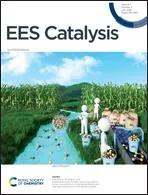
Boosting the catalytic performance of metal–zeolite catalysts in the hydrocracking of polyolefin wastes by optimizing the nanoscale proximity
文献情報
出版日
2023-10-09
DOI
10.1039/D3EY00180F
インパクトファクター
0
著者
Xinlei Han, Xinru Zhou, Tuo Ji, Feng Zeng, Weiping Deng, Zhenchen Tang, Rizhi Chen
原文を見る
要旨
Hydrocracking polyolefins using bifunctional metal–zeolite catalysts is a pivotal strategy for the catalytic upcycling of plastic waste to produce value-added fuels. However, the macro-molecular size and stable C–C bond of polyolefins impose major challenges on catalyst design based on noble metal and microporous zeolites. The lack of investigation into the nanoscale proximity between Pt and USY has hindered the development of an evolving generation of catalysts. Herein, we report Pt/USY prepared by colloid-immobilization method with Pt nanoparticles exclusively located on the surface of USY is a superior catalyst (>50% higher activity) compared to its analogues that have Pt inside or away from USY crystalline, reaching a selectivity to gasoline (C5–12) over 90%. The formation rate of liquid products reaches 6122 gliquid gPt−1 h−1 and 5048 gliquid gPt−1 h−1 in hydrocracking polyethylene (PE) and polypropylene (PP) at 280 °C, respectively. The hydrocracking of model alkanes with different molecular sizes demonstrates the nanoscale Pt-USY proximity as a key criterion in optimizing the accessibility and acidic environment of Pt, and the diffusion distance between metal and acid sites. These findings comprise a significant step forward toward rational catalyst design aiming at upcycling plastic waste for sustainable fuel production.
関連文献
Iron-containing poly(ionic liquid) membranes: a heterogeneous Fenton reaction and enhanced anti-fouling ability
2021-12-01
Paper
DOI: 10.1039/D1PY01345A
Organocatalytic sequential ring-opening polymerization of cyclic ester/epoxide and N-sulfonyl aziridine: metal-free and easy access to block copolymers
Huishan Huang, Wenyi Luo, Linlin Zhu, Ying Wang
2021-08-26
Paper
DOI: 10.1039/D1PY00890K
Long-chain polyamide covalent adaptable networks based on renewable ethylene brassylate and disulfide exchange
Charalampos Pronoitis, Minna Hakkarainen, Karin Odelius
2021-09-23
Paper
DOI: 10.1039/D1PY00811K
Sequence-controlled and sequence-defined polypeptoids via the Ugi reaction: synthesis and sequence-driven properties
Yinuo Zhu, Youhua Tao
2021-07-19
Minireview
DOI: 10.1039/D1PY00658D
Poly(para-phenylene) ionomer membranes: effect of methyl and trifluoromethyl substituents
Fanghua Liu, Jinju Ahn, Junpei Miyake
2021-09-15
Paper
DOI: 10.1039/D1PY01141C
Insight into the influence of the polymerization time of polydopamine nanoparticles on their size, surface properties and nanomedical applications
Rania Djermane, Celia Nieto, Julio C. Vargas, Milena Vega, Eva M. Martín del Valle
2021-12-07
Paper
DOI: 10.1039/D1PY01473K
Multisegmented polymers via step-growth and RAFT miniemulsion polymerization
Thiago R. Guimarães, Dewen Zhou, Per B. Zetterlund
2021-09-23
Paper
DOI: 10.1039/D1PY01163D
こちらもおすすめ
化合物よくある質問
3-(5-フェニル-2-ファイル)-プロパン酸の市場動向や研究トレンドはどうですか?
この化合物の市場動向は不明ですが、類似化合物の需要は化学繊維、医薬品、農薬分野で安定しています。研究トレンドとしては、該当化合物の生物学的活性の評価や、その他の...
3465-61-03-(5-Phenyl-2-furyl)...
化合物よくある質問
3- Chloro-1H-indazol-5-olはどのように保存すればよいですか?
3- チロロ-1H-吲唑-5-醇は遮光し、直射日光を避けて、温度は室温を推奨し、密閉容器に保存してください。
885519-34-63-Chloro-1H-indazol-...
849924-76-11,2,3,4,5-Cyclopenta...
化合物よくある質問
L-(1-~13~C)メチオニンの市場動向や研究トレンドはどうですか?
L-(1-~13~C)メチオニンは、医薬品やバイオテクノロジー分野での研究が増加しており、その価格は安定しています。新興研究分野では、代謝解析や遺伝子機能解析で...
81202-04-2L-(1-~13~C)Methionin...
化合物よくある質問
1,3-フェニレンビスメチレンビスアクリレートは安全ですか?
1,3-フェニレンビスメチレンビスアクリレートは一般的に安全ですが、直接皮膚に触れる場合は保護用具を使用することを推奨します。高濃度の蒸気が吸入された場合は呼吸...
22757-16-01,3-Phenylenebis(met...
化合物よくある質問
丹参醇Aはどのように保存すればよいですか?
丹参醇Aは、直射日光を避けて室温で保存し、密栓容器に入れることをお勧めします。適切な保存条件は、安定性を保ち、安全性を確保する上で重要です。
189308-08-5Danshenol A
化合物よくある質問
4-メチル-2-(1,1,1-三フロロ-2-メチルプロパニル)ピリドインとは何ですか?
CAS番号1378865-93-0の4-メチル-2-(1,1,1-三フロロ-2-メチルプロパニル)ピリドインは、合成化学分野で用いられる有機化合物の一種です。こ...
1378865-93-04-Methyl-2-(1,1,1-tr...
化合物よくある質問
N-フェニルベンジル-2-クロロ酢氨を取り扱う際の実験室安全事項は何ですか?
N-フェニルベンジル-2-クロロ酢氨は毒性があり、皮膚や粘膜に刺激を与えます。取り扱う際には、保護眼鏡、手袋、ゴーグルを着用することを強く推奨します。ドラフトチ...
2653-14-7N-benzyl-2-chloro-N-...
化合物よくある質問
UCN-02を取り扱う際の実験室安全事項は何ですか?
UCN-02は毒性は低いですが、人体への直接的な接触は避けるべきです。PPE要件はグローブと顔面保護具を着用することです。ドラフトチャンバーを使用して漏洩を処理...
121569-61-7UCN-02
化合物よくある質問
N-[3-[2-(二甲基氨基)乙氧基]-4-甲氧基苯基]-2'-甲基-4'-(5-甲基-1,2,4-恶二唑-3-基)-[1,1'-联苯]-4-甲酰胺を取り扱う際の実験室安全事項は何ですか?
手袋と保護眼鏡を着用し、漏洩時には吸気防止装置を使用してください。室温、乾燥した場所に保管し、直日光から隔離してください。SDS(安全データシート)を参照してく...
170230-39-4N-{3-[2-(Dimethylami...
掲載誌
おすすめ化合物
![2,9-Dichloro-5,12-dihydroquinolino[2,3-b]acridine-7,14-dione structure](https://static.chemtradehub.com/structs/308/3089-17-6-750b.webp "2,9-Dichloro-5,12-dihydroquinolino[2,3-b]acridine-7,14-dione structure")
おすすめサプライヤー




免責事項
このページに表示される学術雑誌情報は、参考および研究目的のみを目的としています。当社は雑誌出版社とは提携しておらず、投稿の取り扱いも行っておりません。出版に関するお問い合わせは、各雑誌出版社に直接ご連絡ください。
表示されている情報に誤りがある場合は、support@chemtradehub.com までご連絡ください。迅速に確認し、対応いたします。