


Low-concentration methane removal: what can we learn from high-concentration methane conversion?
文献情報
出版日
2023-07-20
DOI
10.1039/D3CY00810J
インパクトファクター
6.119
著者
Yun Wang, Haiyuan Zhang, Jie Zhang, Yijie Fu, Yuyin Wang, Yang Bai, Xin Feng, Jiahua Zhu, Xiaohua Lu, Liwen Mu, Wei Li
原文を見る
要旨
Methane (CH4) is the world's second most potent greenhouse gas after carbon dioxide (CO2). Removal of low concentrations of CH4 from the environment by an advanced oxidation process (i.e., total oxidation to CO2) powered by solar energy is attractive. However, studies of solar-driven methane oxidation have focused on the selective conversion of CH4 to high-value chemicals, where methane usually occurs in high concentrations. In this paper, the related work of selective conversion of high-concentration CH4 is introduced first, and the mechanism of selective conversion of CH4 is discussed. The “bad” reaction (i.e., total oxidation to CO2) reported in selective conversion of high concentration CH4 is pointed out, hoping to guide the related work of removal of low concentration CH4.
おすすめジャーナル

Herald of the Russian Academy of Sciences

Electroanalysis

NDT & E International

Bioorganic & Medicinal Chemistry

Polycyclic Aromatic Compounds

Medicinal Chemistry Research

Journal of Asian Natural Products Research

Main Group Chemistry

Critical Reviews in Solid State and Materials Sciences

Journal of Chemical Sciences
関連文献
Investigation by two-color IR dissociation spectroscopy of Hoogsteen-type binding in a metalated nucleobase pair mimic
2013-04-05
Paper
DOI: 10.1039/C3CP44283G
Elucidation of structure and nature of the PdO–Pd transformation using in situ PDF and XAS techniques
Jonathan Keating, Gopinathan Sankar, Timothy I. Hyde, Shinji Kohara, Koji Ohara
2013-04-26
Paper
DOI: 10.1039/C3CP50600B
Organic spin-valves: from unipolar to bipolar devices
Z. Valy Vardeny
2013-04-25
Perspective
DOI: 10.1039/C3CP50639H
Morphology dependent oxygen reduction activity of titanium carbide: bulk vs. nanowires
Vankayala Kiran, Kancharlapalli Srinivasu, Srinivasan Sampath
2013-04-03
Paper
DOI: 10.1039/C3CP50731A
Accurate determination of the ultrafast proton transfer rate in porphycene using nuclear spin relaxation
Piotr Bernatowicz
2013-04-09
Paper
DOI: 10.1039/C3CP50963J
Confirmation of disordered structure of ultrasmall CdSe nanoparticles from X-ray atomic pair distribution function analysis
Xiaohao Yang, Ahmad S. Masadeh, James R. McBride, Emil S. Božin, Sandra J. Rosenthal
2013-03-12
Paper
DOI: 10.1039/C3CP00111C
The fast Z-scan method for studying working catalytic reactors with high energy X-ray diffraction: ZSM-5 in the methanol to gasoline process
David S. Wragg, Francesca L. Bleken, Matthew G. O'Brien, Marco Di Michiel, Helmer Fjellvåg, Unni Olsbye
2013-03-18
Paper
DOI: 10.1039/C3CP44343D
Speciation of adsorbed CO2 on metal oxides by a new 2-dimensional approach: 2D infrared inversion spectroscopy (2D IRIS)
Sergey Sirotin, Philippe Bazin, Françoise Maugé, Arnaud Travert
2013-04-17
Paper
DOI: 10.1039/C3CP51146D
Intrinsic fluorescence properties of rhodamine cations in gas-phase: triplet lifetimes and dispersed fluorescence spectra
Jean-François Greisch, Michael E. Harding, Mattias Kordel
2013-03-27
Paper
DOI: 10.1039/C3CP44362K
A variable temperature synchrotron X-ray diffraction study of the ferroelastic double perovskite Ba2GdMoO6
Thomas K. Wallace, Ross H. Colman, Abbie C. Mclaughlin
2013-01-03
Paper
DOI: 10.1039/C2CP43732E
こちらもおすすめ
化合物よくある質問
2-氟-4-イオドベンzo酸エチルエステルを取り扱う際の実験室安全事項は何ですか?
2-氟-4-イオドベンzo酸エチルエステルは有機溶媒を用いた反応であり、ドラフトチャンバーでの操作が必要です。漏洩時にはSDS参照の安全措置を講じ、PPE(防護...
205750-82-9Benzoic acid, 2-fluo...
化合物よくある質問
血根碱の主な用途は何ですか?
血根碱は主に医薬分野で利用され、抗炎症や抗がん剤としての潜在的な効果が研究されています。また、化学研究や薬物開発において、新しい薬剤設計の参考となる化合物として...
2447-54-313-Methyl[1,3]benzod...
化合物よくある質問
Methyl 3-methoxythiophene-2-carboxylateの主な用途は何ですか?
Methyl 3-メトキシスチフェン-2-カルボン酸メチルエステルは、薬品合成、染料製造、以及合成中間体としての用途が広がっています。
62353-75-7Methyl 3-methoxythio...
化合物よくある質問
丹磺酰-L-亮氨酸はどのように保存すればよいですか?
丹磺酰-L-亮氨酸は乾燥した場所で、直射日光から保護し、低温(室温以下)で保存してください。密閉容器に入れて保管することをおすすめします。
1100-22-7N-{[5-(Dimethylamino...
化合物よくある質問
5-(苄氧基)ピラミジン-4-アミンの代替品はありますか?
5-(苄氧基)ピラミジン-4-アミンの代替品として、6-メトキシピラミジンや5-フェニルピラミジンなどが挙げられます。これらの化合物は、5-(苄氧基)ピラミジン...
92289-50-45-benzyloxypyrimidin...
化合物よくある質問
8-ヒドロキシノルデコペントアセートの物理化学的性質は何ですか?
8-ヒドロキシノルデコペントアセートはCAS番号84807-87-4の化合物で、分子量は750.02 uです。これは油溶性で、水に溶けにくい特徴があります。反応...
84807-87-4(5Z,8Z,11Z,13E,15S)-...
化合物よくある質問
tert-ブチル(エス)-1-ヒドロキシペンタ-4-エン-2-イルカルバamateの主な用途は何ですか?
tert-ブチル(エス)-1-ヒドロキシペンタ-4-エン-2-イルカルバamateは主に医薬品の合成材料や分析化学の試薬として使用されます。
116613-81-12-Methyl-2-propanyl ...
化合物よくある質問
ブコール-L-2-フローヨルブリンについて適切な法規ガイドラインは何ですか?
ブコール-L-2-フローヨルブリン(CAS番号: 1196107-73-9)は、GHS(グローバルハザードアサessmentシステム)に基づく危害分類と表示が求...
1196107-73-92-Bromo-13,13-dimeth...
化合物よくある質問
6-ブロモ-N-環丙基-2-ピリジニニメタンの市場動向や研究トレンドはどうですか
6-ブロモ-N-環丙基-2-ピリジニニメタンは、薬理学研究や合成化学に使用される化合物であり、特に抗ウイルス薬や抗がん薬の開発に注目されています。市場では、薬物...
959237-20-86-Bromo-N-cyclopropy...
化合物よくある質問
RS-AMPÀはどのように保存すればよいですか?
RS-AMPÀは、遮光容器に保存し、室温(15〜25℃)で保管することが推奨されます。高湿や熱は物質を劣化させるため、湿度は50%以下に保つことが重要です。また...
74341-63-2(RS)-AMPA
掲載誌
Catalysis Science & Technology
CiteScore:
5.91
自己引用率:
4.5%
年間論文数:
600
Catalysis Science & Technology is committed to publishing research reporting high-quality, cutting-edge developments across the catalysis community at large. The journal places equal focus on publications from the heterogeneous, homogeneous, thermo-, electro-, photo-, organo- and biocatalysis communities. Works published in the journal feature a balanced mix of fundamental, technology-oriented, experimental, computational, digital and data-driven original research, thus appealing to catalysis practitioners in both academic and industrial environments. Original research articles published in the journal must demonstrate new catalytic discoveries and/or methodological advances that represent a significant advance on previously published work, from the molecular to the process scales. We welcome rigorous research in a wide range of timely or emerging applications related to the environment, health, energy and materials. Catalysis Science & Technology publishes Communications, Articles, Reviews and Perspectives. More details regarding manuscript types may be found in the Information for Authors section.
おすすめ化合物
![(1R)-3-Bromo-1,7,7-trimethylbicyclo[2.2.1]heptan-2-one structure](https://static.chemtradehub.com/structs/102/10293-06-8-dd8a.webp "(1R)-3-Bromo-1,7,7-trimethylbicyclo[2.2.1]heptan-2-one structure")
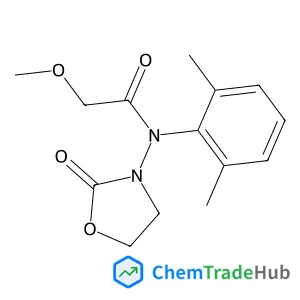
N-(2,6-Dimethylphenyl)-2-methoxy-N-(2-oxo-1,3-oxazolidin-3-yl)acetamide
CAS番号:
77732-09-3
分子式:
C14H18N2O4
おすすめサプライヤー



免責事項
このページに表示される学術雑誌情報は、参考および研究目的のみを目的としています。当社は雑誌出版社とは提携しておらず、投稿の取り扱いも行っておりません。出版に関するお問い合わせは、各雑誌出版社に直接ご連絡ください。
表示されている情報に誤りがある場合は、support@chemtradehub.com までご連絡ください。迅速に確認し、対応いたします。