












Strategies to engineer various nanocarrier-based hybrid catalysts for enhanced chemodynamic cancer therapy
文献情報
出版日
2023-10-24
DOI
10.1039/D3CS00356F
インパクトファクター
54.564
著者
Ji-Na Hao, Kaiming Ge, Guoli Chen, Bin Dai
原文を見る
要旨
Chemodynamic therapy (CDT) is a newly developed cancer-therapeutic modality that kills cancer cells by the highly toxic hydroxyl radical (˙OH) generated from the in situ triggered Fenton/Fenton-like reactions in an acidic and H2O2-overproduced tumor microenvironment (TME). By taking the advantage of the TME-activated catalytic reaction, CDT enables a highly specific and minimally-invasive cancer treatment without external energy input, whose efficiency mainly depends on the reactant concentrations of both the catalytic ions and H2O2, and the reaction conditions (including pH, temperature, and amount of glutathione). Unfortunately, it suffers from unsatisfactory therapy efficiency for clinical application because of the limited activators (i.e., mild acid pH and insufficient H2O2 content) and overexpressed reducing substance in TME. Currently, various synergistic strategies have been elaborately developed to increase the CDT efficiency by regulating the TME, enhancing the catalytic efficiency of catalysts, or combining with other therapeutic modalities. To realize these strategies, the construction of diverse nanocarriers to deliver Fenton catalysts and cooperatively therapeutic agents to tumors is the key prerequisite, which is now being studied but has not been thoroughly summarized. In particular, nanocarriers that can not only serve as carriers but are also active themselves for therapy are recently attracting increasing attention because of their less risk of toxicity and metabolic burden compared to nanocarriers without therapeutic capabilities. These therapy-active nanocarriers well meet the requirements of an ideal therapy system with maximum multifunctionality but minimal components. From this new perspective, in this review, we comprehensively summarize the very recent research progress on nanocarrier-based systems for enhanced CDT and the strategies of how to integrate various Fenton agents into the nanocarriers, with particular focus on the studies of therapy-active nanocarriers for the construction of CDT catalysts, aiming to guide the design of nanosystems with less components and more functionalities for enhanced CDT. Finally, the challenges and prospects of such a burgeoning cancer-theranostic modality are outlooked to provide inspirations for the further development and clinical translation of CDT.
関連文献
Base-promoted cascade reaction of isocyanides, selenium and amines: a practical approach to 2-aminobenzo[d][1,3]selenazines under metal-free conditions
Yi Fang, Shun-Yi Wang, Xiao-Bin Shen, Shun-Jun Ji
2015-07-28
Research Article
DOI: 10.1039/C5QO00150A
Gold-catalyzed tandem synthesis of bioactive spiro-dipyrroloquinolines and its application in the one-step synthesis of incargranine B aglycone and seneciobipyrrolidine (I)
Can-Liang Ma, Xiao-Hua Li, Xiao-Long Yu, Xiao-Long Zhu, Yong-Zhou Hu, Xiao-Wu Dong, Bin Tan, Xin-Yuan Liu
2016-01-06
Research Article
DOI: 10.1039/C5QO00354G
Fluorescent nanoassemblies between tetraphenylethenes and sulfonatocalixarenes: a systematic study of calixarene-induced aggregation
Yan-Cen Liu, Yu-Ying Wang, Han-Wen Tian, Yu Liu, Dong-Sheng Guo
2015-11-13
Research Article
DOI: 10.1039/C5QO00326A
Regiospecific synthesis of distally chlorinated ketones via C–C bond cleavage of cycloalkanols
Xuefeng Fan, Huijun Zhao, Jiajia Yu, Xiaoguang Bao
2015-12-10
Research Article
DOI: 10.1039/C5QO00368G
Transformable nanostructures of cholesteryl-containing rhomboidal metallacycles through hierarchical self-assembly
Li-Jun Chen, Bo Jiang, Hai-Bo Yang
2016-03-01
Research Article
DOI: 10.1039/C6QO00017G
Metal-free oxidative hydrophosphinylation of 1,7-enynes
De-Cai Wang, Bo Jiang, Wen-Juan Hao, Ping Wei, Ai-Fang Wang, Shu-Jiang Tu
2016-01-25
Research Article
DOI: 10.1039/C5QO00430F
Direct construction of chiral quaternary dihydropyranones through highly enantioselective organocatalytic hetero-Diels–Alder reactions of olefinic azlactones
Tai-Ping Gao, Dan Liu, Jun-Bing Lin, Xiu-Qin Hu, Zhu-Yin Wang, Peng-Fei Xu
2016-03-03
Research Article
DOI: 10.1039/C6QO00018E
Palladium-catalyzed decarboxylative alkoxycarbonylation of potassium aryltrifluoroborates with potassium oxalate monoesters
Jinmin Miao, Ping Fang, Sahota Jagdeep, Haibo Ge
2015-12-11
Research Article
DOI: 10.1039/C5QO00349K
Studies towards the synthesis of the functionalized C3–C14 decalin framework of alchivemycin A
Shaoqiang Yang, Xiaofei Li
2015-12-21
Research Article
DOI: 10.1039/C5QO00343A
K2S2O8-mediated metal-free direct C–H functionalization of quinones using arylboronic acids
Andivelu Ilangovan, Ashok Polu, Gandhesiri Satish
2015-10-15
Research Article
DOI: 10.1039/C5QO00246J
こちらもおすすめ
化合物よくある質問
1-{3-[5-(エチルカルボンイル)-2,4-ジメチル-1H-ピロロール-3-基]プロパニル}ピペリジン-4-カルボン酸について、適用される法規ガイドラインは何ですか?
この化合物はCAS番号1142209-81-1であり、GHS分類では corrosive (腐食性物質) と classified (分類物質) として指定され...
1142209-81-11-{3-[5-(Ethoxycarbo...
化合物よくある質問
2,2-二氟-1,3-ベンゾジオキサン-5-カルボキシlic酸とは何ですか?
2,2-二氟-1,3-ベンゾジオキサン-5-カルボキシlic酸は、CAS番号656-46-2の化合物で、化学式はC8H4F2O4です。この化合物は白色の結晶性粉...
656-46-22,2-Difluoro-1,3-ben...
化合物よくある質問
8-氯-4-色原酮の代替品はありますか?
8-氯-4-色原酮(CAS番号: 49701-11-3)の代替品には、他の色原酮類似物や、構造が似ている化合物があります。例えば、8-メチル-4-色原酮や、他の...
49701-11-38-Chloro-2,3-dihydro...
化合物よくある質問
エチル6,6-ジメチル-4,5,6,7-テトラヒドロ-1H-インドアゼー-3-カルボキシレートとは何ですか?
エチル6,6-ジメチル-4,5,6,7-テトラヒドロ-1H-インドアゼー-3-カルボキシレートは、CAS番号1233243-56-5を有する化合物です。これは有...
1233243-56-5Ethyl 6,6-dimethyl-4...
化合物よくある質問
4-叔丁基-6-氯-嘧啶に適用される法規ガイドラインは何ですか?
4-叔丁基-6-氯-嘧啶はCAS番号3435-24-3で、GHS分類では毒性物質とみなし、GHSの危険性分類が適用されます。REACH規則では登録が必要で、Eu...
3435-24-34-Tert-butyl-6-chlor...
化合物よくある質問
維库溴铵杂质Bはどのように合成されますか?
維库溴铵杂质Bは、アンドロステンデンから始まり、一連の合成反応、包括的な選択性と高い収率で合成されます。具体的には、ブロミド化、酸化、ジマーゼ反応、アミド化など...
50587-95-6(2beta,3alpha,5alpha...
化合物よくある質問
2-(4-氟苄基)-吡咯烷の物理化学的性質は何ですか?
CAS番号350017-04-8の2-(4-氟苄基)-吡咯烷は、結晶性の白色粉末です。分子量は199.17 g/molで、水に溶けにくいです。化学反応では比較的...
350017-04-82-(4-Fluorobenzyl)py...
化合物よくある質問
3-喹啉甲醛(2-チロール-8-エチル)は安全ですか?
3-喹啉甲醛(2-チロール-8-エチル)は一定の毒性を持つため、取扱には注意が必要です。使用する際は適切な防護具を着用し、密閉容器で保管・搬送し、直接的な接触を...
335196-05-92-Chloro-8-ethyl-3-q...
化合物よくある質問
エチル3-(ヒドロキシメチル)-1H-ピロール-2-カルボキシレートはどのように保存すればよいですか?
エチル3-(ヒドロキシメチル)-1H-ピロール-2-カルボキシレートは、室温(25℃)以下で保存し、直射日光を避け、乾燥した環境で保管することが推奨されます。ま...
75448-69-0Ethyl 3-(hydroxymeth...
119410-05-88-Chloro-11-(4-piper...
掲載誌
Chemical Society Reviews

CiteScore:
80.8
自己引用率:
1.2%
年間論文数:
250
Chem Soc Rev publishes review articles covering important topics at the forefront of the chemical sciences. Reviews should be of the very highest quality and international impact. We particularly encourage international and multidisciplinary collaborations among our authors. Our scope covers the breadth of the chemical sciences, including interdisciplinary topics where the article has a basis in chemistry. Topics include: Analytical chemistry Biomaterials chemistry Bioorganic/medicinal chemistry Catalysis Chemical Biology Coordination Chemistry Crystal Engineering Energy Sustainable chemistry Green chemistry Inorganic chemistry Inorganic materials Main group chemistry Nanoscience Organic chemistry Organic materials Organometallics Physical chemistry Supramolecular chemistry Synthetic methodology Theoretical and computational chemistry
おすすめ化合物

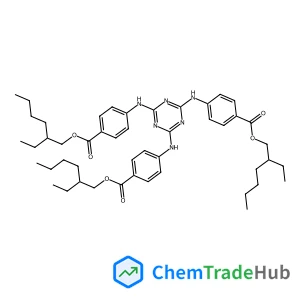
Tris(2-ethylhexyl) 4,4',4''-(1,3,5-triazine-2,4,6-triyltriimino)tribenzoate
CAS番号:
88122-99-0
分子式:
C48H66N6O6
![2-{3-[4-(3-Chlorophenyl)-1-piperazinyl]propyl}[1,2,4]triazolo[4,3-a]pyridin-3(2H)-one hydrochloride (1:1) structure](https://static.chemtradehub.com/structs/253/25332-39-2-496e.webp "2-{3-[4-(3-Chlorophenyl)-1-piperazinyl]propyl}[1,2,4]triazolo[4,3-a]pyridin-3(2H)-one hydrochloride (1:1) structure")
おすすめサプライヤー




免責事項
このページに表示される学術雑誌情報は、参考および研究目的のみを目的としています。当社は雑誌出版社とは提携しておらず、投稿の取り扱いも行っておりません。出版に関するお問い合わせは、各雑誌出版社に直接ご連絡ください。
表示されている情報に誤りがある場合は、support@chemtradehub.com までご連絡ください。迅速に確認し、対応いたします。