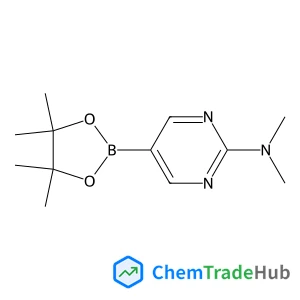
N,N-Dimethyl-5-(4,4,5,5-tetramethyl-1,3,2-dioxaborolan-2-yl)-2-pyrimidinamine
CAS番号:
1032759-30-0
分子式:
C12H20BN3O2
José A. Jiménez, Dugan Hayes, Cali Antolini, Benjamin J. Reinhart
Barium phosphate glasses were prepared with 0.5 mol% Tb4O7 added alongside SnO up to 5 mol% with the purpose of evaluating the resulting terbium and tin oxidation states and their impact on glass structural, thermal, and luminescent properties. Following material synthesis by melt-quenching, the composition-structure–property investigation was pursued encompassing measurements by X-ray diffraction (XRD), X-ray absorption near-edge spectroscopy (XANES), Raman spectroscopy, differential scanning calorimetry (DSC), dilatometry, and photoluminescence (PL) spectroscopy. While XRD confirmed the amorphous nature of the glasses, results from XANES indicated that terbium occurs as terbium(III) with a predisposition for tin to exist as tin(IV) which decreased at high SnO content. The structural as well as the thermal properties appeared to be mostly impacted by the presence of tin(IV). Specifically, glass depolymerization was indicated to be induced by Sn4+ ions, and their concentration was observed to correlate with glass transition and softening temperatures. On the other hand, the tin(II) remnants were observed to exert an impact on the luminescent properties shifting light emission from the green towards the blue-green (cyan). It is indicated that Tb4O7 reacting to produce Tb2O3 supports the oxidation of tin(II) to tin(IV) which in turn dominates the physical properties. However, this was somewhat circumvented at the highest SnO content wherein tin(IV) appeared to be lower.
Youliang Wang, Mingzhu Xia, Kebin Li, Xinlin Shen, Tahir Muhmood, Fengyun Wang
DOI: 10.1039/C6CP90250B
Ana B. Muñoz-García, Michele Pavone
DOI: 10.1039/C6CP05089A
Andrej Junginger, Galen T. Craven, Thomas Bartsch, R. M. Benito, Rigoberto Hernandez
DOI: 10.1039/C6CP02519F
Yi-Jung Tu, Matthew J. Allen, G. Andrés Cisneros
DOI: 10.1039/C6CP04957E
Xiaofeng Li, Hanyu Liu, Feng Peng
DOI: 10.1039/C6CP05702K
Pushpendra Kumar, Suman Kalyan Pal
DOI: 10.1039/C6CP04610J
Bernhard Frick, Johannes Elbert, Markus Gallei, Bernd Stühn
DOI: 10.1039/C6CP05156A
Andrew G. Stack, Jose M. Borreguero, Timothy R. Prisk, Eugene Mamontov, Hsiu-Wen Wang, Lukas Vlcek, David J. Wesolowski
DOI: 10.1039/C6CP05836A
Thomas W. Keal, Paul Sherwood, Alexey A. Sokol
DOI: 10.1039/C6CP04622C
C. Satriano, G. Forte, A. Magrì, P. Di Pietro, A. Travaglia, G. Pandini, F. Gianì, D. La Mendola
DOI: 10.1039/C6CP05476E
6- bromo-1-cyclopropyl-1H-benzimidazoleは、抗炎症、抗ウイルス作用を持つことが報告されており、新薬開発の研究対象として注目...
取り扱う際には、防護眼鏡と手袋を使用し、ドラフトチャンバー内で操作することを推奨します。漏洩時には適切な手順で処理し、安全データシートを常に参照してください。
2,2’-ジメチル-3,3’-ビピリジンは、ピリジンと2-メチルアクリルアミドを有機合成反応で合成します。この反応では、ピリジンと2-メチルアクリルアミドを含有...
6-甲基ピリジン-2-ボリック酸は、合成化学、医薬品合成、以及研究用途などに広く使用され、特に組換えDNA技術や分子生物学の研究において重要な役割を果たします。
(R)-3-(1-甲基-2-氧環己基)プロpano酸メチルは一定の安全性がありますが、直接的な皮膚接触や吸入は避けるべきです。使用する際は適切な個々の安全データ...
ketorolacは、密封して遮光容器に保管し、直射日光や高温を避けて保存してください。温度は常温で保存し、湿度をなるべく低く保つことが推奨されます。
L-2,3-二氨基丙酸二盐酸盐は腐食性が強く、皮膚や粘膜に刺激を与える可能性があります。取り扱う際は、防塵マスク、ゴーグル、手袋を使用し、適切な排気設備を使用し...
2-(4-溴ピリジン-2-基)乙腈のCAS番号は312325-73-8です。主に結晶形態で存在し、分子量は159.01 g/molです。この化合物は水に溶けやす...
この化合物は毒性は低いですが、直接的な接触や吸入に注意が必要です。PPE(個人防護具)を着用し、ドラフトチャンバーを使用して操作することを推奨します。また、漏洩...
3-(1-氧代-1,3-二氢-2H-2-异吲哚)丙酸は、薬理学研究や医薬品製造において広く用いられる化合物です。また、工業的な用途でも一部の化学反応の触媒や助剤...

Physical Chemistry Chemical Physics (PCCP) is an international journal co-owned by 19 physical chemistry and physics societies from around the world. This journal publishes original, cutting-edge research in physical chemistry, chemical physics and biophysical chemistry. To be suitable for publication in PCCP, articles must include significant innovation and/or insight into physical chemistry; this is the most important criterion that reviewers and Editors will judge against when evaluating submissions. The journal has a broad scope and welcomes contributions spanning experiment, theory, computation and data science. Topical coverage includes spectroscopy, dynamics, kinetics, statistical mechanics, thermodynamics, electrochemistry, catalysis, surface science, quantum mechanics, quantum computing and machine learning. Interdisciplinary research areas such as polymers and soft matter, materials, nanoscience, energy, surfaces/interfaces, and biophysical chemistry are welcomed if they demonstrate significant innovation and/or insight into physical chemistry. Joined experimental/theoretical studies are particularly appreciated when complementary and based on up-to-date approaches.