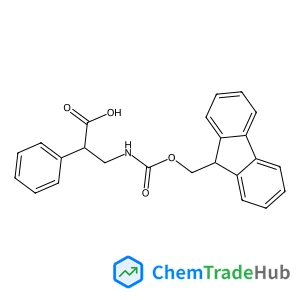
(S)-3-((((9H-Fluoren-9-yl)methoxy)carbonyl)amino)-2-phenylpropanoic acid
CAS番号:
1217663-60-9
分子式:
C24H21NO4
Andrej Junginger, Galen T. Craven, Thomas Bartsch, R. M. Benito, Rigoberto Hernandez
Reaction rates across time-dependent barriers are difficult to define and difficult to obtain using standard transition state theory approaches because of the complexity of the geometry of the dividing surface separating reactants and products. Using perturbation theory (PT) or Lagrangian descriptors (LDs), we can obtain the transition state trajectory and the associated recrossing-free dividing surface. With the latter, we are able to determine the exact reactant population decay and the corresponding rates to benchmark the PT and LD approaches. Specifically, accurate rates are obtained from a local description regarding only direct barrier crossings and to those obtained from a stability analysis of the transition state trajectory. We find that these benchmarks agree with the PT and LD approaches for obtaining recrossing-free dividing surfaces. This result holds not only for the local dynamics in the vicinity of the barrier top, but also for the global dynamics of particles that are quenched at the reactant or product wells after their sojourn over the barrier region. The double-well structure of the potential allows for long-time dynamics related to collisions with the outside walls that lead to long-time returns in the low-friction regime. This additional global dynamics introduces slow-decay pathways that do not result from the local transition across the recrossing-free dividing surface associated with the transition state trajectory, but can be addressed if that structure is augmented by the population transfer of the long-time returns.
Dušan Ž. Veljković, Michael B. Hall, Edward N. Brothers
DOI: 10.1039/C8CP06312E
Xiaojun Lv, Zexun Han, Hengxing Zhang, Qingsheng Liu, Jiangan Chen, Liangxing Jiang
DOI: 10.1039/C9CP00377K
Qiang Zhu
DOI: 10.1039/C8CP07202G
Md Habib, Ritabrata Sarkar, Santu Biswas, Anup Pramanik, Pranab Sarkar, Sougata Pal
DOI: 10.1039/C9CP00133F
Olaf W. Morawski, Andrzej L. Sobolewski, Daniel T. Gryko
DOI: 10.1039/C9CP00978G
Yu Chen, Junyi Liu, Jiabing Yu
DOI: 10.1039/C8CP04669G
Stefano Di Stefano, Luigi Mandolini
DOI: 10.1039/C8CP06344C
Xiang Liu, Wenbo Mi
DOI: 10.1039/C9CP00033J
Luca Grisanti, Sara Laporte, Marco Micciarelli, Marta Rosa, Rebecca J. Robbins, Tom Collins, Alessandra Magistrato
DOI: 10.1039/C9CP00747D
Sergei Manzhos, Amrita Pal, Yingqian Chen, Giacomo Giorgi
DOI: 10.1039/C9CP01348B
6- bromo-1-cyclopropyl-1H-benzimidazoleは、抗炎症、抗ウイルス作用を持つことが報告されており、新薬開発の研究対象として注目...
取り扱う際には、防護眼鏡と手袋を使用し、ドラフトチャンバー内で操作することを推奨します。漏洩時には適切な手順で処理し、安全データシートを常に参照してください。
2,2’-ジメチル-3,3’-ビピリジンは、ピリジンと2-メチルアクリルアミドを有機合成反応で合成します。この反応では、ピリジンと2-メチルアクリルアミドを含有...
6-甲基ピリジン-2-ボリック酸は、合成化学、医薬品合成、以及研究用途などに広く使用され、特に組換えDNA技術や分子生物学の研究において重要な役割を果たします。
(R)-3-(1-甲基-2-氧環己基)プロpano酸メチルは一定の安全性がありますが、直接的な皮膚接触や吸入は避けるべきです。使用する際は適切な個々の安全データ...
ketorolacは、密封して遮光容器に保管し、直射日光や高温を避けて保存してください。温度は常温で保存し、湿度をなるべく低く保つことが推奨されます。
L-2,3-二氨基丙酸二盐酸盐は腐食性が強く、皮膚や粘膜に刺激を与える可能性があります。取り扱う際は、防塵マスク、ゴーグル、手袋を使用し、適切な排気設備を使用し...
2-(4-溴ピリジン-2-基)乙腈のCAS番号は312325-73-8です。主に結晶形態で存在し、分子量は159.01 g/molです。この化合物は水に溶けやす...
この化合物は毒性は低いですが、直接的な接触や吸入に注意が必要です。PPE(個人防護具)を着用し、ドラフトチャンバーを使用して操作することを推奨します。また、漏洩...
3-(1-氧代-1,3-二氢-2H-2-异吲哚)丙酸は、薬理学研究や医薬品製造において広く用いられる化合物です。また、工業的な用途でも一部の化学反応の触媒や助剤...

Physical Chemistry Chemical Physics (PCCP) is an international journal co-owned by 19 physical chemistry and physics societies from around the world. This journal publishes original, cutting-edge research in physical chemistry, chemical physics and biophysical chemistry. To be suitable for publication in PCCP, articles must include significant innovation and/or insight into physical chemistry; this is the most important criterion that reviewers and Editors will judge against when evaluating submissions. The journal has a broad scope and welcomes contributions spanning experiment, theory, computation and data science. Topical coverage includes spectroscopy, dynamics, kinetics, statistical mechanics, thermodynamics, electrochemistry, catalysis, surface science, quantum mechanics, quantum computing and machine learning. Interdisciplinary research areas such as polymers and soft matter, materials, nanoscience, energy, surfaces/interfaces, and biophysical chemistry are welcomed if they demonstrate significant innovation and/or insight into physical chemistry. Joined experimental/theoretical studies are particularly appreciated when complementary and based on up-to-date approaches.