












![Ethyl thieno[3,2-f]quinoline-2-carboxylate structure](https://static.chemtradehub.com/structs/299/29948-26-3-f62b.webp "Ethyl thieno[3,2-f]quinoline-2-carboxylate structure")
Regioselective synthesis of indazolo[2,3-a]quinazolines enabled by I2/S-facilitated annulation relay dehydrogenative aromatization of cyclohexanones
文献情報
出版日
2023-10-26
DOI
10.1039/D3CC04698B
インパクトファクター
6.222
著者
Qinghe Gao, Yimei Guo, Penghui Cao, Guangping Fan, Yongtao Xu
原文を見る
要旨
A method for concise and efficient synthesis of indazolo[2,3-a]quinazolines has been developed via a sequential annulation of 3-aminoindazoles and dehydrogenative aromatization of cyclohexanones. This high regioselectivity is attributed to the fact that the Mannich reaction is superior to the aldol reaction in this system. It is worth mentioning that this convenient process is successfully extended to 3-aminopyrazoles for assembling another class of medicinally prevalent pyrazolo[1,5-a]quinazolines.
関連文献
Intermolecular structure and hydrogen-bonding in liquid 1,2-propylene carbonate and 1,2-glycerol carbonate determined by neutron scattering
Yoan M. Delavoux, Mark Gilmore, Martin P. Atkins, Małgorzata Swadźba-Kwaśny, John D. Holbrey
2016-12-15
Paper
DOI: 10.1039/C6CP07790K
Infrared characterisation of acetonitrile and propionitrile aerosols under Titan's atmospheric conditions
C. Ennis, R. Auchettl, M. Ruzi, E. G. Robertson
2017-01-12
Paper
DOI: 10.1039/C6CP08110J
Excited state proton transfer in 2′-hydroxychalcone derivatives
Michael Dommett, Rachel Crespo-Otero
2016-12-22
Paper
DOI: 10.1039/C6CP07541J
Electronic properties of layered phosphorus heterostructures
Ruge Quhe, Shenyan Feng, Ming Lei
2016-12-02
Paper
DOI: 10.1039/C6CP06583J
Probing nonlinear optical coefficients in self-assembled peptide nanotubes
Soma Khanra, Kartik Ghosh, Fabio F. Ferreira, Wendel A. Alves, Francesco Punzo, Ping Yu, Suchismita Guha
2017-01-04
Paper
DOI: 10.1039/C6CP07879F
Electrochemical polypyrrole formation from pyrrole ‘adlayer’
Deivis Plausinaitis, Linas Sinkevicius, Lina Mikoliunaite, Valentina Plausinaitiene, Almira Ramanaviciene
2016-11-22
Paper
DOI: 10.1039/C6CP06545G
The impact of the structuring of hydrotropes in water on the mesoscale solubilisation of a third hydrophobic component
Thomas Buchecker, Sebastian Krickl, Robert Winkler, Isabelle Grillo, Pierre Bauduin, Didier Touraud, Arno Pfitzner, Werner Kunz
2016-11-30
Paper
DOI: 10.1039/C6CP06696H
Jahn–Teller effect in LiMn2O4: influence on charge ordering, magnetoresistance and battery performance
K. Ragavendran, H. Xia, P. Mandal, A. K. Arof
2016-12-12
Paper
DOI: 10.1039/C6CP07289E
The strongest CO binding and the highest C–O stretching frequency
Ranajit Saha, Sudip Pan, Gernot Frenking, Pratim K. Chattaraj, Gabriel Merino
2016-12-14
Paper
DOI: 10.1039/C6CP06824C
Structural, elastic, electronic, and optical properties of the tricycle-like phosphorene
Yang Zhang, Zhi-Feng Wu, Peng-Fei Gao, Dang-Qi Fang, Er-Hu Zhang, Sheng-Li Zhang
2016-12-12
Paper
DOI: 10.1039/C6CP07575D
こちらもおすすめ
化合物よくある質問
4'-ブロモビフェニル-3-メトークシーディ.ActionBarはどのように保存すればよいですか?
4'-ブロモビフェニル-3-メトークシーディ.ActionBarは、冷暗所で、直射日光を避け、密栓の容器に保存し、遠隔場所に保管してください。温度は常温(0〜2...
149506-25-24'-Bromo-biphenyl-3-...
2947-60-6(3-Methylphenyl)acet...
化合物よくある質問
2-異丙基フェニルヒドラジン塩酸塩とは何ですか?
2-異丙基フェニルヒドラジン塩酸塩は、CAS番号58928-82-8を有する化合物で、構造式はC11H14N2HClです。これは塩基性化合物であり、水に溶けやす...
58928-82-8(2-Isopropylphenyl)h...
化合物よくある質問
5-(4-クロロフェニル)-4H-1,2,4-三氮唑-3-アミンを取り扱う際の実験室安全事項は何ですか?
5-(4-クロロフェニル)-4H-1,2,4-三氮唑-3-アミンは取り扱いに注意が必要です。PPEとして防塵マスク、ゴーグル、手袋を使用し、ドラフトチャンバーを...
98554-00-85-(4-Chlorophenyl)-1...
化合物よくある質問
去甲基雷贝拉唑硫醚はどのように合成されますか?
去甲基雷贝拉唑硫醚は、ベンジミダゾール硫化物と3-メチル-4-ピリジノールの反応によって合成されます。具体的には、2-チオキシドベンジミダゾールと3-メチル-4...
117976-91-73-({2-[(1H-Benzimida...
化合物よくある質問
2-ブロモ-5-フロロ-N-(2-フェノールメチル)ベンゼンウレアは安全ですか?
2-ブロモ-5-フロロ-N-(2-フェノールメチル)ベンゼンウレアは、毒性や刺激性の実験データに基づき、適切な取扱いと防護措置を講じることで安全に使用できます。...
923722-86-52-Bromo-5-fluoro-N-(...
化合物よくある質問
対甲苯磺酸酯-四聚乙二醇-四氢吡喃醚の物理化学的性質は何ですか?
対甲苯磺酸酯-四聚乙二醇-四氢吡喃醚のCAS番号は86259-89-4です。この化合物は無色の液体で、分子量は約724.8です。高濃度では溶血性が報告されており...
86259-89-42-(2-{2-[2-(Tetrahyd...
化合物よくある質問
2-(3-(二氟甲基)-4-氟苯基)-4,4,5,5-四甲基-1,3,2-二噁硼戊環はどのように保存すればよいですか?
2-(3-(二氟甲基)-4-氟苯基)-4,4,5,5-四甲基-1,3,2-二噁硼戊環は、室温で暗い場所に保管し、直射日光から遠ざけ、容器は密閉状態で保存してくだ...
445303-65-12-[3-(difluoromethyl...
化合物よくある質問
6-アミノ-5-クロロ-2-シクロプロピルピリミジンカルボン酸の代替品はありますか?
この化合物の代替品には、ピロリミジン酸やその類似物、またピロリミジンカルボン酸の他の異性体があります。これらの代替品は、特定の化学反応や目的に応じて選択すること...
858956-08-86-Amino-5-chloro-2-c...
化合物よくある質問
5-クロロベンゾ[1,3]二オキセイン-4-アミンに適用される法規ガイドラインは何ですか?
5-クロロベンゾ[1,3]二オキセイン-4-アミンはCAS番号379228-45-2に該当します。この化合物はGHS分類でH314(接触により急性毒性がある)と...
379228-45-25-Chloro-1,3-benzodi...
掲載誌
Chemical Communications

CiteScore:
8.6
自己引用率:
4.7%
年間論文数:
2458
ChemComm publishes urgent research which is of outstanding significance and interest to experts in the field, while also appealing to the journal’s broad chemistry readership. Our communication format is ideally suited to short, urgent studies that are of such importance that they require accelerated publication. Our scope covers all topics in chemistry, and research at the interface of chemistry and other disciplines (such as materials science, nanoscience, physics, engineering and biology) where there is a significant novelty in the chemistry aspects. Major topic areas covered include: Analytical Chemistry Catalysis Chemical Biology and medicinal chemistry Computational Chemistry and Machine Learning Energy and sustainable chemistry Environmental Chemistry Green Chemistry Inorganic Chemistry Materials Chemistry Nanoscience Organic Chemistry Physical Chemistry Polymer Chemistry Supramolecular Chemistry
おすすめ化合物
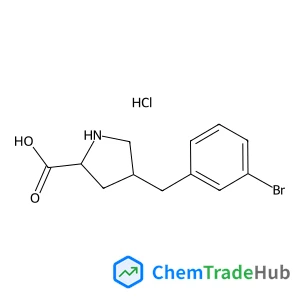
(2S,4R)-4-(3-Bromobenzyl)pyrrolidine-2-carboxylic acid hydrochloride
CAS番号:
1049734-10-2
分子式:
C12H15BrClNO2

![Ethyl ({[(2-methyl-2-propanyl)oxy]carbonyl}amino)(2-pyridinyl)acetate structure](https://static.chemtradehub.com/structs/313/313490-90-3-dd15.webp "Ethyl ({[(2-methyl-2-propanyl)oxy]carbonyl}amino)(2-pyridinyl)acetate structure")
Ethyl ({[(2-methyl-2-propanyl)oxy]carbonyl}amino)(2-pyridinyl)acetate
CAS番号:
313490-90-3
分子式:
C14H20N2O4

おすすめサプライヤー






免責事項
このページに表示される学術雑誌情報は、参考および研究目的のみを目的としています。当社は雑誌出版社とは提携しておらず、投稿の取り扱いも行っておりません。出版に関するお問い合わせは、各雑誌出版社に直接ご連絡ください。
表示されている情報に誤りがある場合は、support@chemtradehub.com までご連絡ください。迅速に確認し、対応いたします。