












![2-{3-[4-(3-Chlorophenyl)-1-piperazinyl]propyl}[1,2,4]triazolo[4,3-a]pyridin-3(2H)-one hydrochloride (1:1) structure](https://static.chemtradehub.com/structs/253/25332-39-2-496e.webp "2-{3-[4-(3-Chlorophenyl)-1-piperazinyl]propyl}[1,2,4]triazolo[4,3-a]pyridin-3(2H)-one hydrochloride (1:1) structure")
Recent advances in the design of afterglow materials: mechanisms, structural regulation strategies and applications
文献情報
出版日
2023-10-26
DOI
10.1039/D2CS00993E
インパクトファクター
54.564
著者
Geoffrey I. N. Waterhouse, Siyu Lu
原文を見る
要旨
Afterglow materials are attracting widespread attention owing to their distinctive and long-lived optical emission properties which create exciting opportunities in various fields. Recent research has led to the discovery of many new afterglow materials featuring high photoluminescence quantum yields (PLQY) and lifetimes of up to several hours under ambient conditions. Afterglow materials are typically categorized according to their luminescence mechanism, such as long-persistent luminescence (LPL), room temperature phosphorescence (RTP), or thermally activated delayed fluorescence (TADF). Through rational design and novel synthetic strategies to modulate spin–orbit coupling (SOC) and populate triplet exciton states (T1), luminophores with long lifetimes and bright afterglow characteristics can be realized. Initial research towards afterglow materials focused mainly on pure inorganic materials, many of which possessed inherent disadvantages such as metal toxicity or low energy emissions. In recent years, organic–inorganic hybrid afterglow materials (OIHAMs) have been developed with high PLQY and long lifetimes. These hybrid materials exploit the tunable structure and easy processing of organic molecules, as well as enhanced SOC and intersystem crossing (ISC) processes involving heavy atom dopants, to achieve excellent afterglow performance. In this review, we begin by briefly discussing the structure and composition of inorganic and organic–inorganic hybrid afterglow materials, including strategies for regulating their lifetime, PLQY and luminescence wavelength. The specific advantages of organic–inorganic hybrid afterglow materials, including low manufacturing costs, diverse molecular/electronic structures, tunable structures and optical properties, and compatibility with a variety of substrates, are emphasized. Subsequently, we discuss in detail the fundamental mechanisms used by afterglow materials, their classification, design principles, and end applications (including sensing, anticounterfeiting, and photoelectric devices, among others). Finally, existing challenges and promising future directions are discussed, laying a platform for the design of afterglow materials for specific applications.
関連文献
Selectfluor promoted NHC–oxazoline gold(i) complex catalyzed cycloaddition/oxidation reaction of enynones with alkenes
Qin Xu, Peng Gu, Feijun Wang
2015-09-02
Research Article
DOI: 10.1039/C5QO00155B
Epoxy and aziridinyl enolsilanes in diastereoselective inter- and intramolecular Friedel–Crafts alkylations
Sze Kui Lam, Brian Lo, Wing-Tak Wong, Jian Sun, Guanhua Chen
2016-02-12
Research Article
DOI: 10.1039/C5QO00333D
Synthesis of α-enamino esters via Cu(ii)-promoted dehydrogenation of α-amino acid esters: application to the synthesis of polysubstituted pyrroles
Nini Zhou, Zhongle Li, Zhixiang Xie
2015-09-29
Research Article
DOI: 10.1039/C5QO00182J
Reactivity and mechanistic insight into the cross coupling reaction between isochromans and β-keto esters through C–H bond activation under visible light irradiation
Ming Xiang, Qing-Yuan Meng, Xue-Wang Gao, Tao Lei, Bin Chen, Chen-Ho Tung, Li-Zhu Wu
2016-02-10
Research Article
DOI: 10.1039/C5QO00412H
Studies towards the synthesis of the functionalized C3–C14 decalin framework of alchivemycin A
Shaoqiang Yang, Xiaofei Li
2015-12-21
Research Article
DOI: 10.1039/C5QO00343A
Recent advances in transition metal-catalysed hydroacylation of alkenes and alkynes
Avipsa Ghosh, Kirsten F. Johnson, Kevin L. Vickerman, James A. Walker, Jr., Levi M. Stanley
2016-02-11
Highlight
DOI: 10.1039/C6QO00023A
Transformable nanostructures of cholesteryl-containing rhomboidal metallacycles through hierarchical self-assembly
Li-Jun Chen, Bo Jiang, Hai-Bo Yang
2016-03-01
Research Article
DOI: 10.1039/C6QO00017G
A concise total synthesis of sespenine, a structurally unusual indole terpenoid from Streptomyces
Yu Sun, Zhanchao Meng, Pengxi Chen, Deliang Zhang, Martin Baunach, Christian Hertweck, Ang Li
2016-01-14
Research Article
DOI: 10.1039/C5QO00416K
こちらもおすすめ
化合物よくある質問
1-{3-[5-(エチルカルボンイル)-2,4-ジメチル-1H-ピロロール-3-基]プロパニル}ピペリジン-4-カルボン酸について、適用される法規ガイドラインは何ですか?
この化合物はCAS番号1142209-81-1であり、GHS分類では corrosive (腐食性物質) と classified (分類物質) として指定され...
1142209-81-11-{3-[5-(Ethoxycarbo...
化合物よくある質問
2,2-二氟-1,3-ベンゾジオキサン-5-カルボキシlic酸とは何ですか?
2,2-二氟-1,3-ベンゾジオキサン-5-カルボキシlic酸は、CAS番号656-46-2の化合物で、化学式はC8H4F2O4です。この化合物は白色の結晶性粉...
656-46-22,2-Difluoro-1,3-ben...
化合物よくある質問
8-氯-4-色原酮の代替品はありますか?
8-氯-4-色原酮(CAS番号: 49701-11-3)の代替品には、他の色原酮類似物や、構造が似ている化合物があります。例えば、8-メチル-4-色原酮や、他の...
49701-11-38-Chloro-2,3-dihydro...
化合物よくある質問
エチル6,6-ジメチル-4,5,6,7-テトラヒドロ-1H-インドアゼー-3-カルボキシレートとは何ですか?
エチル6,6-ジメチル-4,5,6,7-テトラヒドロ-1H-インドアゼー-3-カルボキシレートは、CAS番号1233243-56-5を有する化合物です。これは有...
1233243-56-5Ethyl 6,6-dimethyl-4...
化合物よくある質問
4-叔丁基-6-氯-嘧啶に適用される法規ガイドラインは何ですか?
4-叔丁基-6-氯-嘧啶はCAS番号3435-24-3で、GHS分類では毒性物質とみなし、GHSの危険性分類が適用されます。REACH規則では登録が必要で、Eu...
3435-24-34-Tert-butyl-6-chlor...
化合物よくある質問
維库溴铵杂质Bはどのように合成されますか?
維库溴铵杂质Bは、アンドロステンデンから始まり、一連の合成反応、包括的な選択性と高い収率で合成されます。具体的には、ブロミド化、酸化、ジマーゼ反応、アミド化など...
50587-95-6(2beta,3alpha,5alpha...
化合物よくある質問
2-(4-氟苄基)-吡咯烷の物理化学的性質は何ですか?
CAS番号350017-04-8の2-(4-氟苄基)-吡咯烷は、結晶性の白色粉末です。分子量は199.17 g/molで、水に溶けにくいです。化学反応では比較的...
350017-04-82-(4-Fluorobenzyl)py...
化合物よくある質問
3-喹啉甲醛(2-チロール-8-エチル)は安全ですか?
3-喹啉甲醛(2-チロール-8-エチル)は一定の毒性を持つため、取扱には注意が必要です。使用する際は適切な防護具を着用し、密閉容器で保管・搬送し、直接的な接触を...
335196-05-92-Chloro-8-ethyl-3-q...
化合物よくある質問
エチル3-(ヒドロキシメチル)-1H-ピロール-2-カルボキシレートはどのように保存すればよいですか?
エチル3-(ヒドロキシメチル)-1H-ピロール-2-カルボキシレートは、室温(25℃)以下で保存し、直射日光を避け、乾燥した環境で保管することが推奨されます。ま...
75448-69-0Ethyl 3-(hydroxymeth...
119410-05-88-Chloro-11-(4-piper...
掲載誌
Chemical Society Reviews

CiteScore:
80.8
自己引用率:
1.2%
年間論文数:
250
Chem Soc Rev publishes review articles covering important topics at the forefront of the chemical sciences. Reviews should be of the very highest quality and international impact. We particularly encourage international and multidisciplinary collaborations among our authors. Our scope covers the breadth of the chemical sciences, including interdisciplinary topics where the article has a basis in chemistry. Topics include: Analytical chemistry Biomaterials chemistry Bioorganic/medicinal chemistry Catalysis Chemical Biology Coordination Chemistry Crystal Engineering Energy Sustainable chemistry Green chemistry Inorganic chemistry Inorganic materials Main group chemistry Nanoscience Organic chemistry Organic materials Organometallics Physical chemistry Supramolecular chemistry Synthetic methodology Theoretical and computational chemistry
おすすめ化合物

![Bis[(1,2,3,4,5-eta)-1-(diphenylphosphino)cyclopentadienyl]iron structure](https://static.chemtradehub.com/structs/121/12150-46-8-ecd2.webp "Bis[(1,2,3,4,5-eta)-1-(diphenylphosphino)cyclopentadienyl]iron structure")
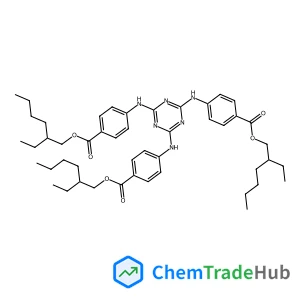
Tris(2-ethylhexyl) 4,4',4''-(1,3,5-triazine-2,4,6-triyltriimino)tribenzoate
CAS番号:
88122-99-0
分子式:
C48H66N6O6
おすすめサプライヤー





免責事項
このページに表示される学術雑誌情報は、参考および研究目的のみを目的としています。当社は雑誌出版社とは提携しておらず、投稿の取り扱いも行っておりません。出版に関するお問い合わせは、各雑誌出版社に直接ご連絡ください。
表示されている情報に誤りがある場合は、support@chemtradehub.com までご連絡ください。迅速に確認し、対応いたします。