


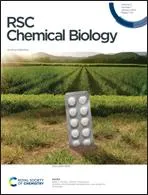

QSAR models reveal new EPAC-selective allosteric modulators
文献情報
出版日
2022-08-03
DOI
10.1039/D2CB00106C
インパクトファクター
0
著者
Hebatallah Mohamed, Hongzhao Shao, Madoka Akimoto, Patrick Darveau, Marc R. MacKinnon, Jakob Magolan
原文を見る
要旨
Exchange proteins directly activated by cAMP (EPAC) are guanine nucleotide exchange factors for the small GTPases, Rap1 and Rap2. They regulate several physiological functions and mitigation of their activity has been suggested as a possible treatment for multiple diseases such as cardiomyopathy, diabetes, chronic pain, and cancer. Several EPAC-specific modulators have been developed, however studies that quantify their structure–activity relationships are still lacking. Here we propose a quantitative structure–activity relationship (QSAR) model for a series of EPAC-specific compounds. The model demonstrated high reproducibility and predictivity and the predictive ability of the model was tested against a series of compounds that were unknown to the model. The compound with the highest predicted affinity was validated experimentally through fluorescence-based competition assays and NMR experiments revealed its mode of binding and mechanism of action as a partial agonist. The proposed QSAR model can, therefore, serve as an effective screening tool to identify promising EPAC-selective drug leads with enhanced potency.
おすすめジャーナル

Current Opinion in Colloid & Interface Science

Nature Medicine

Russian Journal of Coordination Chemistry

Russian Journal of Organic Chemistry

Journal of Peptide Science

Journal of Saudi Chemical Society

Russian Chemical Bulletin

Chemistry Education Research and Practice

Russian Journal of Applied Chemistry

New Journal of Chemistry
関連文献
Continuous flow synthesis of the URAT1 inhibitor lesinurad
Mariana C. F. C. B. Damião, Henrique M. Marçon, Julio Cezar Pastre
2020-01-27
Paper
DOI: 10.1039/C9RE00483A
From self-assembled toroids to dynamic nanotubules
Yongju Kim, Taehoon Kim, Myongsoo Lee
2012-11-12
Minireview
DOI: 10.1039/C2PY20868G
Synthesis of amphiphilic copolymers with a dendritic polyethylene core and poly(ethylene oxide) arms and their self-assembled nanostructures
Haiyang Gao, Ying Tang, Zhilong Hu, Qirui Guan, Xinbo Shi, Fangming Zhu, Qing Wu
2012-10-31
Paper
DOI: 10.1039/C2PY20831H
Thermoresponsive block copolymers containing reactive azlactone groups and their bioconjugation with lysozyme
Hien The Ho, Martin E. Levere, Sagrario Pascual, Véronique Montembault, Nathalie Casse, Aurore Caruso, Laurent Fontaine
2012-09-28
Paper
DOI: 10.1039/C2PY20714A
Thiophene spacers impart crystallinity and enhance the efficiency of benzotrithiophene-based conjugated polymers for bulk heterojunction photovoltaics
Shang-Che Lan, Po-An Yang, Meng-Jie Zhu, Chia-Min Yu, Jian-Ming Jiang, Kung-Hwa Wei
2012-11-12
Paper
DOI: 10.1039/C2PY20819A
Functionalized linear low-density polyethylene by ring-opening metathesis polymerization
Shingo Kobayashi, Hyunwoo Kim, Christopher W. Macosko, Marc A. Hillmyer
2012-11-28
Paper
DOI: 10.1039/C2PY20883K
Reducing polyazomethine to poly(N-phenylbenzylamine) with near infrared electrochromic, fluorescence and photovoltaic properties
Jiwei Cai, Ping Zhao, Haijun Niu, Yongfu Lian, Cheng Wang, Xuduo Bai, Wen Wang
2012-11-02
Paper
DOI: 10.1039/C2PY20846F
Surface modification of magnetite hybrid particles with carbohydrates and gold nanoparticlesvia “click” chemistry
M. Álvarez-Paino, G. Marcelo, A. Muñoz-Bonilla, J. Rodríguez-Hernández, M. Fernández-García
2012-10-25
Paper
DOI: 10.1039/C2PY20824E
Preparation of hybrid nanomaterials by supramolecular interactions between dendritic polymers and carbon nanotubes
Mohsen Adeli, Siamak Beyranvand, Roya Kabiri
2012-09-25
Paper
DOI: 10.1039/C2PY20497E
Mono- and di-cyclocarbonate telechelic polyolefins synthesized from ROMP using glycerol carbonate derivatives as chain-transfer agents
Liana Annunziata, Stéphane Fouquay, Guillaume Michaud, Frédéric Simon, Sophie M. Guillaume, Jean-François Carpentier
2013-01-08
Communication
DOI: 10.1039/C2PY21141F
こちらもおすすめ
化合物よくある質問
1-{3-[5-(エチルカルボンイル)-2,4-ジメチル-1H-ピロロール-3-基]プロパニル}ピペリジン-4-カルボン酸について、適用される法規ガイドラインは何ですか?
この化合物はCAS番号1142209-81-1であり、GHS分類では corrosive (腐食性物質) と classified (分類物質) として指定され...
1142209-81-11-{3-[5-(Ethoxycarbo...
化合物よくある質問
2,2-二氟-1,3-ベンゾジオキサン-5-カルボキシlic酸とは何ですか?
2,2-二氟-1,3-ベンゾジオキサン-5-カルボキシlic酸は、CAS番号656-46-2の化合物で、化学式はC8H4F2O4です。この化合物は白色の結晶性粉...
656-46-22,2-Difluoro-1,3-ben...
化合物よくある質問
8-氯-4-色原酮の代替品はありますか?
8-氯-4-色原酮(CAS番号: 49701-11-3)の代替品には、他の色原酮類似物や、構造が似ている化合物があります。例えば、8-メチル-4-色原酮や、他の...
49701-11-38-Chloro-2,3-dihydro...
化合物よくある質問
エチル6,6-ジメチル-4,5,6,7-テトラヒドロ-1H-インドアゼー-3-カルボキシレートとは何ですか?
エチル6,6-ジメチル-4,5,6,7-テトラヒドロ-1H-インドアゼー-3-カルボキシレートは、CAS番号1233243-56-5を有する化合物です。これは有...
1233243-56-5Ethyl 6,6-dimethyl-4...
化合物よくある質問
4-叔丁基-6-氯-嘧啶に適用される法規ガイドラインは何ですか?
4-叔丁基-6-氯-嘧啶はCAS番号3435-24-3で、GHS分類では毒性物質とみなし、GHSの危険性分類が適用されます。REACH規則では登録が必要で、Eu...
3435-24-34-Tert-butyl-6-chlor...
化合物よくある質問
維库溴铵杂质Bはどのように合成されますか?
維库溴铵杂质Bは、アンドロステンデンから始まり、一連の合成反応、包括的な選択性と高い収率で合成されます。具体的には、ブロミド化、酸化、ジマーゼ反応、アミド化など...
50587-95-6(2beta,3alpha,5alpha...
化合物よくある質問
2-(4-氟苄基)-吡咯烷の物理化学的性質は何ですか?
CAS番号350017-04-8の2-(4-氟苄基)-吡咯烷は、結晶性の白色粉末です。分子量は199.17 g/molで、水に溶けにくいです。化学反応では比較的...
350017-04-82-(4-Fluorobenzyl)py...
化合物よくある質問
3-喹啉甲醛(2-チロール-8-エチル)は安全ですか?
3-喹啉甲醛(2-チロール-8-エチル)は一定の毒性を持つため、取扱には注意が必要です。使用する際は適切な防護具を着用し、密閉容器で保管・搬送し、直接的な接触を...
335196-05-92-Chloro-8-ethyl-3-q...
化合物よくある質問
エチル3-(ヒドロキシメチル)-1H-ピロール-2-カルボキシレートはどのように保存すればよいですか?
エチル3-(ヒドロキシメチル)-1H-ピロール-2-カルボキシレートは、室温(25℃)以下で保存し、直射日光を避け、乾燥した環境で保管することが推奨されます。ま...
75448-69-0Ethyl 3-(hydroxymeth...
119410-05-88-Chloro-11-(4-piper...
掲載誌
おすすめ化合物

![2-{3-[4-(3-Chlorophenyl)-1-piperazinyl]propyl}[1,2,4]triazolo[4,3-a]pyridin-3(2H)-one hydrochloride (1:1) structure](https://static.chemtradehub.com/structs/253/25332-39-2-496e.webp "2-{3-[4-(3-Chlorophenyl)-1-piperazinyl]propyl}[1,2,4]triazolo[4,3-a]pyridin-3(2H)-one hydrochloride (1:1) structure")

おすすめサプライヤー



免責事項
このページに表示される学術雑誌情報は、参考および研究目的のみを目的としています。当社は雑誌出版社とは提携しておらず、投稿の取り扱いも行っておりません。出版に関するお問い合わせは、各雑誌出版社に直接ご連絡ください。
表示されている情報に誤りがある場合は、support@chemtradehub.com までご連絡ください。迅速に確認し、対応いたします。