













Reducing polyazomethine to poly(N-phenylbenzylamine) with near infrared electrochromic, fluorescence and photovoltaic properties
文献情報
出版日
2012-11-02
DOI
10.1039/C2PY20846F
インパクトファクター
5.582
著者
Jiwei Cai, Ping Zhao, Haijun Niu, Yongfu Lian, Cheng Wang, Xuduo Bai, Wen Wang
原文を見る
要旨
A novel series of solution-processable near-infrared (NIR) electrochromic aromatic poly(N-phenylbenzylamines) (RPAMs) have been synthesized by the reduction of polyazomethines (PAMs). The RPAMs were characterized by FT-IR and 1H NMR spectroscopy. Thermogravimetric analysis (TGA) showed that all the RPAMs were stable, with 5% weight losses recorded above 353 °C in nitrogen atmosphere. All the polymers are readily soluble in common organic solvents such as CHCl3, THF, DMF and DMAc. The RPAMs exhibit a strong blue-green fluorescence with a maximum at 415–514 nm, and the fluorescence quantum yield of RPAM-a in THF is about 18%. The PL intensity and color of the RPAMs changed depending on the value of pH. The highest occupied molecular orbital (HOMO) and the lowest unoccupied molecular orbital (LUMO) energy levels of these polymers were determined in the range of −4.51–−5.03 and −1.58–−2.33 eV (vs. the vacuum level) by cyclic voltammetry method consistent with the results of quantum chemical calculation. The polymer films revealed excellent stability of the electrochromic characteristics, with a color change from neutral pale yellowish to a purple doped form at applied potentials ranging from 0.0 to 1.5 V. The RPAMs showed a typical photovoltaic response and the SEM images implied the RPAM would be inclined to self assemble into ball particles.
関連文献
Biocatalytic reductive aminations with NAD(P)H-dependent enzymes: enzyme discovery, engineering and synthetic applications
Dameng Yang, Nicholas J. Turner
2023-12-07
Review Article
DOI: 10.1039/D3CS00391D
Virus-mimicking nanosystems: from design to biomedical applications
Hao-Yang Liu, Xiao Li, Zhi-Gang Wang
2023-11-06
Tutorial Review
DOI: 10.1039/D3CS00138E
Implications of Ga promotion and metal–oxide interface from tailored PtGa propane dehydrogenation catalysts supported on carbon
Enzo Brack, Marc-Georg Willinger, Christophe Copéret
2023-10-25
Edge Article
DOI: 10.1039/D3SC04711C
Towards multimodal cellular imaging: optical and X-ray fluorescence
Marcus E. Graziotto, Clinton J. Kidman, Simon A. James, Hugh H. Harris
2023-11-01
Review Article
DOI: 10.1039/D3CS00509G
Pursuing excitonic energy transfer with programmable DNA-based optical breadboards
Divita Mathur, Sebastián A. Díaz, Ryan D. Pensack, Bernard Yurke, Austin Biaggne, Joseph S. Melinger, William B. Knowlton, Igor L. Medintz
2023-10-24
Review Article
DOI: 10.1039/D0CS00936A
Mechanisms and models for water transport in reverse osmosis membranes: history, critical assessment, and recent developments
Hanqing Fan, Xinglin Lu, Menachem Elimelech
2023-10-27
Tutorial Review
DOI: 10.1039/D3CS00395G
Bio-based hyperbranched epoxy resins: synthesis and recycling
Jiang Li, Dan Li, Yunke Ma, Shucun Zhou, Yu Wang, Daohong Zhang
2023-12-18
Review Article
DOI: 10.1039/D3CS00713H
A CuICoII cryptate for the visible light-driven reduction of CO2
Julia Jökel, Esma Birsen Boydas, Joël Wellauer, Oliver S. Wenger, Michael Römelt
2023-10-27
Edge Article
DOI: 10.1039/D3SC02679E
こちらもおすすめ
化合物よくある質問
1-{3-[5-(エチルカルボンイル)-2,4-ジメチル-1H-ピロロール-3-基]プロパニル}ピペリジン-4-カルボン酸について、適用される法規ガイドラインは何ですか?
この化合物はCAS番号1142209-81-1であり、GHS分類では corrosive (腐食性物質) と classified (分類物質) として指定され...
1142209-81-11-{3-[5-(Ethoxycarbo...
化合物よくある質問
2,2-二氟-1,3-ベンゾジオキサン-5-カルボキシlic酸とは何ですか?
2,2-二氟-1,3-ベンゾジオキサン-5-カルボキシlic酸は、CAS番号656-46-2の化合物で、化学式はC8H4F2O4です。この化合物は白色の結晶性粉...
656-46-22,2-Difluoro-1,3-ben...
化合物よくある質問
8-氯-4-色原酮の代替品はありますか?
8-氯-4-色原酮(CAS番号: 49701-11-3)の代替品には、他の色原酮類似物や、構造が似ている化合物があります。例えば、8-メチル-4-色原酮や、他の...
49701-11-38-Chloro-2,3-dihydro...
化合物よくある質問
エチル6,6-ジメチル-4,5,6,7-テトラヒドロ-1H-インドアゼー-3-カルボキシレートとは何ですか?
エチル6,6-ジメチル-4,5,6,7-テトラヒドロ-1H-インドアゼー-3-カルボキシレートは、CAS番号1233243-56-5を有する化合物です。これは有...
1233243-56-5Ethyl 6,6-dimethyl-4...
化合物よくある質問
4-叔丁基-6-氯-嘧啶に適用される法規ガイドラインは何ですか?
4-叔丁基-6-氯-嘧啶はCAS番号3435-24-3で、GHS分類では毒性物質とみなし、GHSの危険性分類が適用されます。REACH規則では登録が必要で、Eu...
3435-24-34-Tert-butyl-6-chlor...
化合物よくある質問
維库溴铵杂质Bはどのように合成されますか?
維库溴铵杂质Bは、アンドロステンデンから始まり、一連の合成反応、包括的な選択性と高い収率で合成されます。具体的には、ブロミド化、酸化、ジマーゼ反応、アミド化など...
50587-95-6(2beta,3alpha,5alpha...
化合物よくある質問
2-(4-氟苄基)-吡咯烷の物理化学的性質は何ですか?
CAS番号350017-04-8の2-(4-氟苄基)-吡咯烷は、結晶性の白色粉末です。分子量は199.17 g/molで、水に溶けにくいです。化学反応では比較的...
350017-04-82-(4-Fluorobenzyl)py...
化合物よくある質問
3-喹啉甲醛(2-チロール-8-エチル)は安全ですか?
3-喹啉甲醛(2-チロール-8-エチル)は一定の毒性を持つため、取扱には注意が必要です。使用する際は適切な防護具を着用し、密閉容器で保管・搬送し、直接的な接触を...
335196-05-92-Chloro-8-ethyl-3-q...
化合物よくある質問
エチル3-(ヒドロキシメチル)-1H-ピロール-2-カルボキシレートはどのように保存すればよいですか?
エチル3-(ヒドロキシメチル)-1H-ピロール-2-カルボキシレートは、室温(25℃)以下で保存し、直射日光を避け、乾燥した環境で保管することが推奨されます。ま...
75448-69-0Ethyl 3-(hydroxymeth...
119410-05-88-Chloro-11-(4-piper...
掲載誌
Polymer Chemistry

CiteScore:
8.6
自己引用率:
7.3%
年間論文数:
457
Polymer Chemistry welcomes submissions in all areas of polymer science that have a strong focus on macromolecular chemistry. Manuscripts may cover a broad range of fields, yet no direct application focus is required.
おすすめ化合物


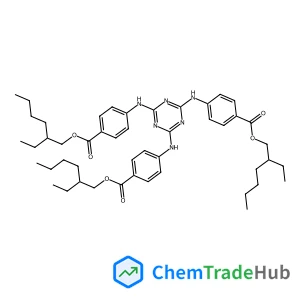
Tris(2-ethylhexyl) 4,4',4''-(1,3,5-triazine-2,4,6-triyltriimino)tribenzoate
CAS番号:
88122-99-0
分子式:
C48H66N6O6

おすすめサプライヤー




免責事項
このページに表示される学術雑誌情報は、参考および研究目的のみを目的としています。当社は雑誌出版社とは提携しておらず、投稿の取り扱いも行っておりません。出版に関するお問い合わせは、各雑誌出版社に直接ご連絡ください。
表示されている情報に誤りがある場合は、support@chemtradehub.com までご連絡ください。迅速に確認し、対応いたします。