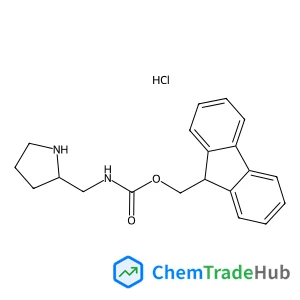
(S)-(9H-Fluoren-9-yl)methyl (pyrrolidin-2-ylmethyl)carbamate hydrochloride
CAS番号:
1217813-15-4
分子式:
C20H23ClN2O2
Xiucui Hu, Yadi Liu, Liguang Dou, Yuan Gao, Xin Tu
The direct nonoxidative conversion of methane (CH4) to valuable chemicals has attracted increasing interest. However, the carbon deposition will inevitably occur due to CH4 decomposition at high temperature. Here, we report the conversion of CH4 assisted by non-thermal plasma into olefins and H2 over a Pd/CeO2 catalyst. The addition of the plasma could effectively enhance the anti-coking performance of the catalyst, facilitating the conversion of CH4. The interaction between plasma and catalyst was explored in detail. The energized electron and ions generated by plasma could interact with the adsorbed CH3 species to efficiently suppress the consequent dehydrogenation of the adsorbed CH3, accelerating the desorption of the CH3 species from the surface of the catalyst, thus reducing the amount of carbon deposition on the catalyst surface. The highly efficient catalyst assisted by plasma is effective in enhancing the CH4 conversion and suppressing the carbon deposition, which deserves to be widely applied in catalysis.

Lab on a Chip

Foundations of Chemistry

Coloration Technology

Angewandte Chemie International Edition

Journal of Enzyme inhibition and Medicinal Chemistry

Advanced Engineering Materials

Photochemical & Photobiological Sciences

Environmental Toxicology and Pharmacology

Nature Reviews Drug Discovery

Contact Lens & Anterior Eye
Fangming Yang, Duanzhi Li, Zhihao Chen, Wenzhong Yang
DOI: 10.1039/D3NJ05155B
Benjamin Kirchweger, Julia Zwirchmayr, Ulrike Grienke, Judith M. Rollinger
DOI: 10.1039/D3NP00021D
DOI: 10.1039/D3NP00025G
Lili Song
DOI: 10.1039/D3NP00029J
David Dan, Sara L. Adelman, David B. Kimball, Stosh A. Kozimor, Jenifer C. Shafer
DOI: 10.1039/D3NJ03730D
Lei Zhao, Tingting Yang, Pei Xiong, Xiaobin Niu, Jinxia Jiang, Qian Xue, Le Yu, Rui Wu
DOI: 10.1039/D3TA04591A
Xu Huang, Hui Sun, Xuewei He, Yunkai Ruan, Lizhen Gan
DOI: 10.1039/D3NJ04854C
Zhaoshun Zhan, Qixing Shi, Lei Wang, Jinfeng Shen, Tianyou Bao, Lixin Li, Fanna Meng
DOI: 10.1039/D3NJ04981G
Khiem Chau Nguyen, Duy T. M. Chung, Phattananawee Nalaoh, Jonathan S. Lindsey
DOI: 10.1039/D3NJ03900E
Andreas E. Bumberger, Sergej Ražnjević, Zaoli Zhang, Gernot Friedbacher, Juergen Fleig
DOI: 10.1039/D3TA05086F
2-メトキシ-4-(メチルスルフィニル)アミンは、主に医薬品および農薬の製造に使用されます。また、合成化学の一部として研究用材料としても利用されます。
代替品としては、4,6-二クロロピラミジンアミンや他のピラミジン系化合物が考えられます。ただし、目的と用途によって最適な代替品は異なります。
6-氯-4-甲基-1H-吲哚の廃棄物は、適切な容器に収集し、密閉して保管します。温度は常温、湿度は低く、直射日光を避けて保管することを推奨します。廃棄処理は専門...
2-フローユロ-4-(トリフルオロメチル)ベンゾイドのCAS番号は207974-08-1です。この化合物はGHS分類で毒性物質と有害な反応物質として分類されます...
4-ニトロフェニルN-[(ベンゼルオキシルカーボンイル]グリシングリシングリシン酸は、室温で暗所に保管し、乾燥した環境で保存することを推奨します。容器は密閉性の...
イソデスロラタドリンの代替品としては、デスロラタドリンや他の抗ヒスタミン薬が挙げられます。具体的には、デスロラタドリン、ラセカミド、フェルタドリンなどが、症状や...
5-甲氧基-1,2,3,4-四氢异喹啉盐酸盐の一般的な合成方法は、メタノール中で5-メトキシ-1,2,3,4-四ヒュドロイソキシンを塩酸で塩化します。この反応で...
CAS番号6471-78-9の4-アミノ-5-メトキシ-2-トルエンサルホニック酸は、GHS分類では corrosive(腐食性)と識別されます。EUのREAC...
甲基孕酮の取り扱いは、PPE(個人保護具)の使用が必要な重要な安全事項を伴います。防塵マスク、ゴーグル、手袋を着用することが推奨されます。ドラフトチャンバーを使...