



Self-shape-transformable 3D tessellated bifacial crystalline Si solar cell module enabling extra energy gain through intervals and an integrated actuator
文献情報
出版日
2021-11-03
DOI
10.1039/D1SE01205C
インパクトファクター
6.367
著者
Min Ju Yun, Dong Yoon Lee
原文を見る
要旨
The previously reported strategies for photovoltaics (PVs) have been one-size-one-fits-all methods under a watt per cost concept, which is changing in favor of a customized-fit strategy under an energy yield per watt concept to generate more energy per installed photovoltaic (PV) device and thereby expand applications of PVs. Bifacial solar cells have attracted attention for possible implementation of this new PV concept. In this study, as a novel approach for bifacial technology in urban environments, we propose an automated solar trackable and self-shape-transformable three-dimensional (3D) tessellated bifacial module that can be used with any curved surface and can change shape according to the angle of incidence (AOI) of light to maximize the power output without external assistance. The proposed self-shape-transformable 3D tessellated bifacial module with 2 mm intervals between the cells and with an installed reflector achieved a 47% enhancement in the power output compared with that of a flat module under 1 sun, 1.5 a.m. conditions. At high AOI values, the power output was greater than that of a flat module, owing to solar illumination AOI sensitive shape changes and the effect of bifacial energy production with a controlled reflector. This indicates that the proposed module has strong potential for use in urban environments.
おすすめジャーナル

Journal of the Indian Institute of Science

Acta Metallurgica Sinica-English Letters

Bioorganic & Medicinal Chemistry Letters

Polycyclic Aromatic Compounds

Cellulose

Atomization and Sprays

Heteroatom Chemistry

Critical Reviews in Solid State and Materials Sciences

Herald of the Russian Academy of Sciences

Topics in Catalysis
関連文献
Inducing microstructural changes in Nafion by incorporating graphitic carbon nitride to enhance the vanadium-blocking effect
Chunxiao Wu, Shanfu Lu, Jin Zhang, Yan Xiang
2018-02-09
Paper
DOI: 10.1039/C7CP07744K
An accurate full-dimensional potential energy surface and quasiclassical trajectory dynamics of the H + H2O2 two-channel reaction
Kejie Shao, Bina Fu, Xingan Wang, Dong H. Zhang
2018-08-15
Paper
DOI: 10.1039/C8CP04045A
A molecular quantum switch based on tunneling in meta-d-phenol C6H4DOH
Sieghard Albert, Ziqiu Chen, Robert Prentner, Martin Quack
2018-03-01
Communication
DOI: 10.1039/C8CP00133B
On the contribution of f electrons to the quadratic hyperpolarizability: the case of lanthanide terpyridyl complexes
Fatima Ibersiene, Camille Latouche, Claudine Katan, Abdou Boucekkine
2018-02-27
Communication
DOI: 10.1039/C8CP00853A
Structures of FEC-containing electrolytes and the stabilization mechanism at high voltage and elevated temperature
Yamin Wang, Debing Li, Xiaoying Yu, Chao Shang, Yingchun Liu, Qi Wang
2018-07-09
Paper
DOI: 10.1039/C7CP08362A
Effect of halogen dopants on the properties of Li2O2: is chloride special?
Henry A. Cortes
2018-05-08
Paper
DOI: 10.1039/C8CP01211C
A first-principles study of the electrically tunable band gap in few-layer penta-graphene
Jinjin Wang, Zhanyu Wang, R. J. Zhang, Y. X. Zheng, L. Y. Chen, Chia-Chin Tsoo, Hung-Ji Huang
2018-06-12
Paper
DOI: 10.1039/C8CP02624F
Towards reliable references for electron paramagnetic resonance parameters based on quantum chemistry: the case of verdazyl radicals
Steffen Eusterwiemann, Armido Studer
2018-02-26
Paper
DOI: 10.1039/C7CP05657E
Solvation of Al3+ cations in bulk and confined protic ionic liquids: a computational study
Víctor Gómez-González, Borja Docampo-Álvarez, Hadrián Montes-Campos, Juan Carlos Otero, Elena López Lago, Oscar Cabeza, Luis J. Gallego, Luis M. Varela
2018-07-04
Paper
DOI: 10.1039/C8CP02933D
Clarifying the role of cryo- and lyo-protectants in the biopreservation of proteins
Andrea Arsiccio, Roberto Pisano
2018-03-05
Paper
DOI: 10.1039/C7CP08029H
こちらもおすすめ
化合物よくある質問
2-メトキシ-4-(メチルスルフィニル)アミンの主な用途は何ですか?
2-メトキシ-4-(メチルスルフィニル)アミンは、主に医薬品および農薬の製造に使用されます。また、合成化学の一部として研究用材料としても利用されます。
41608-73-52-Methoxy-4-(methyls...
118684-13-24-(Bromomethyl)-3-me...
化合物よくある質問
4,6-二氯-N-甲基ピラミジンアミンの代替品はありますか?
代替品としては、4,6-二クロロピラミジンアミンや他のピラミジン系化合物が考えられます。ただし、目的と用途によって最適な代替品は異なります。
10397-15-64,6-Dichloro-N-methy...
化合物よくある質問
6-氯-4-甲基-1H-吲哚を含む廃棄物はどのように処理すべきですか?
6-氯-4-甲基-1H-吲哚の廃棄物は、適切な容器に収集し、密閉して保管します。温度は常温、湿度は低く、直射日光を避けて保管することを推奨します。廃棄処理は専門...
885520-84-36-chloro-4-methyl-1H...
化合物よくある質問
2-フローユロ-4-(トリフルオロメチル)ベンゾイドについて「に適用される法規ガイドラインは何ですか」
2-フローユロ-4-(トリフルオロメチル)ベンゾイドのCAS番号は207974-08-1です。この化合物はGHS分類で毒性物質と有害な反応物質として分類されます...
207974-08-1[2-Fluoro-4-(trifluo...
化合物よくある質問
4-ニトロフェニルN-[(ベンゼルオキシルカーボンイル]グリシングリシングリシン酸はどのように保存すればよいですか?
4-ニトロフェニルN-[(ベンゼルオキシルカーボンイル]グリシングリシングリシン酸は、室温で暗所に保管し、乾燥した環境で保存することを推奨します。容器は密閉性の...
19811-64-44-Nitrophenyl N-[(be...
化合物よくある質問
イソデスロラタドリンの代替品はありますか?
イソデスロラタドリンの代替品としては、デスロラタドリンや他の抗ヒスタミン薬が挙げられます。具体的には、デスロラタドリン、ラセカミド、フェルタドリンなどが、症状や...
183198-49-4Iso Desloratadine
化合物よくある質問
5-甲氧基-1,2,3,4-四氢异喹啉盐酸盐はどのように合成されますか?
5-甲氧基-1,2,3,4-四氢异喹啉盐酸盐の一般的な合成方法は、メタノール中で5-メトキシ-1,2,3,4-四ヒュドロイソキシンを塩酸で塩化します。この反応で...
103030-69-95-Methoxy-1,2,3,4-te...
化合物よくある質問
4-アミノ-5-メトキシ-2-トルエンサルホニック酸についての法規ガイドラインは何ですか?
CAS番号6471-78-9の4-アミノ-5-メトキシ-2-トルエンサルホニック酸は、GHS分類では corrosive(腐食性)と識別されます。EUのREAC...
6471-78-94-Amino-5-Methoxy-2-...
化合物よくある質問
甲基孕酮を取り扱う際の実験室安全事項は何ですか?
甲基孕酮の取り扱いは、PPE(個人保護具)の使用が必要な重要な安全事項を伴います。防塵マスク、ゴーグル、手袋を着用することが推奨されます。ドラフトチャンバーを使...
204063-33-22-[(Diphenylmethyl)a...
掲載誌
おすすめ化合物
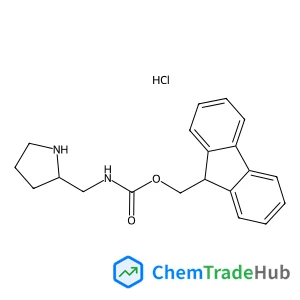
(S)-(9H-Fluoren-9-yl)methyl (pyrrolidin-2-ylmethyl)carbamate hydrochloride
CAS番号:
1217813-15-4
分子式:
C20H23ClN2O2


おすすめサプライヤー




免責事項
このページに表示される学術雑誌情報は、参考および研究目的のみを目的としています。当社は雑誌出版社とは提携しておらず、投稿の取り扱いも行っておりません。出版に関するお問い合わせは、各雑誌出版社に直接ご連絡ください。
表示されている情報に誤りがある場合は、support@chemtradehub.com までご連絡ください。迅速に確認し、対応いたします。