













A facile freeze–thaw ultrasonic assisted circulation method of graphite flakes prepared by anode graphite from spent lithium-ion batteries for application in nanofluids
文献情報
出版日
2021-08-16
DOI
10.1039/D1SE00973G
インパクトファクター
6.367
著者
Yu Qiao, Wen Sheng, Chen He, Bai Yang, Haoxuan Xu, Chenzhen Liu, Zhonghao Rao
原文を見る
要旨
Graphite has been widely used as the anode material in lithium-ion batteries (LIBs) due to its good conductivity, layered crystal structure, high charging–discharge potential, and other characteristics. With the rapid development of the LIB industry, the graphite industry has also developed into a mode of high production capacity. The anode graphite of spent LIBs has the characteristics of large layer spacing and ease of being intercalated and peeled due to the reduction of the interlamination force after repeated charge and discharge cycles. In this study, we present a facile freeze–thaw ultrasonic assisted circulation method to prepare two-dimensional low-layer graphite flakes (GFs) using anode graphite from spent LIBs. Characterizations of GFs were carried out by SEM, TEM, XRD and Raman spectroscopy. The results indicate that GFs prepared by graphite of spent LIBs have a better morphology than that prepared by purchased graphite. Furthermore, the GF-filled ethylene glycol (EG) nanofluids exhibit higher thermal conductivity and conductive heat transfer coefficient than base fluids, of which the maximum enhancements are 10.5% and 30%, respectively. The freeze–thaw ultrasonic assisted circulation method is not only an effective method for the reuse of anode graphite from spent LIBs, but also a reference for the synthesis of two-dimensional materials. Furthermore, GF-filled nanofluids could be a potential heat transfer working medium.
関連文献
Interpenetrating covalent adaptable networks with enhanced mechanical properties and facile reprocessability and recyclability
Yufeng Lei, Anqiang Zhang, Yaling Lin
2021-06-21
Paper
DOI: 10.1039/D1PY00623A
Electronic spectra of linear isoelectronic species HC6H+, C6H, HC5N+
Sigrid D. Peyerimhoff
2001-03-19
Paper
DOI: 10.1039/B009604K
Dielectric studies of freezing behavior in porous materials: Water and methanol in activated carbon fibres
K. E. Gubbins, R. Radhakrishnan
2001-03-13
Paper
DOI: 10.1039/B009792F
Structure and solvation forces in confined alkane films
Fabien Porcheron, Bernard Rousseau, Martin Schoen, Alain H. Fuchs
2001-01-12
Paper
DOI: 10.1039/B008828P
Dynamics of the OH( = 1,2,4) + O3 atmospheric reaction
L. Zhang, A. J. C. Varandas
2001-03-20
Paper
DOI: 10.1039/B010149O
Ion pair formation ia photoinduced proton transfer in excited hydroxynaphthalimide-N-methylimidazole hydrogen bonded complex: effect of temperature and viscosity on dual fluorescence
László Biczók, Pierre Valat, Véronique Wintgens
2001-03-19
Paper
DOI: 10.1039/B100692O
An improved azo chromophore for optical NO2 sensing
A. Bradford, P. L. Drake, O. Worsfold, I. R. Peterson, D. J. Walton, G. J. Price
2001-03-22
Paper
DOI: 10.1039/B008894N
こちらもおすすめ
化合物よくある質問
カルボニル基が付いた5-氰基-1-{[(2-メチル-2-プロpanyl)オキシ]カーボンイル}1H-吲哚-2-イリド-2-ボリン酸はどのように保存すればよいですか?
カルボニル基が付いた5-氰基-1-{[(2-メチル-2-プロpanyl)オキシ]カーボンイル}1H-吲哚-2-イリド-2-ボリン酸は、直射日光を避けて室温(15...
475102-15-9(5-Cyano-1-{[(2-meth...
化合物よくある質問
tert-ブチル2-クロロメチルピリジン-3-基炭酸エステルの市場動向や研究トレンドはどうですか?
この化合物は合成化学分野において、特にピリジン化合物の合成や改良に用いられます。最近の研究では、ピリジン化合物の新規合成法や特性の改良が注目されています。市場動...
1203498-98-9tert-Butyl 2-chloro-...
化合物よくある質問
聚二季戊四醇六丙烯酸酯はどの業界で使用されていますか?
聚二季戊四醇六丙烯酸酯は、医薬品、ポリマー、センサー、半導体などの業界で広く使用されています。特にポリマー業界では硬化剤として、医薬分野では医療機器の製造に使用...
29570-58-93-(Acryloyloxy)-2-({...
化合物よくある質問
1-氯-5-硝基异喹啉の市場動向や研究トレンドはどうですか?
1-氯-5-硝基异喹啉は、薬理学や合成化学の研究分野で注目されています。市場動向としては、その生物学的な活性や合成可能性を評価する研究が増えています。また、代替...
58142-97-51-Chloro-5-nitroisoq...
化合物よくある質問
2-チロール-5-メチルスルフェニル-3-trifルオルメチルベンゼンはどのように合成されますか?
2-チロール-5-メチルスルフェニル-3-trifルオルメチルベンゼンは、トリフルオロメチル化反応と硫化反応を経て合成されます。通常、トリフルオロメチル化剤と硫...
957066-04-51-Chloro-4-(methylsu...
化合物よくある質問
p-トールイルマグネシウムブロミドの物理化学的性質は何ですか?
p-トールイルマグネシウムブロミドのCAS番号は4294-57-9です。この化合物は白色の結晶性粉末で、分子量は204.32です。溶剤中で良好に溶解しますが、水...
4294-57-9p-Tolylmagnesium bro...
化合物よくある質問
1-(5-甲基-2-硫化素基)プロパン-1-酮の市場動向や研究トレンドはどうですか?
1-(5-甲基-2-硫化素基)プロパン-1-酮の市場動向は、化学産業全体の需要に影響を受けますが、最近では pharmaceutical 分野での応用が注目され...
59303-13-81-(5-Methyl-2-thieny...
化合物よくある質問
十一碳烯酰甘氨酸を取り扱う際の実験室安全事項は何ですか?
十一碳烯酰甘氨酸は吸入や皮膚から吸収されることがあり、取り扱う際には防塵マスクと手袋を使用してください。ドラフトチャンバーを用いて漏洩を処理し、適切なSDS(S...
54301-26-7N-10-Undecenoylglyci...
化合物よくある質問
1H,1H-全氟-3,6-二氧杂葵-1-醇を取り扱う際の実験室安全事項は何ですか?
この化合物は吸入や皮膚吸収による毒性があるため、防塵マスク、ゴーグル、防護手袋を使用する必要があります。ドラフトチャンバーでの操作が必要です。漏洩時には即座に換...
152914-73-32,2-Difluoro-2-[1,1,...
化合物よくある質問
3-(4-(フルオロメチルオキシ)フェニル)-1,2,4-オキサジアゾール-5-カルボハイドライドは安全ですか?
安全性は化合物の使用方法によります。直接的な毒性は報告されていませんが、吸入や皮膚接触には注意が必要です。適切な防護服を着用し、換気を図ることを推奨します。
883028-82-83-(4-(Trifluorometho...
掲載誌
おすすめ化合物
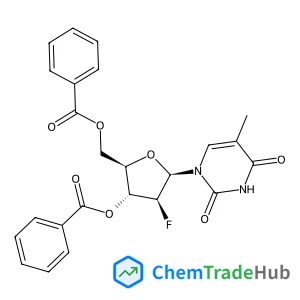
1-(3',5'-Di-O-benzoyl-2'-deoxy-2'-fluoro-b-D-arabinofuranosyl)thymine
CAS番号:
97614-47-6
分子式:
C24H21FN2O7
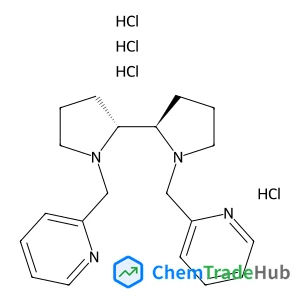
(2R,2'R)-1,1'-Bis(2-pyridinylmethyl)-2,2'-bipyrrolidine tetrahydrochloride
CAS番号:
1228077-88-0
分子式:
C20H30Cl4N4
おすすめサプライヤー





免責事項
このページに表示される学術雑誌情報は、参考および研究目的のみを目的としています。当社は雑誌出版社とは提携しておらず、投稿の取り扱いも行っておりません。出版に関するお問い合わせは、各雑誌出版社に直接ご連絡ください。
表示されている情報に誤りがある場合は、support@chemtradehub.com までご連絡ください。迅速に確認し、対応いたします。