












DFT study of phenol alkylation with propylene on H-BEA in the absence and presence of water
文献情報
出版日
2021-09-10
DOI
10.1039/D1RE00201E
インパクトファクター
4.239
著者
Sajal Kanti Dutta
原文を見る
要旨
We employ ab initio density functional theory calculations to investigate the mechanisms of phenol (a model compound for lignin-derived bio-oil) alkylation with propylene to 2-isopropylphenol, in the presence and absence of water on H-BEA. We also compute the reaction pathways for phenol alkylation in the uncatalyzed gas phase to understand H-BEA catalysis. In the uncatalyzed gas phase, phenol acts as a self-catalyst, activating propylene by transferring a proton from phenolic oxygen and facilitating the carbon–carbon bond formation reaction. We find that the lowest barrier process proceeds via an intermediate both in the uncatalyzed gas phase and on dry H-BEA. On H-BEA, the intermediate is stabilized by the transfer of a zeolitic proton. Our calculations show that, in comparison to the uncatalyzed gas phase, H-BEA reduces the barrier for converting the reactant complex to the intermediate by ∼40 kJ mol−1, which translates to a four order-of-magnitude increase in the transition-state theory rate coefficient at 350 °C. However, we find that the rate coefficient for the next step, which is also the rate-limiting step, remains unchanged on H-BEA. We further find that the presence of water reduces the activation barrier for this step—i.e., the rate-limiting step—by ∼30 kJ mol−1, which leads to a two order-of-magnitude increase in the transition-state theory rate coefficient at 350 °C.
関連文献
Photodissociation dynamics of dinitrite at 355 nm: initiation of a reactive pathway
Lingxuan Wang, Lily Zu
2016-08-17
Paper
DOI: 10.1039/C6CP03049A
Preparation and structure of Fe-containing aluminosilicate thin films
Héloïse Tissot, Linfei Li, Shamil Shaikhutdinov, Hans-Joachim Freund
2016-08-11
Paper
DOI: 10.1039/C6CP03460H
Probing ligand-induced modulation of metallic states in small gold nanoparticles using conduction electron spin resonance
Anthony Cirri, Alexey Silakov, Lasse Jensen, Benjamin J. Lear
2016-08-25
Paper
DOI: 10.1039/C6CP02205G
Encapsulation capacity and natural payload delivery of an anticancer drug from boron nitride nanotube
M. El Khalifi, J. Bentin, E. Duverger, T. Gharbi, H. Boulahdour, F. Picaud
2016-07-27
Paper
DOI: 10.1039/C6CP01387B
The growth and thermal properties of Au deposited on Rh(111): formation of an ordered surface alloy
László Óvári, András Berkó, Gábor Vári, Richárd Gubó, Arnold Péter Farkas
2016-08-17
Paper
DOI: 10.1039/C6CP02128J
Feynman force components: basis for a solution to the covalent vs. ionic dilemma
Justyna Dominikowska, Mirosław Jabłoński, Marcin Palusiak
2016-08-26
Paper
DOI: 10.1039/C6CP03774G
Calculation of Raman parameters of real-size zigzag (n, 0) single-walled carbon nanotubes using finite-size models
Teobald Kupka, Michal Stachów, Leszek Stobiński, Jakub Kaminský
2016-08-11
Paper
DOI: 10.1039/C6CP04100K
A multifunctional material of two-dimensional g-C4N3/graphene bilayer
Jie Cui, Shuhua Liang, Jianmin Zhang
2016-08-12
Paper
DOI: 10.1039/C6CP03946D
A joint experimental and theoretical determination of the structure of discharge products in Na–SO2 batteries
Young-Kyu Han, Goojin Jeong, Keon-Joon Lee, Taeeun Yim
2016-08-22
Communication
DOI: 10.1039/C6CP04423A
Vapour adsorption kinetics: statistical rate theory and zeta adsorption isotherm approach
Seyed Hadi Zandavi, C. A. Ward
2016-08-26
Paper
DOI: 10.1039/C6CP05088C
こちらもおすすめ
化合物よくある質問
2,3-スチオエポキシマドルを取り扱う際の実験室安全事項は何ですか?
取り扱いにはPPE(プロテクティブ・パーソナル・エイド)が必要で、防ぐ手袋と保護眼鏡を着用してください。ドラフトチャンバーの使用を推奨します。漏洩した場合は、適...
4267-80-52,3-Thioepoxy Madol
53981-25-22-Amino-6-fluorophen...
化合物よくある質問
BOC-S-3-アミニ-4-(4-メチオキシベンチル)-ブタン酸の代替品はありますか?
この化合物の代替品としては、BOC保護基を有さないアミノ酸やその他の保護基化合物が考えられます。また、メチオキシ基を有しない他の芳香族アミノ酸も代替品として挙げ...
126800-59-7(3S)-4-(4-Methoxyphe...
化合物よくある質問
Methyl 2-(chloromethyl)-3-nitrobenzoate(1218910-61-2)の代替品はありますか?
Methyl 2-(chloromethyl)-3-nitrobenzoate(1218910-61-2)の代替品としては、化学組成を変えることで効果を達成する...
1218910-61-2Methyl 2-(chlorometh...
化合物よくある質問
(2R)-2-アミノ-N-ベンジル-3-ヒドロキシプロパナミドを含む廃棄物はどのように処理すべきですか?
(2R)-2-アミノ-N-ベンジル-3-ヒドロキシプロパナミドを含む廃棄物は、適切な廃棄物管理ガイドラインに基づき処理する必要があります。まず、廃棄物を適切に収...
175481-39-7(2R)-2-amino-N-benzy...
化合物よくある質問
6,7-二氢-咪唑並[1,2-a]ピリドイン-8(5h)-酮はどのように合成されますか?
6,7-二氢-咪唑並[1,2-a]ピリドイン-8(5h)-酮は、2-ブロモフェニルアセトインとリン酸ハロゲン化物を反応させることで合成できます。この反応は高温で...
457949-09-66,7-Dihydroimidazo[1...
化合物よくある質問
エチル(3R)-3-ピロリジニル酢酸水和塩とは何ですか?
エチル(3R)-3-ピロリジニル酢酸水和塩は、CAS番号1332459-32-1の化合物で、(R)-乙基2-(ピロリジン-3-基)酢酸塩水和塩と呼ばれます。この...
1332459-32-1Ethyl (3R)-3-pyrroli...
化合物よくある質問
(2S)-{[(2-メチルエチルオキシ]カルボニル}アミノ)[2-(トリアフルオロメチルフェニル]エチカシック酸の物理化学的性質は何ですか?
(2S)-{[(2-メチルエチルオキシ]カルボニル}アミノ)[2-(トリアフルオロメチルフェニル]エチカシック酸のCAS番号は1203454-45-8です。この...
1203454-45-8(2S)-({[(2-Methyl-2-...
化合物よくある質問
2-ブロモ-1-(2-メチル-2-プロパニル)-4-ニトロベンゼンはどのように保存すればよいですか?
2-ブロモ-1-(2-メチル-2-プロパニル)-4-ニトロベンゼンは、直射日光を避けて暗所で、室温(約15℃〜25℃)、乾燥した場所に保存する必要があります。ま...
6310-17-42-Bromo-1-(2-methyl-...
化合物よくある質問
1-[(4-硝基フェニル)スルホニル]-1H-1,2,4-三唑の市場動向や研究トレンドはどうですか?
市場動向としては、1-[(4-硝基フェニル)スルホニル]-1H-1,2,4-三唑は主に農業用除草剤や合成化学製品の原料として利用されています。研究トレンドとして...
57777-84-11-[(4-Nitrophenyl)su...
掲載誌
Reaction Chemistry & Engineering

CiteScore:
0
自己引用率:
8.8%
年間論文数:
284
Reaction Chemistry & Engineering is an interdisciplinary journal reporting cutting-edge research focused on enhancing the understanding and efficiency of reactions. Reaction engineering leverages the interface where fundamental molecular chemistry meets chemical engineering and technology. Challenges in chemistry can be overcome by the application of new technologies, while engineers may find improved solutions for process development from the latest developments in reaction chemistry. Reaction Chemistry & Engineering is a unique forum for researchers whose interests span the broad areas of chemical engineering and chemical sciences to come together in solving problems of importance to wider society. All papers should be written to be approachable by readers across the engineering and chemical sciences. Papers that consider multiple scales, from the laboratory up to and including plant scale, are particularly encouraged.
おすすめ化合物
![tert-butyl 8-benzyl-2,8-diazaspiro[4.5]decane-2-carboxylate structure](https://static.chemtradehub.com/structs/336/336191-16-3-bb55.webp "tert-butyl 8-benzyl-2,8-diazaspiro[4.5]decane-2-carboxylate structure")
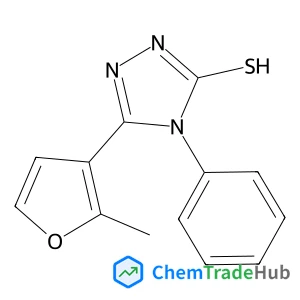
5-(2-Methyl-3-furyl)-4-phenyl-2,4-dihydro-3H-1,2,4-triazole-3-thione
CAS番号:
346464-59-3
分子式:
C13H11N3OS
![(1R,5R)-3-{[(2-Methyl-2-propanyl)oxy]carbonyl}-3-azabicyclo[3.1.0]hexane-1-carboxylic acid structure](https://static.chemtradehub.com/structs/116/1165450-63-4-bfe1.webp "(1R,5R)-3-{[(2-Methyl-2-propanyl)oxy]carbonyl}-3-azabicyclo[3.1.0]hexane-1-carboxylic acid structure")
おすすめサプライヤー



免責事項
このページに表示される学術雑誌情報は、参考および研究目的のみを目的としています。当社は雑誌出版社とは提携しておらず、投稿の取り扱いも行っておりません。出版に関するお問い合わせは、各雑誌出版社に直接ご連絡ください。
表示されている情報に誤りがある場合は、support@chemtradehub.com までご連絡ください。迅速に確認し、対応いたします。