



Polymerization of phenylacetylene catalyzed by rhodium(i) complexes with N-functionalized N-heterocyclic carbene ligands
文献情報
出版日
2022-02-10
DOI
10.1039/D1PY01650D
インパクトファクター
5.582
著者
Marta Angoy, M. Victoria Jiménez, Fernando J. Lahoz, Eugenio Vispe, Jesús J. Pérez-Torrente
原文を見る
要旨
A series of neutral [RhX(nbd)(κC-MeIm∩Z)] and cationic [Rh(nbd)(κ2C,N-MeIm∩Z)]+ (X = Cl, Br; MeIm = 3-methylimidazol-2-yliden-1-yl; ∩Z = N-functionalized wingtip; nbd = 2,5-norbornadiene) complexes featuring NHC ligands functionalized with a 1-aminopropyl, 3-dimethylaminopropyl, pyridin-2-ylmethyl, or quinolin-8-ylmethyl substituent have been prepared. These complexes efficiently catalyze the polymerization of phenylacetylene without base as a co-catalyst affording stereoregular polyphenylacetylenes of very high molar mass. Polymers of Mw up to 2 × 10⁶ g mol−1 and moderate dispersity have been prepared with neutral chloro-complexes having aminopropyl wingtips. Catalyst precursors bearing functionalized NHC ligands with a flexible amino-alkyl wingtip are significantly more active than those having a heterocyclic substituent. These complexes are in general much more active than related compounds having N-functionalized phosphine ligands. Polymer characterization by SEC/MALS/DRI analysis has revealed the presence of a fraction of branched polymer of high molar mass in most samples obtained with catalysts having N-heterocyclic substituents at the NHC ligand. The N-donor function at the NHC ligand likely behaves as an internal base for the deprotonation of phenylacetylene to give the initiating alkynyl cationic [Rh(nbd)(CC-Ph)(κC-MeIm∩ZH)]+ species. However, the participation of neutral alkynyl species [Rh(nbd)(CC-Ph)(κC-MeIm∩Z)] should be considered in order to rationalize the notable catalytic activity of some neutral chloro-complexes.
おすすめジャーナル

Current Opinion in Solid State & Materials Science

Russian Journal of General Chemistry

Drug Discovery Today

Russian Journal of Applied Chemistry

Current Opinion in Colloid & Interface Science

Saudi Pharmaceutical Journal

New Journal of Chemistry

Journal of Saudi Chemical Society

Russian Journal of Organic Chemistry

Journal of Natural Medicines
関連文献
Preventing iron(ii) precipitation in aqueous systems using polyacrylic acid: some molecular insights
Pierre-Arnaud Artola, Bernard Rousseau, Carine Clavaguéra, Marion Roy, Dominique You, Gabriel Plancque
2018-06-06
Paper
DOI: 10.1039/C7CP02743E
Structural definition of the BIL and DL: a new universal methodology to rationalize non-linear χ(2)(ω) SFG signals at charged interfaces, including χ(3)(ω) contributions
Simone Pezzotti, Daria Ruth Galimberti, Y. Ron Shen, Marie-Pierre Gaigeot
2018-01-23
Paper
DOI: 10.1039/C7CP06110B
Reduction of the thermal conductivity of a graphene/hBN heterobilayer via interlayer sp3 bonds
T. Iwata, K. Shintani
2018-01-23
Paper
DOI: 10.1039/C7CP07345C
Multiple binding modes of a moderate ice-binding protein from a polar microalga
Maddalena Bayer-Giraldi
2018-09-13
Paper
DOI: 10.1039/C8CP04727H
Tuning nuclear depolarization under MAS by electron T1e
Alicia Lund, Asif Equbal
2018-09-05
Paper
DOI: 10.1039/C8CP04167A
Understanding interface (odd–even) effects in charge tunneling using a polished EGaIn electrode
Jiahao Chen, Thomas J. Giroux, Yen Nguyen, Atte A. Kadoma, Boyce S. Chang, Brett VanVeller, Martin M. Thuo
2018-01-12
Paper
DOI: 10.1039/C7CP07531F
Photoelectron spectroscopy and thermochemistry of o-, m-, and p-methylenephenoxide anions
Daniel J. Nelson, Wilson K. Gichuhi, Charles M. Nichols, Veronica M. Bierbaum, W. Carl Lineberger
2018-09-20
Paper
DOI: 10.1039/C8CP05403G
Ab initio kinetic Monte Carlo simulation of seeded emulsion polymerizations of styrene
Marco Drache, Katrin Brandl, Rebecca Reinhardt, Sabine Beuermann
2018-01-31
Paper
DOI: 10.1039/C7CP07768H
Reactivity of hydropersulfides toward the hydroxyl radical unraveled: disulfide bond cleavage, hydrogen atom transfer, and proton-coupled electron transfer
Josep M. Anglada, Ramon Crehuet, Sarju Adhikari, Joseph S. Francisco
2018-01-17
Paper
DOI: 10.1039/C7CP07570G
Structural transformations of carbon and boron nitride nanoscrolls at high impact collisions
C. F. Woellner, L. D. Machado, P. A. S. Autreto, D. S. Galvao
2018-01-16
Paper
DOI: 10.1039/C7CP07402F
こちらもおすすめ
化合物よくある質問
2-ヒドロキシ-5-ニトロベンジンブロモイドの代替品はありますか?
2-ヒドロキシ-5-ニトロベンジンブロモイドは特定の化学反応に適しているため、代替品は限られています。しかし、同様の構造を持つ2-ヒドロキシ-4-ニトロベンジン...
772-33-82-(Bromomethyl)-4-ni...
化合物よくある質問
N-(2-ブロモフェニル)-1-チロール-3-オキソ-3-(ピペリジニル)プロペン-2-イル)ベンゼンアミドを取り扱う際の実験室安全事項は何ですか?
N-(2-ブロモフェニル)-1-チロール-3-オキソ-3-(ピペリジニル)プロペン-2-イル)ベンゼンアミドは有毒で、皮膚や粘膜に刺激を与える可能性があります。...
1800044-77-2N-[(1Z)-1-(2-Bromoph...
化合物よくある質問
1,3プロパンジオール,2-[2-(2アミノ-6クロロ-9Hピリミジン-9-イル)エチル-1,1,2,2-D4]-2,3-ジアセタートの市場動向や研究トレンドはどうですか?
この化合物は、新規治療薬の開発に注目されています。市場では、その有効性と安全性が評価され、研究分野では、分子生物学と医薬化学の新たな発見が期待されています。
1020718-81-31,3-Propanediol, 2-[...
579-44-2Ethanone, 2-hydroxy-...
化合物よくある質問
Succinimidyl-alanyl-phenylalanyl-prolyl-phenylalanine 4-nitroanilide はどの業界で使用されていますか?
Succinimidyl-alanyl-phenylalanyl-prolyl-phenylalanine 4-nitroanilide は主に医薬品開発やポ...
128802-73-3succinimidyl-alanyl-...
化合物よくある質問
メチル6-アミノ-5-クロロピリジン-2-カーボイル酸について、適用される法規ガイドラインは何ですか?
メチル6-アミノ-5-クロロピリジン-2-カーボイル酸(CAS番号: 1256794-05-4)の使用には、GHS( Globally Harmonized S...
1256794-05-4Methyl 6-amino-5-chl...
化合物よくある質問
エチル4-(シクロ Pentagonyl)アミノ-2-メチル硫化基ピリミジン-5-カルボキシレートを取り扱う際の実験室安全事項は何ですか?
取り扱いには、耐薬品性の容器を使用し、通気性の良い場所で操作することを推奨します。漏れ時は、SDS(安全データシート)を参照して適切な措置を取ること。手洗いと洗...
211245-62-4ethyl 4-(cyclopentyl...
化合物よくある質問
(S)-3-ベンZYルピペリジン塩酸塩とは何ですか?
(S)-3-ベンZYルピペリジン塩酸塩は、CAS番号1258940-00-9で表される化合物です。これは、(S)-3-苯基哌啶的盐酸盐であり、主に医薬品の原料と...
1258940-00-9(S)-3-Phenylpiperidi...
化合物よくある質問
3,5-二甲基金剛胺の主な用途は何ですか?
3,5-二甲基金剛胺は、主に医薬品の原料として使用され、また抗うつ薬や抗アルツハイマー薬の開発に利用されます。さらに、化粧品や食品添加物の製造でも重要な役割を果...
19988-45-52-(2,3-Dihydroxyphen...
化合物よくある質問
ビス(4-メチル-2-ペンチル)フェニルカルボン酸エステルの代替品はありますか?
ビス(4-メチル-2-ペンチル)フェニルカルボン酸エステル (CAS番号: 1398066-13-1) の代替品には、ビス(2-エチルヘキシル)フェノールカルボ...
1398066-13-1Bis(4-methyl-2-penty...
掲載誌
Polymer Chemistry

CiteScore:
8.6
自己引用率:
7.3%
年間論文数:
457
Polymer Chemistry welcomes submissions in all areas of polymer science that have a strong focus on macromolecular chemistry. Manuscripts may cover a broad range of fields, yet no direct application focus is required.
おすすめ化合物
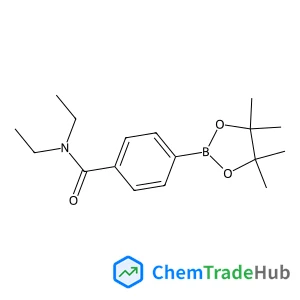
N,N-Diethyl-4-(4,4,5,5-tetramethyl-1,3,2-dioxaborolan-2-yl)benzamide
CAS番号:
325142-99-2
分子式:
C17H26BNO3
おすすめサプライヤー







免責事項
このページに表示される学術雑誌情報は、参考および研究目的のみを目的としています。当社は雑誌出版社とは提携しておらず、投稿の取り扱いも行っておりません。出版に関するお問い合わせは、各雑誌出版社に直接ご連絡ください。
表示されている情報に誤りがある場合は、support@chemtradehub.com までご連絡ください。迅速に確認し、対応いたします。