













Posttranslational modifications of α-conotoxins: sulfotyrosine and C-terminal amidation stabilise structures and increase acetylcholine receptor binding
文献情報
出版日
2021-07-26
DOI
10.1039/D1MD00182E
インパクトファクター
0
著者
Thao N. T. Ho, Han Siean Lee, Shilpa Swaminathan, Lewis Goodwin, Nishant Rai, Brianna Ushay, Richard J. Lewis, K. Johan Rosengren, Anne C. Conibear
原文を見る
要旨
Conotoxins are peptides found in the venoms of marine cone snails. They are typically highly structured and stable and have potent activities at nicotinic acetylcholine receptors, which make them valuable research tools and promising lead molecules for drug development. Many conotoxins are also highly modified with posttranslational modifications such as proline hydroxylation, glutamic acid gamma-carboxylation, tyrosine sulfation and C-terminal amidation, amongst others. The role of these posttranslational modifications is poorly understood, and it is unclear whether the modifications interact directly with the binding site, alter conotoxin structure, or both. Here we synthesised a set of twelve conotoxin variants bearing posttranslational modifications in the form of native sulfotyrosine and C-terminal amidation and show that these two modifications in combination increase their activity at nicotinic acetylcholine receptors and binding to soluble acetylcholine binding proteins, respectively. We then rationalise how these functional differences between variants might arise from stabilization of the three-dimensional structures and interactions with the binding sites, using high-resolution nuclear magnetic resonance data. This study demonstrates that posttranslational modifications can modulate interactions between a ligand and receptor by a combination of structural and binding alterations. A deeper mechanistic understanding of the role of posttranslational modifications in structure–activity relationships is essential for understanding receptor biology and could help to guide structure-based drug design.
関連文献
Hierarchical phenomena in multicomponent liquids: simulation methods, analysis, chemistry
Michael J. Servis, Ernesto Martinez-Baez
2020-03-05
Perspective
DOI: 10.1039/D0CP00164C
Categorization of atomic mixing patterns in bimetallic nanoparticles by the energy competition
Kayoung Yun, Ho-Seok Nam, Seungchul Kim
2020-03-16
Paper
DOI: 10.1039/C9CP06967D
Hydrogen adsorption on two-dimensional germanene and its structural defects: an ab initio investigation
Tran Thi Thu Hanh, Nguyen Minh Phi, Nguyen Van Hoa
2020-03-04
Paper
DOI: 10.1039/D0CP00016G
Interplay between aggregation number, micelle charge and hydration of catanionic surfactants
Žiga Medoš, Sergej Friesen, Richard Buchner, Marija Bešter-Rogač
2020-04-17
Paper
DOI: 10.1039/D0CP00877J
Quantifying the hydration structure of sodium and potassium ions: taking additional steps on Jacob's Ladder
Gregory K. Schenter, John L. Fulton, Thomas Huthwelker, Mahalingam Balasubramanian, Mirza Galib, Marcel D. Baer, Jürg Hutter, Mauro Del Ben, X. S. Zhao
2019-12-19
Paper
DOI: 10.1039/C9CP06161D
Ion migration in Br-doped MAPbI3 and its inhibition mechanisms investigated via quantum dynamics simulations
Yinjie Liao, Lei Tong, Yieqin Yang, Xiaogang Wang
2020-03-10
Paper
DOI: 10.1039/D0CP00866D
Microfluidic out-of-equilibrium control of molecular nanotubes
Björn Kriete, Carolien J. Feenstra, Maxim S. Pshenichnikov
2020-04-21
Paper
DOI: 10.1039/D0CP01734E
Impact of t-butyl substitution in a rubrene emitter for solid state NIR-to-visible photon upconversion
Edvinas Radiunas, Manvydas Dapkevičius, Steponas Raišys, Saulius Juršėnas, Augustina Jozeliūnaitė, Tomas Javorskis, Ugnė Šinkevičiūtė, Edvinas Orentas, Karolis Kazlauskas
2020-03-05
Paper
DOI: 10.1039/D0CP00144A
Effects of fixed charge group physicochemistry on anion exchange membrane permselectivity and ion transport
Yuanyuan Ji, Hongxi Luo, Geoffrey M. Geise
2020-03-16
Paper
DOI: 10.1039/D0CP00018C
Penning spectroscopy and structure of acetylene oligomers in He nanodroplets
S. Mandal, R. Gopal, M. Shcherbinin, A. D’Elia, H. Srinivas, R. Richter, B. Bapat, S. R. Krishnan, V. Sharma
2020-04-21
Paper
DOI: 10.1039/D0CP00689K
こちらもおすすめ
化合物よくある質問
2-ヒドロキシ-5-ニトロベンジンブロモイドの代替品はありますか?
2-ヒドロキシ-5-ニトロベンジンブロモイドは特定の化学反応に適しているため、代替品は限られています。しかし、同様の構造を持つ2-ヒドロキシ-4-ニトロベンジン...
772-33-82-(Bromomethyl)-4-ni...
化合物よくある質問
N-(2-ブロモフェニル)-1-チロール-3-オキソ-3-(ピペリジニル)プロペン-2-イル)ベンゼンアミドを取り扱う際の実験室安全事項は何ですか?
N-(2-ブロモフェニル)-1-チロール-3-オキソ-3-(ピペリジニル)プロペン-2-イル)ベンゼンアミドは有毒で、皮膚や粘膜に刺激を与える可能性があります。...
1800044-77-2N-[(1Z)-1-(2-Bromoph...
化合物よくある質問
1,3プロパンジオール,2-[2-(2アミノ-6クロロ-9Hピリミジン-9-イル)エチル-1,1,2,2-D4]-2,3-ジアセタートの市場動向や研究トレンドはどうですか?
この化合物は、新規治療薬の開発に注目されています。市場では、その有効性と安全性が評価され、研究分野では、分子生物学と医薬化学の新たな発見が期待されています。
1020718-81-31,3-Propanediol, 2-[...
579-44-2Ethanone, 2-hydroxy-...
化合物よくある質問
Succinimidyl-alanyl-phenylalanyl-prolyl-phenylalanine 4-nitroanilide はどの業界で使用されていますか?
Succinimidyl-alanyl-phenylalanyl-prolyl-phenylalanine 4-nitroanilide は主に医薬品開発やポ...
128802-73-3succinimidyl-alanyl-...
化合物よくある質問
メチル6-アミノ-5-クロロピリジン-2-カーボイル酸について、適用される法規ガイドラインは何ですか?
メチル6-アミノ-5-クロロピリジン-2-カーボイル酸(CAS番号: 1256794-05-4)の使用には、GHS( Globally Harmonized S...
1256794-05-4Methyl 6-amino-5-chl...
化合物よくある質問
エチル4-(シクロ Pentagonyl)アミノ-2-メチル硫化基ピリミジン-5-カルボキシレートを取り扱う際の実験室安全事項は何ですか?
取り扱いには、耐薬品性の容器を使用し、通気性の良い場所で操作することを推奨します。漏れ時は、SDS(安全データシート)を参照して適切な措置を取ること。手洗いと洗...
211245-62-4ethyl 4-(cyclopentyl...
化合物よくある質問
(S)-3-ベンZYルピペリジン塩酸塩とは何ですか?
(S)-3-ベンZYルピペリジン塩酸塩は、CAS番号1258940-00-9で表される化合物です。これは、(S)-3-苯基哌啶的盐酸盐であり、主に医薬品の原料と...
1258940-00-9(S)-3-Phenylpiperidi...
化合物よくある質問
3,5-二甲基金剛胺の主な用途は何ですか?
3,5-二甲基金剛胺は、主に医薬品の原料として使用され、また抗うつ薬や抗アルツハイマー薬の開発に利用されます。さらに、化粧品や食品添加物の製造でも重要な役割を果...
19988-45-52-(2,3-Dihydroxyphen...
化合物よくある質問
ビス(4-メチル-2-ペンチル)フェニルカルボン酸エステルの代替品はありますか?
ビス(4-メチル-2-ペンチル)フェニルカルボン酸エステル (CAS番号: 1398066-13-1) の代替品には、ビス(2-エチルヘキシル)フェノールカルボ...
1398066-13-1Bis(4-methyl-2-penty...
掲載誌
おすすめ化合物
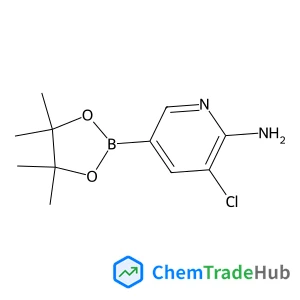
3-Chloro-5-(4,4,5,5-tetramethyl-1,3,2-dioxaborolan-2-yl)-2-pyridinamine
CAS番号:
1032758-99-8
分子式:
C11H16BClN2O2
![2,6-Di(thiophen-2-yl)dithieno[3,2-b:2',3'-d]thiophene structure](https://static.chemtradehub.com/structs/910/910788-24-8-5b70.webp "2,6-Di(thiophen-2-yl)dithieno[3,2-b:2',3'-d]thiophene structure")
![1-[3-(4-Morpholinylsulfonyl)phenyl]methanamine structure](https://static.chemtradehub.com/structs/933/933989-32-3-51af.webp "1-[3-(4-Morpholinylsulfonyl)phenyl]methanamine structure")
おすすめサプライヤー





免責事項
このページに表示される学術雑誌情報は、参考および研究目的のみを目的としています。当社は雑誌出版社とは提携しておらず、投稿の取り扱いも行っておりません。出版に関するお問い合わせは、各雑誌出版社に直接ご連絡ください。
表示されている情報に誤りがある場合は、support@chemtradehub.com までご連絡ください。迅速に確認し、対応いたします。