












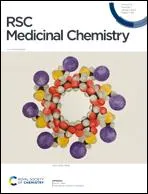
Sulfonium-based liposome-encapsulated antibiotics deliver a synergistic antibacterial activity
文献情報
出版日
2021-05-24
DOI
10.1039/D1MD00091H
インパクトファクター
0
著者
Anjali Patel, Subhasis Dey, Kamal Shokeen, Tomasz M. Karpiński, Senthilkumar Sivaprakasam, Sachin Kumar
原文を見る
要旨
The devastating antibacterial infections, coupled with their antibiotic resistance abilities, emphasize the need for effective antibacterial therapeutics. In this prospect, liposomal delivery systems have been employed in improving the efficacy of the antibacterial agents. The liposome-based antibiotics enhance the therapeutic potential of the new or existing antibiotics and reduce their adverse effects. The current study describes the development of sulfonium-based antibacterial lipids that demonstrate the delivery of existing antibiotics. The presence of cationic sulfonium moieties and inherent membrane targeting abilities of the lipids could help reduce the antibiotic resistance abilities of the bacteria and deliver the antibiotics to remove the infectious pathogens electively. The transmission electron microscopic images and dynamic light scattering analyses revealed the liposome formation abilities of the sulfonium-based amphiphilic compounds in the aqueous medium. The effectiveness of the compounds was tested against the Gram-negative and Gram-positive bacterial strains. The viability of the bacterial cells was remarkably reduced in the presence of the compounds. The sulfonium-based compounds with pyridinium moiety and long hydrocarbon chains showed the most potent antibacterial activities among the tested compounds. Mechanistic studies revealed the membrane-targeted bactericidal activities of the compounds. The potent compound also showed tetracycline and amoxicillin encapsulation and sustained release profiles in the physiologically relevant medium. The tetracycline and amoxicillin-encapsulated lipid showed much higher antibacterial activities than the free antibiotics at similar concentrations, emphasizing the usefulness of the synergistic effect of sulfonium-based lipid and the antibiotics, signifying that the sulfonium lipid penetrated the bacterial membrane and increased the cellular uptake of the antibiotics. The potent lipid also showed therapeutic potential, as it is less toxic to mammalian cells (like HeLa and HaCaT cells) at concentrations higher than their minimum inhibitory concentration values against S. aureus, E. coli, and MRSA. Hence, the sulfonium-based lipid exemplifies a promising framework for assimilating various warheads, and provides a potent antibacterial material.
関連文献
Predicted organic compounds derived from rare gas atoms and formic acid
Min Zhang, Li Sheng
2013-10-15
Paper
DOI: 10.1039/C3CP52175C
Protein destabilisation in ionic liquids: the role of preferential interactions in denaturation
Angelo Miguel Figueiredo, Joao Sardinha, Geoffrey R. Moore, Eurico J. Cabrita
2013-10-03
Paper
DOI: 10.1039/C3CP53395F
Stopped-flow kinetic studies of the formation and disintegration of polyion complex micelles in aqueous solution
Sangui Chen, Zhiyuan Zhu, Shiyong Liu
2013-10-15
Paper
DOI: 10.1039/C3CP53608D
Unravelling the quantum-entanglement effect of noble gas coordination on the spin ground state of CUO
Paweł Tecmer, Katharina Boguslawski, Örs Legeza, Markus Reiher
2013-11-04
Paper
DOI: 10.1039/C3CP53975J
Hydrodeoxygenation by deuterium gas – a powerful way to provide insight into the reaction mechanisms
Glen A. Ferguson, Yunqiao Pu, Fang Huang, Mark Jarvis, Mary Biddy
2013-10-14
Communication
DOI: 10.1039/C3CP53409J
Ground state spectroscopy of hydroxyquinolines: evidence for the formation of protonated species in water-rich dioxane–water mixtures
Osama K. Abou-Zied, John Husband, Najla Al-Lawatia, Thomas B. Steinbrecher
2013-10-10
Paper
DOI: 10.1039/C3CP52811A
Experimental and theoretical investigation of correlated fine structure branching ratios arising from state-selected predissociation of BrO (A2Π3/2)
Michael P. Grubb, Kristin S. Dooley, C. Daniel Freeman, Kirk A. Peterson, Simon W. North
2013-10-29
Paper
DOI: 10.1039/C3CP53766H
In situ deposition of Ag–Ag2S hybrid nanoparticles onto TiO2 nanotube arrays towards fabrication of photoelectrodes with high visible light photoelectrochemical properties
Wenguang Fan, Simon Jewell, Yiyi She, Michael K. H. Leung
2013-11-04
Communication
DOI: 10.1039/C3CP54098G
Decoding the patterns of ubiquitin recognition by ubiquitin-associated domains from free energy simulations
2013-10-25
Paper
DOI: 10.1039/C3CP52436A
Enhanced potassium selectivity in a bioinspired solid nanopore
Fabien Picaud, Sebastian Kraszewski, Christophe Ramseyer, Philippe Déjardin, Jean Marc Janot, François Henn
2013-07-31
Paper
DOI: 10.1039/C3CP52123K
こちらもおすすめ
化合物よくある質問
カルボニル基が付いた5-氰基-1-{[(2-メチル-2-プロpanyl)オキシ]カーボンイル}1H-吲哚-2-イリド-2-ボリン酸はどのように保存すればよいですか?
カルボニル基が付いた5-氰基-1-{[(2-メチル-2-プロpanyl)オキシ]カーボンイル}1H-吲哚-2-イリド-2-ボリン酸は、直射日光を避けて室温(15...
475102-15-9(5-Cyano-1-{[(2-meth...
化合物よくある質問
tert-ブチル2-クロロメチルピリジン-3-基炭酸エステルの市場動向や研究トレンドはどうですか?
この化合物は合成化学分野において、特にピリジン化合物の合成や改良に用いられます。最近の研究では、ピリジン化合物の新規合成法や特性の改良が注目されています。市場動...
1203498-98-9tert-Butyl 2-chloro-...
化合物よくある質問
聚二季戊四醇六丙烯酸酯はどの業界で使用されていますか?
聚二季戊四醇六丙烯酸酯は、医薬品、ポリマー、センサー、半導体などの業界で広く使用されています。特にポリマー業界では硬化剤として、医薬分野では医療機器の製造に使用...
29570-58-93-(Acryloyloxy)-2-({...
化合物よくある質問
1-氯-5-硝基异喹啉の市場動向や研究トレンドはどうですか?
1-氯-5-硝基异喹啉は、薬理学や合成化学の研究分野で注目されています。市場動向としては、その生物学的な活性や合成可能性を評価する研究が増えています。また、代替...
58142-97-51-Chloro-5-nitroisoq...
化合物よくある質問
2-チロール-5-メチルスルフェニル-3-trifルオルメチルベンゼンはどのように合成されますか?
2-チロール-5-メチルスルフェニル-3-trifルオルメチルベンゼンは、トリフルオロメチル化反応と硫化反応を経て合成されます。通常、トリフルオロメチル化剤と硫...
957066-04-51-Chloro-4-(methylsu...
化合物よくある質問
p-トールイルマグネシウムブロミドの物理化学的性質は何ですか?
p-トールイルマグネシウムブロミドのCAS番号は4294-57-9です。この化合物は白色の結晶性粉末で、分子量は204.32です。溶剤中で良好に溶解しますが、水...
4294-57-9p-Tolylmagnesium bro...
化合物よくある質問
1-(5-甲基-2-硫化素基)プロパン-1-酮の市場動向や研究トレンドはどうですか?
1-(5-甲基-2-硫化素基)プロパン-1-酮の市場動向は、化学産業全体の需要に影響を受けますが、最近では pharmaceutical 分野での応用が注目され...
59303-13-81-(5-Methyl-2-thieny...
化合物よくある質問
十一碳烯酰甘氨酸を取り扱う際の実験室安全事項は何ですか?
十一碳烯酰甘氨酸は吸入や皮膚から吸収されることがあり、取り扱う際には防塵マスクと手袋を使用してください。ドラフトチャンバーを用いて漏洩を処理し、適切なSDS(S...
54301-26-7N-10-Undecenoylglyci...
化合物よくある質問
1H,1H-全氟-3,6-二氧杂葵-1-醇を取り扱う際の実験室安全事項は何ですか?
この化合物は吸入や皮膚吸収による毒性があるため、防塵マスク、ゴーグル、防護手袋を使用する必要があります。ドラフトチャンバーでの操作が必要です。漏洩時には即座に換...
152914-73-32,2-Difluoro-2-[1,1,...
化合物よくある質問
3-(4-(フルオロメチルオキシ)フェニル)-1,2,4-オキサジアゾール-5-カルボハイドライドは安全ですか?
安全性は化合物の使用方法によります。直接的な毒性は報告されていませんが、吸入や皮膚接触には注意が必要です。適切な防護服を着用し、換気を図ることを推奨します。
883028-82-83-(4-(Trifluorometho...
掲載誌
おすすめ化合物
おすすめサプライヤー




免責事項
このページに表示される学術雑誌情報は、参考および研究目的のみを目的としています。当社は雑誌出版社とは提携しておらず、投稿の取り扱いも行っておりません。出版に関するお問い合わせは、各雑誌出版社に直接ご連絡ください。
表示されている情報に誤りがある場合は、support@chemtradehub.com までご連絡ください。迅速に確認し、対応いたします。