


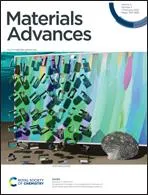
Silver quasi-nanoparticles: bridging the gap between molecule-like clusters and plasmonic nanoparticles
文献情報
出版日
2021-06-30
DOI
10.1039/D1MA00382H
インパクトファクター
0
著者
Fatima Douma, Louwanda Lakiss, Oleg I. Lebedev, Julien Cardin, Krassimir L. Kostov, Jaafar El Fallah, Valentin Valtchev, Mohamad El-Roz
原文を見る
要旨
Herein, we report a new strategy for preparing connected silver sub-nanoparticles with unique optical behavior via the selective photo-assisted electrochemical reduction of silver cations in FAU-type zeolite X (FAUX) cages. Bi2+/Bi3+-doped zeolite nanoparticles (ZX-Bi) were prepared by one-pot hydrothermal synthesis and stabilized as a colloidal water suspension. A ZX-Bi suspension, containing silver nitrate, was subjected to UV irradiation resulting in the reduction of silver cations and the generation of Agn&+ (with n > &) clusters (Ag@ZX-Bi). The physicochemical characterization of the samples, using XRD, TG, N2 sorption, NMR, HRTEM-STEM, ICP, EDX and XPS analyses, provided comprehensive information on the textural and structural properties, the chemical compositions and the metal oxidation states of the samples. Their optical behavior was investigated using UV-visible and photoluminescence spectroscopies. The IR-operando analysis under visible-light revealed local heating of Ag@ZX-Bi up to 400 K. Theoretical calculation of the absorption, scattering, and extinction cross-sections, σabs, σsca and σext, respectively, of the different silver models prepared in this study was in agreement with the experimental data, elucidating the unique optical behavior of the silver particles. The set of analyses shows that quasi-nanoparticles of Ag are formed from bridged Ag clusters (AgCLs) through zeolite channels closing the gap between clusters and plasmonic nanoparticles for the first time.
おすすめジャーナル

Organic Process Research & Development

Journal of Peptide Science

Chemistry Education Research and Practice

Russian Journal of Applied Chemistry

Crystallography Reports

Current Opinion in Solid State & Materials Science

Russian Journal of Organic Chemistry

Acta Materialia

Saudi Pharmaceutical Journal

New Journal of Chemistry
関連文献
Covalent modification of surfaces with porous metal–organic materials
Michael R. Dworzak, Glenn P. A. Yap, Eric D. Bloch
2023-10-09
Paper
DOI: 10.1039/D3TA04662A
NIR-activated quercetin-based nanogels embedded with CuS nanoclusters for the treatment of drug-resistant biofilms and accelerated chronic wound healing
Amit Nain, Yu-Ting Tseng, Akash Gupta, Yu-Feng Lin, Sangili Arumugam, Yu-Fen Huang
2023-09-19
Communication
DOI: 10.1039/D3NH00275F
Ultrahigh-quality graphene resonators by liquid-based strain-engineering
Mario Hofmann, Chi-Te Liang, Ya-Ping Hsieh
2023-11-02
Communication
DOI: 10.1039/D3NH00420A
Polyurethane-based nanocomposite film with thermal deicing capability and anti-erosion for wind turbine blades protection in extreme environments
Xiaofeng Cui, Na Zhang, Ming Huang, Guoli Gao, Shihai Liu, Chuntai Liu
2023-10-14
Paper
DOI: 10.1039/D3TA05595G
Topology driven and soft phonon mode enabled Na-ion diffusion in quaternary chalcogenides, Na3ZnGaX4 (X = S, and Se)
Santhoshkumar Sundaramoorthy, Amitava Choudhury, Naresh C. Osti, Alexander I. Kolesnikov, Matthew B. Stone, Yongqiang Cheng
2023-10-04
Paper
DOI: 10.1039/D3TA04479C
A single-phase gadolinium-doped ceria cathode for highly efficient CO2 electrolysis
Ahmad Shaur, Michel Drazkowski, Shaochen Zhu, Bernard Boukamp
2023-11-03
Paper
DOI: 10.1039/D3TA03977C
Amorphous C/SbSx composites from natural stibnite as low cost and high performance lithium/sodium-ion battery anodes
Shuonan Wang, Kai Zhang, Hao Liu, Libing Liao
2023-10-26
Paper
DOI: 10.1039/D3TA05355E
Rapidly tuning the electrocatalytic activity of perovskite oxides by plasma treatment
2023-11-01
Paper
DOI: 10.1039/D3TA05214A
こちらもおすすめ
化合物よくある質問
アエポキシアビレーターONE酢酸エステルを含む廃棄物はどのように処理すべきですか?
アエポキシアビレーターONE酢酸エステルを含む廃棄物は、焼却や専門廃棄処理が一般的です。具体的には、廃棄物は密閉容器に収集し、適切な温度と湿度の下で保存します。...
2484719-11-9a-Epoxyabiraterone A...
化合物よくある質問
4-ヒドロキシ但線を取り扱う際の実験室安全事項は何ですか?
取り扱いには化学製品安全管理データシート(SDS)を参照してください。温度10℃以下で保存し、密閉容器に保管してください。漏れ時にはドラフトチャンバーを使用し、...
25714-71-04-Hydroxybutanal
化合物よくある質問
4-(3-環戊基尿素)フェノールボロネートはどの業界で使用されていますか?
4-(3-環戊基尿素)フェノールボロネートは主に医薬品産業で使用されています。この化合物は抗炎症薬や抗うつ薬の候補物質として研究されています。また、ポリマー産業...
874297-80-01-Cyclopentyl-3-[4-(...
化合物よくある質問
N~1~-[3-氯-5-(三氟甲基)-2-吡啶]-1,2-乙二胺の市場動向や研究トレンドはどうですか?
市場では、安全性と効果性を基にした化学物質の需要が高まっています。研究分野では、環境に優しい代替品の開発が進んでおり、その結果、この化合物の市場需要は減少傾向に...
219478-19-0N'-[3-chloro-5-(trif...
化合物よくある質問
6-硝基苯并二氢吡喃-4-酮についての法規ガイドラインは何ですか?
6-硝基苯并二氢吡喃-4-酮(CAS番号: 68043-53-8)は、GHS(統一化された化学品の危険性的分類と標識)で急性毒性第4クラスに分類されます。EUで...
68043-53-86-Nitro-2,3-dihydro-...
1016705-16-05-(Hydrazinomethyl)-...
化合物よくある質問
6-乙酰基-2(3H)-苯并噻唑酮は安全ですか?
安全性は化合物の使用方法によります。適切な取扱いと防護措置を講じれば、一定の安全性があります。ただし、吸入や皮膚への接触は避けてください。
133044-44-76-Acetyl-1,3-benzoth...
化合物よくある質問
3-メチル-6-(1-メチルヒドラジニル)ピリジジンはどの業界で使用されていますか?
3-メチル-6-(1-メチルヒドラジニル)ピリジジンは主に医薬品、ポリマー、センサー製造業界で使用されています。特に、医薬品産業では抗がん剤や抗真菌剤の候補物質...
175135-44-13-Methyl-6-(1-methyl...
化合物よくある質問
tert-butyl 5-oxo-2,6-diazaspiro[3.4]octane-2-carboxylateの物理化学的性質は何ですか?
tert-butyl 5-オキソ-2,6-ジアザスパイロ[3.4]オクタネ-2-カルボキサongyangはCAS番号1330765-39-3で、分子量は334....
1330765-39-32-Methyl-2-propanyl ...
化合物よくある質問
3-塩素メチルフェニル-4,4,5,5-テトラメチル-1,3,2-ジオキソボロラノールは安全ですか?
3-塩素メチルフェニル-4,4,5,5-テトラメチル-1,3,2-ジオキソボロラノールは、毒性が低いと考えられていますが、直接的な皮膚接触や吸入は避けるべきです...
1073353-44-22-[3-(Chloromethyl)p...
掲載誌
おすすめ化合物
![(3aS,6aS)-1-Methyloctahydropyrrolo[3,4-b]pyrrole structure](https://static.chemtradehub.com/structs/877/877212-98-1-9157.webp "(3aS,6aS)-1-Methyloctahydropyrrolo[3,4-b]pyrrole structure")
おすすめサプライヤー






免責事項
このページに表示される学術雑誌情報は、参考および研究目的のみを目的としています。当社は雑誌出版社とは提携しておらず、投稿の取り扱いも行っておりません。出版に関するお問い合わせは、各雑誌出版社に直接ご連絡ください。
表示されている情報に誤りがある場合は、support@chemtradehub.com までご連絡ください。迅速に確認し、対応いたします。