


![(1R,5R)-3-{[(2-Methyl-2-propanyl)oxy]carbonyl}-3-azabicyclo[3.1.0]hexane-1-carboxylic acid structure](https://static.chemtradehub.com/structs/116/1165450-63-4-bfe1.webp "(1R,5R)-3-{[(2-Methyl-2-propanyl)oxy]carbonyl}-3-azabicyclo[3.1.0]hexane-1-carboxylic acid structure")
Condensation and growth of amorphous aluminosilicate nanoparticles via an aggregation process
文献情報
出版日
2022-03-19
DOI
10.1039/D1CP05412K
インパクトファクター
3.676
著者
Romain Dupuis, Seung Ho Hahn, Adri C. T. van Duin, Roland J.-M. Pellenq, Arnaud Poulesquen
原文を見る
要旨
The precipitation of zeolite nanoparticles involves the initial formation of metastable precursors, such as amorphous entities, that crystallize through non-classical pathways. Here, using reactive force field-based simulations, we reveal how aluminosilicate oligomers grow concomitantly to the decondensation of silicate entities during the initial step of the reaction. Aluminate clusters first form in the solution, thus violating the Loewenstein rule in the first instant of the reaction, which is then followed by their connection with silicate oligomers at the terminal silanol groups before reorganization to finally diffuse within the silicate oligomers to form stable amorphous aluminosilicate nanoparticles that do obey the Loewenstein rule. Our results clearly indicate that aluminate does not serve as the nucleation center for the growth of aluminosilicates in a nucleation-like process but rather proceeds via an aggregation process. The coexistence of aluminosilicate oligomers and small silicate entities induces a phase separation that promotes the precipitation of zeolites with aging.
おすすめジャーナル

Current Opinion in Colloid & Interface Science

Russian Journal of Bioorganic Chemistry

Russian Journal of Organic Chemistry

Russian Chemical Bulletin

Organic Process Research & Development

Journal of Saudi Chemical Society

Russian Journal of Coordination Chemistry

Journal of Natural Medicines

Acta Materialia

Journal of Peptide Science
関連文献
Statistical terpolymers with thermo-responsive fluorescence response in an ionic liquid: effects of solvatophilicity on LCST phase separation and reversibility
Chi Zhang, Milan Maric
2014-04-16
Paper
DOI: 10.1039/C4PY00300D
Fast and accurate partial hydrolysis of poly(2-ethyl-2-oxazoline) into tailored linear polyethylenimine copolymers
Victor R. de la Rosa, Eva Bauwens, Bryn D. Monnery, Bruno G. De Geest, Richard Hoogenboom
2014-04-11
Paper
DOI: 10.1039/C4PY00355A
A supramolecular approach for fabrication of photo-responsive block-controllable supramolecular polymers
Lichao Liu, Leilei Rui, Yun Gao, Weian Zhang
2014-06-27
Paper
DOI: 10.1039/C4PY00645C
Supramolecular flower micelle formation of polyrotaxane-containing triblock copolymers prepared from macro-chain transfer agents bearing molecular hooks
Atsushi Tamura, Hajime Tanaka, Nobuhiko Yui
2014-05-16
Paper
DOI: 10.1039/C4PY00379A
A well-defined coil–comb polycationic brush with “star polymers” as side chains for gene delivery
Mingming Zhang, Qingqing Xiong, Yinsong Wang, Zhibao Zhang, Wei Shen, Lingrong Liu, Quanyao Wang
2014-04-22
Paper
DOI: 10.1039/C4PY00311J
Reactive macromolecular micelle crosslinked highly elastic hydrogel with water-triggered shape-memory behaviour
Tingting Zhao, Mei Tan, Yulin Cui, Chao Deng, He Huang, Mingyu Guo
2014-05-07
Paper
DOI: 10.1039/C4PY00554F
Synthesis and self-assembly of a novel fluorinated triphilic block copolymer
Xinxin Li, Yanhua Yang, Guojun Li
2014-04-22
Paper
DOI: 10.1039/C4PY00308J
New method for the synthesis of fully aliphatic telechelic α,ω-dihydroxy-polyisobutylene
Marcela Castano, Matthew L. Becker
2014-06-11
Paper
DOI: 10.1039/C4PY00569D
Polythiol copolymers with precise architectures: a platform for functional materials
Morgane Le Neindre, Renaud Nicolaÿ
2014-06-03
Review Article
DOI: 10.1039/C4PY00293H
こちらもおすすめ
化合物よくある質問
2,3-スチオエポキシマドルを取り扱う際の実験室安全事項は何ですか?
取り扱いにはPPE(プロテクティブ・パーソナル・エイド)が必要で、防ぐ手袋と保護眼鏡を着用してください。ドラフトチャンバーの使用を推奨します。漏洩した場合は、適...
4267-80-52,3-Thioepoxy Madol
53981-25-22-Amino-6-fluorophen...
化合物よくある質問
BOC-S-3-アミニ-4-(4-メチオキシベンチル)-ブタン酸の代替品はありますか?
この化合物の代替品としては、BOC保護基を有さないアミノ酸やその他の保護基化合物が考えられます。また、メチオキシ基を有しない他の芳香族アミノ酸も代替品として挙げ...
126800-59-7(3S)-4-(4-Methoxyphe...
化合物よくある質問
Methyl 2-(chloromethyl)-3-nitrobenzoate(1218910-61-2)の代替品はありますか?
Methyl 2-(chloromethyl)-3-nitrobenzoate(1218910-61-2)の代替品としては、化学組成を変えることで効果を達成する...
1218910-61-2Methyl 2-(chlorometh...
化合物よくある質問
(2R)-2-アミノ-N-ベンジル-3-ヒドロキシプロパナミドを含む廃棄物はどのように処理すべきですか?
(2R)-2-アミノ-N-ベンジル-3-ヒドロキシプロパナミドを含む廃棄物は、適切な廃棄物管理ガイドラインに基づき処理する必要があります。まず、廃棄物を適切に収...
175481-39-7(2R)-2-amino-N-benzy...
化合物よくある質問
6,7-二氢-咪唑並[1,2-a]ピリドイン-8(5h)-酮はどのように合成されますか?
6,7-二氢-咪唑並[1,2-a]ピリドイン-8(5h)-酮は、2-ブロモフェニルアセトインとリン酸ハロゲン化物を反応させることで合成できます。この反応は高温で...
457949-09-66,7-Dihydroimidazo[1...
化合物よくある質問
エチル(3R)-3-ピロリジニル酢酸水和塩とは何ですか?
エチル(3R)-3-ピロリジニル酢酸水和塩は、CAS番号1332459-32-1の化合物で、(R)-乙基2-(ピロリジン-3-基)酢酸塩水和塩と呼ばれます。この...
1332459-32-1Ethyl (3R)-3-pyrroli...
化合物よくある質問
(2S)-{[(2-メチルエチルオキシ]カルボニル}アミノ)[2-(トリアフルオロメチルフェニル]エチカシック酸の物理化学的性質は何ですか?
(2S)-{[(2-メチルエチルオキシ]カルボニル}アミノ)[2-(トリアフルオロメチルフェニル]エチカシック酸のCAS番号は1203454-45-8です。この...
1203454-45-8(2S)-({[(2-Methyl-2-...
化合物よくある質問
2-ブロモ-1-(2-メチル-2-プロパニル)-4-ニトロベンゼンはどのように保存すればよいですか?
2-ブロモ-1-(2-メチル-2-プロパニル)-4-ニトロベンゼンは、直射日光を避けて暗所で、室温(約15℃〜25℃)、乾燥した場所に保存する必要があります。ま...
6310-17-42-Bromo-1-(2-methyl-...
化合物よくある質問
1-[(4-硝基フェニル)スルホニル]-1H-1,2,4-三唑の市場動向や研究トレンドはどうですか?
市場動向としては、1-[(4-硝基フェニル)スルホニル]-1H-1,2,4-三唑は主に農業用除草剤や合成化学製品の原料として利用されています。研究トレンドとして...
57777-84-11-[(4-Nitrophenyl)su...
掲載誌
Physical Chemistry Chemical Physics

CiteScore:
5.5
自己引用率:
10.3%
年間論文数:
3036
Physical Chemistry Chemical Physics (PCCP) is an international journal co-owned by 19 physical chemistry and physics societies from around the world. This journal publishes original, cutting-edge research in physical chemistry, chemical physics and biophysical chemistry. To be suitable for publication in PCCP, articles must include significant innovation and/or insight into physical chemistry; this is the most important criterion that reviewers and Editors will judge against when evaluating submissions. The journal has a broad scope and welcomes contributions spanning experiment, theory, computation and data science. Topical coverage includes spectroscopy, dynamics, kinetics, statistical mechanics, thermodynamics, electrochemistry, catalysis, surface science, quantum mechanics, quantum computing and machine learning. Interdisciplinary research areas such as polymers and soft matter, materials, nanoscience, energy, surfaces/interfaces, and biophysical chemistry are welcomed if they demonstrate significant innovation and/or insight into physical chemistry. Joined experimental/theoretical studies are particularly appreciated when complementary and based on up-to-date approaches.
おすすめ化合物
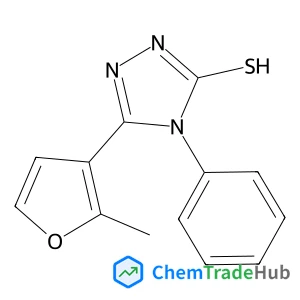
5-(2-Methyl-3-furyl)-4-phenyl-2,4-dihydro-3H-1,2,4-triazole-3-thione
CAS番号:
346464-59-3
分子式:
C13H11N3OS
![8-Bromo-6-fluoro[1,2,4]triazolo[1,5-a]pyridin-2-amine structure](https://static.chemtradehub.com/structs/125/1257705-51-3-9f4a.webp "8-Bromo-6-fluoro[1,2,4]triazolo[1,5-a]pyridin-2-amine structure")
おすすめサプライヤー




免責事項
このページに表示される学術雑誌情報は、参考および研究目的のみを目的としています。当社は雑誌出版社とは提携しておらず、投稿の取り扱いも行っておりません。出版に関するお問い合わせは、各雑誌出版社に直接ご連絡ください。
表示されている情報に誤りがある場合は、support@chemtradehub.com までご連絡ください。迅速に確認し、対応いたします。