












![4-[2-(Trichlorosilyl)ethyl]benzenesulfonyl chloride structure](https://static.chemtradehub.com/structs/797/79793-00-3-de16.webp "4-[2-(Trichlorosilyl)ethyl]benzenesulfonyl chloride structure")
Thermostable water reservoirs in the interlayer space of a sodium hectorite clay through the intercalation of γ-aminopropyl(dimethyl)ethoxysilane in toluene
文献情報
出版日
2021-12-08
DOI
10.1039/D1CP03321B
インパクトファクター
3.676
著者
Waldemar Keil, Kai Zhao, Arthur Oswald, Wolfgang Bremser, Claudia Schmidt, Horst Hintze-Bruening
原文を見る
要旨
Treatment of Na+-based hectorite LAPONITE® (LAP) and of Na+-montmorillonite (MMT) with a homologous series of γ-aminopropyl(methyl)x(ethoxy)ysilanes (x + y = 3, y > 0) in toluene was studied by means of thermogravimetric analysis coupled with mass spectrometry, infrared spectroscopy, 29Si and 23Na solid-state nuclear magnetic resonance spectroscopy and powder X-ray diffraction. The triethoxy silane (APTS) exclusively grafts on the clays' edges as branched oligomers whereas both the monoethoxy silane (APMS) and the diethoxy silane (APDS) are also intercalated, the latter as linear oligomers. Intercalation of APMS varies for MMT and LAP: MMT hosts the smallest amounts of the silanes with marginal increase of the basal distance and no stabilization of water. On the contrary, LAP accommodates the largest amount of guests in the form of monomeric APMS which yields the largest increase of the basal distance and stabilizes water up to 200 °C when APMS dimerizes. APMS stabilization is attributed to intramolecular Si–O–H–NH2 hydrogen bonds and the hydrophobic geminal methyl groups together with the trimethylene sides of the cyclic monomers are thought to compartmentalize the hydrated sodium sites. The high temperature release of water from APMS@LAP is discussed in the light of potentially triggered interphase degradation in composite materials for recycling purposes.
おすすめジャーナル
関連文献
A detailed comparison of centrifugal sudden and J-shift estimates of the reactive properties of the N + N2 reaction
Antonio Laganà, Dimitris Skouteris
2009-10-27
Paper
DOI: 10.1039/B915409D
Theoretical and REMPI spectroscopic study on phenylhydrazine and phenylhydrazine–(Ar)n (n = 1, 2) van der Waals complexes
Daoqing Xiao, Dan Yu, Xiling Xu, Zijun Yu, Min Cheng, Yikui Du, Weijun Zheng, Qihe Zhu, Cunhao Zhang
2009-02-27
Paper
DOI: 10.1039/B818688J
Spectroscopical properties of organic/metal nanohybrids
Giovanna Dellepiane, Carla Cuniberti, Marina Alloisio, Anna Demartini
2010-02-03
Paper
DOI: 10.1039/B912921A
Interdiffusion and surface-sandwich ordering in initial Ni-core–Pd-shell nanoparticle
Alexander V. Evteev, Elena V. Levchenko, Irina V. Belova, Graeme E. Murch
2009-03-16
Paper
DOI: 10.1039/B822112J
Structural and electrochemical studies of Au–Pt nanoalloys
Aurelien Habrioux, Walter Vogel, Maxime Guinel, Laure Guetaz, Karine Servat, Boniface Kokoh, Nicolas Alonso-Vante
2009-03-03
Paper
DOI: 10.1039/B820668F
An experimental confirmation of the products of the reaction between CN radicals and NH3
Mark A. Blitz, Paul W. Seakins, Ian W. M. Smith
2009-10-20
Communication
DOI: 10.1039/B917734E
Parameterizations for ice nucleation in biological and atmospheric systems
Thomas Koop
2009-09-30
Paper
DOI: 10.1039/B914289D
Electron spin relaxation at low field
Per-Olof Westlund, Håkan Wennerström
2009-11-06
Paper
DOI: 10.1039/B916999G
こちらもおすすめ
化合物よくある質問
2-氟-4-イオドベンzo酸エチルエステルを取り扱う際の実験室安全事項は何ですか?
2-氟-4-イオドベンzo酸エチルエステルは有機溶媒を用いた反応であり、ドラフトチャンバーでの操作が必要です。漏洩時にはSDS参照の安全措置を講じ、PPE(防護...
205750-82-9Benzoic acid, 2-fluo...
化合物よくある質問
血根碱の主な用途は何ですか?
血根碱は主に医薬分野で利用され、抗炎症や抗がん剤としての潜在的な効果が研究されています。また、化学研究や薬物開発において、新しい薬剤設計の参考となる化合物として...
2447-54-313-Methyl[1,3]benzod...
化合物よくある質問
Methyl 3-methoxythiophene-2-carboxylateの主な用途は何ですか?
Methyl 3-メトキシスチフェン-2-カルボン酸メチルエステルは、薬品合成、染料製造、以及合成中間体としての用途が広がっています。
62353-75-7Methyl 3-methoxythio...
化合物よくある質問
丹磺酰-L-亮氨酸はどのように保存すればよいですか?
丹磺酰-L-亮氨酸は乾燥した場所で、直射日光から保護し、低温(室温以下)で保存してください。密閉容器に入れて保管することをおすすめします。
1100-22-7N-{[5-(Dimethylamino...
化合物よくある質問
5-(苄氧基)ピラミジン-4-アミンの代替品はありますか?
5-(苄氧基)ピラミジン-4-アミンの代替品として、6-メトキシピラミジンや5-フェニルピラミジンなどが挙げられます。これらの化合物は、5-(苄氧基)ピラミジン...
92289-50-45-benzyloxypyrimidin...
化合物よくある質問
8-ヒドロキシノルデコペントアセートの物理化学的性質は何ですか?
8-ヒドロキシノルデコペントアセートはCAS番号84807-87-4の化合物で、分子量は750.02 uです。これは油溶性で、水に溶けにくい特徴があります。反応...
84807-87-4(5Z,8Z,11Z,13E,15S)-...
化合物よくある質問
tert-ブチル(エス)-1-ヒドロキシペンタ-4-エン-2-イルカルバamateの主な用途は何ですか?
tert-ブチル(エス)-1-ヒドロキシペンタ-4-エン-2-イルカルバamateは主に医薬品の合成材料や分析化学の試薬として使用されます。
116613-81-12-Methyl-2-propanyl ...
化合物よくある質問
ブコール-L-2-フローヨルブリンについて適切な法規ガイドラインは何ですか?
ブコール-L-2-フローヨルブリン(CAS番号: 1196107-73-9)は、GHS(グローバルハザードアサessmentシステム)に基づく危害分類と表示が求...
1196107-73-92-Bromo-13,13-dimeth...
化合物よくある質問
6-ブロモ-N-環丙基-2-ピリジニニメタンの市場動向や研究トレンドはどうですか
6-ブロモ-N-環丙基-2-ピリジニニメタンは、薬理学研究や合成化学に使用される化合物であり、特に抗ウイルス薬や抗がん薬の開発に注目されています。市場では、薬物...
959237-20-86-Bromo-N-cyclopropy...
化合物よくある質問
RS-AMPÀはどのように保存すればよいですか?
RS-AMPÀは、遮光容器に保存し、室温(15〜25℃)で保管することが推奨されます。高湿や熱は物質を劣化させるため、湿度は50%以下に保つことが重要です。また...
74341-63-2(RS)-AMPA
掲載誌
Physical Chemistry Chemical Physics

CiteScore:
5.5
自己引用率:
10.3%
年間論文数:
3036
Physical Chemistry Chemical Physics (PCCP) is an international journal co-owned by 19 physical chemistry and physics societies from around the world. This journal publishes original, cutting-edge research in physical chemistry, chemical physics and biophysical chemistry. To be suitable for publication in PCCP, articles must include significant innovation and/or insight into physical chemistry; this is the most important criterion that reviewers and Editors will judge against when evaluating submissions. The journal has a broad scope and welcomes contributions spanning experiment, theory, computation and data science. Topical coverage includes spectroscopy, dynamics, kinetics, statistical mechanics, thermodynamics, electrochemistry, catalysis, surface science, quantum mechanics, quantum computing and machine learning. Interdisciplinary research areas such as polymers and soft matter, materials, nanoscience, energy, surfaces/interfaces, and biophysical chemistry are welcomed if they demonstrate significant innovation and/or insight into physical chemistry. Joined experimental/theoretical studies are particularly appreciated when complementary and based on up-to-date approaches.
おすすめ化合物
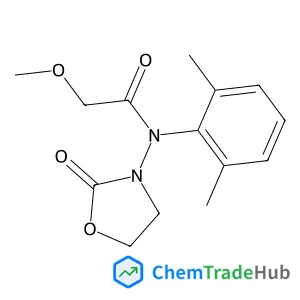
N-(2,6-Dimethylphenyl)-2-methoxy-N-(2-oxo-1,3-oxazolidin-3-yl)acetamide
CAS番号:
77732-09-3
分子式:
C14H18N2O4
おすすめサプライヤー



免責事項
このページに表示される学術雑誌情報は、参考および研究目的のみを目的としています。当社は雑誌出版社とは提携しておらず、投稿の取り扱いも行っておりません。出版に関するお問い合わせは、各雑誌出版社に直接ご連絡ください。
表示されている情報に誤りがある場合は、support@chemtradehub.com までご連絡ください。迅速に確認し、対応いたします。