













Industrial feasibility of anodic hydrogen peroxide production through photoelectrochemical water splitting: a techno-economic analysis
文献情報
出版日
2020-04-17
DOI
10.1039/D0SE00524J
インパクトファクター
6.367
著者
Kasper Wenderich, Wouter Kwak, Alexa Grimm, Gert Jan Kramer, Guido Mul, Bastian Mei
原文を見る
要旨
Photoelectrochemical (PEC) water splitting is a promising approach to drive green, carbon-free production of hydrogen (H2). In ‘classic’ water splitting, oxygen (O2) is formed at the anode as a by-product. It has been suggested that substitution of anodic O2 production with hydrogen peroxide (H2O2) could increase the financial attractiveness of PEC water splitting. Here, we present a techno-economic analysis of a photoelectrochemical H2/H2O2 process. Specifically, we model photoelectrochemical farms with industrially relevant production capacities. Two scenarios are considered: (i) a theoretical scenario with an optimal solar-to-hydrogen (STH) efficiency of 27.55% and (ii) a literature-based state-of-the-art scenario with an STH efficiency of 10.1%. When applying an averaged market value of $0.85 kg−1 for H2O2, the analysis reveals a negative levelized cost of hydrogen (LCH) for scenario (i), i.e. $6.45 kg−1, and for scenario (ii) an LCH of $6.19 kg−1. Our results imply that these values are superior to the LCH of ‘classic’ PEC water splitting (ca. $10 kg−1), while the negative value for scenario (i) even outcompetes the LCH of steam methane reforming ($1.4 kg−1). We predict that significant reduction in the LCH can be realized within the PEC community when future research is aimed at enhancing the stability of the photoanode and optimizing the STH efficiency for anodic H2O2 formation. This manuscript clearly demonstrates the financial benefits of value-added product formation, such as hydrogen peroxide, over O2 formation. In a broader context, our analysis verifies that further research on valuable commodity chemicals at the anode in water splitting and CO2 reduction should be stimulated in the future to facilitate implementation of emerging, cost-intensive technologies.
おすすめジャーナル
関連文献
Synthesis and water sorption of standard and end-capped polylactides: the effect of morphology
Donghun Koo, An Du, Giuseppe R. Palmese, Richard A. Cairncross
2012-01-04
Paper
DOI: 10.1039/C2PY00549B
PEGylated conjugated polyelectrolytes containing 2,1,3-benzoxadiazole units for targeted cell imaging
Jie Liu, Dan Ding, Junlong Geng, Bin Liu
2012-04-13
Paper
DOI: 10.1039/C2PY20113E
Combination of phosphazene base and triisobutylaluminum for the rapid synthesis of polyhydroxy telechelic poly(propylene oxide)
2012-03-02
Paper
DOI: 10.1039/C2PY20014G
Synthesis and post-polymerization modification of poly(pentafluorophenyl methacrylate) brushes
Kemal Arda Günay, Nicolas Schüwer, Harm-Anton Klok
2012-05-02
Paper
DOI: 10.1039/C2PY20162C
Preparation of block copolymer particles by two-step, reversible chain transfer catalyzed polymerization (RTCP) with nitrogencatalyst in miniemulsion systems
Yukiya Kitayama, Mika Yorizane, Hideto Minami
2012-03-30
Communication
DOI: 10.1039/C2PY20120H
Poly(dopamine acrylamide)-co-poly(propargyl acrylamide)-modified titanium surfaces for ‘click’ functionalization
Li Qun Xu, Hua Jiang, Koon-Gee Neoh, En-Tang Kang, Guo Dong Fu
2012-01-30
Paper
DOI: 10.1039/C2PY00552B
Three new conjugated polymers based on benzo[2,1-b:3,4-b′]dithiophene: synthesis, characterization, photoinduced charge transfer and theoretical calculation studies
Shaojie Chen, Qiuyu Zhang, Hepeng Zhang, Junwei Gu, Mingliang Ma, Tiejun Xin, Yanyang Zhou, Jian Zhou, Qing Liu
2012-06-07
Paper
DOI: 10.1039/C2PY20122D
Benzoxazine-based phosphinated bisphenols and their application in preparing flame-retardant, low dielectric cyanate ester thermosets
Hou Chien Chang, Hung Tse Lin, Ching Hsuan Lin
2012-02-01
Paper
DOI: 10.1039/C2PY00528J
Synthesis by nitroxide-mediated aqueous dispersion polymerization, characterization, and physical core-crosslinking of pH- and thermoresponsive dynamic diblock copolymer micelles
Guillaume Delaittre, Maud Save, Marianne Gaborieau, Patrice Castignolles, Jutta Rieger, Bernadette Charleux
2012-04-17
Paper
DOI: 10.1039/C2PY20084H
こちらもおすすめ
化合物よくある質問
6- bromo-1-cyclopropyl-1H-benzimidazoleの市場動向や研究トレンドはどうですか?
6- bromo-1-cyclopropyl-1H-benzimidazoleは、抗炎症、抗ウイルス作用を持つことが報告されており、新薬開発の研究対象として注目...
1416713-53-56-Bromo-1-cyclopropy...
化合物よくある質問
環氧プロpanol-d5を取り扱う際の実験室安全事項は何ですか?
取り扱う際には、防護眼鏡と手袋を使用し、ドラフトチャンバー内で操作することを推奨します。漏洩時には適切な手順で処理し、安全データシートを常に参照してください。
1246819-20-4Glycidol-d5
化合物よくある質問
2,2’-ジメチル-3,3’-ビピリジンはどのように合成されますか?
2,2’-ジメチル-3,3’-ビピリジンは、ピリジンと2-メチルアクリルアミドを有機合成反応で合成します。この反応では、ピリジンと2-メチルアクリルアミドを含有...
86156-55-02,2’-Dimethyl-3,3’-b...
化合物よくある質問
6-甲基ピリジン-2-ボリック酸の主な用途は何ですか?
6-甲基ピリジン-2-ボリック酸は、合成化学、医薬品合成、以及研究用途などに広く使用され、特に組換えDNA技術や分子生物学の研究において重要な役割を果たします。
372963-50-3(6-Methyl-2-pyridiny...
化合物よくある質問
(R)-3-(1-甲基-2-氧環己基)プロpano酸メチルは安全ですか?
(R)-3-(1-甲基-2-氧環己基)プロpano酸メチルは一定の安全性がありますが、直接的な皮膚接触や吸入は避けるべきです。使用する際は適切な個々の安全データ...
94089-47-1methyl 3-[(1R)-1-met...
化合物よくある質問
ketorolacはどのように保存すればよいですか?
ketorolacは、密封して遮光容器に保管し、直射日光や高温を避けて保存してください。温度は常温で保存し、湿度をなるべく低く保つことが推奨されます。
74103-06-3rac Ketorolac
化合物よくある質問
L-2,3-二氨基丙酸二盐酸盐を取り扱う際の実験室安全事項は何ですか?
L-2,3-二氨基丙酸二盐酸盐は腐食性が強く、皮膚や粘膜に刺激を与える可能性があります。取り扱う際は、防塵マスク、ゴーグル、手袋を使用し、適切な排気設備を使用し...
19777-68-5(S)-2,3-Diaminopropa...
化合物よくある質問
2-(4-溴ピリジン-2-基)乙腈の物理化学的性質は何ですか?
2-(4-溴ピリジン-2-基)乙腈のCAS番号は312325-73-8です。主に結晶形態で存在し、分子量は159.01 g/molです。この化合物は水に溶けやす...
312325-73-8(4-Bromo-2-pyridinyl...
化合物よくある質問
3-フローロ-[1,1-ベンジレン]-3,4-ジカルボン酸を取り扱う際の実験室安全事項は何ですか?
この化合物は毒性は低いですが、直接的な接触や吸入に注意が必要です。PPE(個人防護具)を着用し、ドラフトチャンバーを使用して操作することを推奨します。また、漏洩...
1261915-32-53'-Fluoro-[1,1'-biph...
化合物よくある質問
3-(1-氧代-1,3-二氢-2H-2-异吲哚)丙酸の主な用途は何ですか?
3-(1-氧代-1,3-二氢-2H-2-异吲哚)丙酸は、薬理学研究や医薬品製造において広く用いられる化合物です。また、工業的な用途でも一部の化学反応の触媒や助剤...
83747-30-23-(1-Oxo-1,3-dihydro...
掲載誌
おすすめ化合物
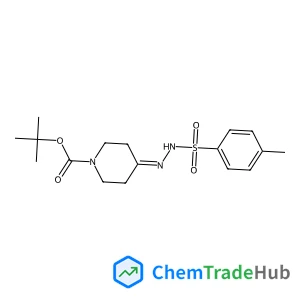
tert-Butyl 4-(2-(p-Tolylsulfonyl)hydrazono)piperidine-1-carboxylate
CAS番号:
1046478-89-0
分子式:
C17H25N3O4S
![4-[(3-Chloro-2-fluorophenyl)amino]-7-methoxy-6-quinazolinyl acetate structure](https://static.chemtradehub.com/structs/740/740081-22-5-f58f.webp "4-[(3-Chloro-2-fluorophenyl)amino]-7-methoxy-6-quinazolinyl acetate structure")
4-[(3-Chloro-2-fluorophenyl)amino]-7-methoxy-6-quinazolinyl acetate
CAS番号:
740081-22-5
分子式:
C17H13ClFN3O3
おすすめサプライヤー





免責事項
このページに表示される学術雑誌情報は、参考および研究目的のみを目的としています。当社は雑誌出版社とは提携しておらず、投稿の取り扱いも行っておりません。出版に関するお問い合わせは、各雑誌出版社に直接ご連絡ください。
表示されている情報に誤りがある場合は、support@chemtradehub.com までご連絡ください。迅速に確認し、対応いたします。