












Solvent-free manufacture of methacrylate polymers from biomass pyrolysis products
文献情報
出版日
2020-12-08
DOI
10.1039/D0RE00419G
インパクトファクター
4.239
著者
J. Ryan, M. T. Elsmore, E. R. Binner, D. S. A. De Focatiis, D. J. Irvine, J. P. Robinson
原文を見る
要旨
This work demonstrates a novel approach to add value to pyrolysis liquids by exploiting the diverse range of alcohol functional groups present within the mixture to yield a non-energy product, without requiring extensive separation. It is shown that 79.2% of the alcohol functional groups can be converted by esterification and subsequently polymerised (85.7%) to produce a range of polymer products with peak molecular weight (Mp) ranging from 22.9–36.9 kDa. Thermal and rheological properties of the most promising pyrolysis material have been compared with conventional poly(butyl methacrylate) (pBMA) of similar molecular weight, showing viability as a potential replacement owing to similarities in its thermorheological behaviour. A low molecular weight wax component of the novel polymer has been identified as a possible plasticizing agent, causing some decreases in viscosity. Production of the monomer is achieved in one reaction step and without separation or the use of toxic reagents. The overall mass balance and relevance to a biorefinery process is highlighted and strategies to tune the process to vary glass transition temperature (Tg) and Mp are discussed.
関連文献
Relations between 77Se NMR chemical shifts of (phenylseleno)benzenes and their molecular structures derived from nine X-ray crystal structures
Jette Oddershede, Lars Henriksen, Sine Larsen
2003-02-21
Paper
DOI: 10.1039/B211130F
The oxa-Michael reaction in the synthesis of 5- and 6-membered oxygen-containing heterocycles
Tauqir Ahmad, Nisar Ullah
2021-01-19
Review Article
DOI: 10.1039/D0QO01312A
Palladium catalyzed C–C and C–N bond forming reactions: an update on the synthesis of pharmaceuticals from 2015–2020
Jayachandra Rayadurgam, Sravani Sana, M. Sasikumar, Qiong Gu
2020-11-11
Review Article
DOI: 10.1039/D0QO01146K
Photochemical synthesis of 3-hydroxyphenanthro[9,10-c]furan-1(3H)-ones from α-keto acids and alkynes
Beibei Zhao, Zhen Zhang, Yu Ge, Pinhua Li, Tao Miao
2021-01-04
Research Article
DOI: 10.1039/D0QO01487G
In the first proven SN2′ fullerene reaction, both C3 and C1 C60F36 hydrolyse to C1 isomers of C60F35OH that eliminate HF to give epoxides C60F34O; C60F36O oxides are shown to be ethers, and a fourth isomer of C60F36 exists
Anthony G. Avent, Ala'a K. Abdul-Sada, Brian W. Clare, David L. Kepert, Joan M. Street, Roger Taylor
2003-02-24
Paper
DOI: 10.1039/B209760P
An electrochemical perspective on the roles of ligands in the merger of transition-metal catalysis and electrochemistry
Jun-Song Zhong, Yi Yu, Zhaojiang Shi, Ke-Yin Ye
2020-12-28
Review Article
DOI: 10.1039/D0QO01227K
Sequence-controlled supramolecular copolymer constructed by self-sorting assembly of multiple noncovalent interactions
Hui Li, Ying Yang, Fenfen Xu, Zhaozhao Duan, Riqiang Li, Herui Wen, Wei Tian
2021-01-28
Research Article
DOI: 10.1039/D0QO01540G
Macrocyclic and acyclic supramolecular elements for co-precipitation of square-planar gold(iii) tetrahalide complexes
Cassandra C. Shaffer, Bradley D. Smith
2021-01-28
Highlight
DOI: 10.1039/D0QO01562H
こちらもおすすめ
化合物よくある質問
1-{3-[5-(エチルカルボンイル)-2,4-ジメチル-1H-ピロロール-3-基]プロパニル}ピペリジン-4-カルボン酸について、適用される法規ガイドラインは何ですか?
この化合物はCAS番号1142209-81-1であり、GHS分類では corrosive (腐食性物質) と classified (分類物質) として指定され...
1142209-81-11-{3-[5-(Ethoxycarbo...
化合物よくある質問
2,2-二氟-1,3-ベンゾジオキサン-5-カルボキシlic酸とは何ですか?
2,2-二氟-1,3-ベンゾジオキサン-5-カルボキシlic酸は、CAS番号656-46-2の化合物で、化学式はC8H4F2O4です。この化合物は白色の結晶性粉...
656-46-22,2-Difluoro-1,3-ben...
化合物よくある質問
8-氯-4-色原酮の代替品はありますか?
8-氯-4-色原酮(CAS番号: 49701-11-3)の代替品には、他の色原酮類似物や、構造が似ている化合物があります。例えば、8-メチル-4-色原酮や、他の...
49701-11-38-Chloro-2,3-dihydro...
化合物よくある質問
エチル6,6-ジメチル-4,5,6,7-テトラヒドロ-1H-インドアゼー-3-カルボキシレートとは何ですか?
エチル6,6-ジメチル-4,5,6,7-テトラヒドロ-1H-インドアゼー-3-カルボキシレートは、CAS番号1233243-56-5を有する化合物です。これは有...
1233243-56-5Ethyl 6,6-dimethyl-4...
化合物よくある質問
4-叔丁基-6-氯-嘧啶に適用される法規ガイドラインは何ですか?
4-叔丁基-6-氯-嘧啶はCAS番号3435-24-3で、GHS分類では毒性物質とみなし、GHSの危険性分類が適用されます。REACH規則では登録が必要で、Eu...
3435-24-34-Tert-butyl-6-chlor...
化合物よくある質問
維库溴铵杂质Bはどのように合成されますか?
維库溴铵杂质Bは、アンドロステンデンから始まり、一連の合成反応、包括的な選択性と高い収率で合成されます。具体的には、ブロミド化、酸化、ジマーゼ反応、アミド化など...
50587-95-6(2beta,3alpha,5alpha...
化合物よくある質問
2-(4-氟苄基)-吡咯烷の物理化学的性質は何ですか?
CAS番号350017-04-8の2-(4-氟苄基)-吡咯烷は、結晶性の白色粉末です。分子量は199.17 g/molで、水に溶けにくいです。化学反応では比較的...
350017-04-82-(4-Fluorobenzyl)py...
化合物よくある質問
3-喹啉甲醛(2-チロール-8-エチル)は安全ですか?
3-喹啉甲醛(2-チロール-8-エチル)は一定の毒性を持つため、取扱には注意が必要です。使用する際は適切な防護具を着用し、密閉容器で保管・搬送し、直接的な接触を...
335196-05-92-Chloro-8-ethyl-3-q...
化合物よくある質問
エチル3-(ヒドロキシメチル)-1H-ピロール-2-カルボキシレートはどのように保存すればよいですか?
エチル3-(ヒドロキシメチル)-1H-ピロール-2-カルボキシレートは、室温(25℃)以下で保存し、直射日光を避け、乾燥した環境で保管することが推奨されます。ま...
75448-69-0Ethyl 3-(hydroxymeth...
119410-05-88-Chloro-11-(4-piper...
掲載誌
Reaction Chemistry & Engineering

CiteScore:
0
自己引用率:
8.8%
年間論文数:
284
Reaction Chemistry & Engineering is an interdisciplinary journal reporting cutting-edge research focused on enhancing the understanding and efficiency of reactions. Reaction engineering leverages the interface where fundamental molecular chemistry meets chemical engineering and technology. Challenges in chemistry can be overcome by the application of new technologies, while engineers may find improved solutions for process development from the latest developments in reaction chemistry. Reaction Chemistry & Engineering is a unique forum for researchers whose interests span the broad areas of chemical engineering and chemical sciences to come together in solving problems of importance to wider society. All papers should be written to be approachable by readers across the engineering and chemical sciences. Papers that consider multiple scales, from the laboratory up to and including plant scale, are particularly encouraged.
おすすめ化合物
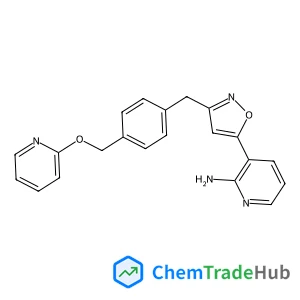
3-(3-(4-((Pyridin-2-yloxy)methyl)benzyl)isoxazol-5-yl)pyridin-2-amine
CAS番号:
936339-60-5
分子式:
C21H18N4O2
おすすめサプライヤー






免責事項
このページに表示される学術雑誌情報は、参考および研究目的のみを目的としています。当社は雑誌出版社とは提携しておらず、投稿の取り扱いも行っておりません。出版に関するお問い合わせは、各雑誌出版社に直接ご連絡ください。
表示されている情報に誤りがある場合は、support@chemtradehub.com までご連絡ください。迅速に確認し、対応いたします。