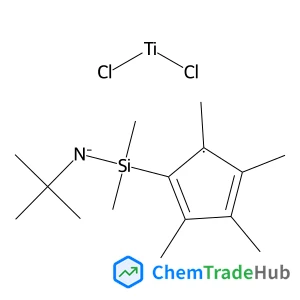
2,3,4,5-TETRAMETHYLCYCLOPENTADIENEDIMETHYLSILYL-TERT-BUTYLAMIDO TITANIUM DICHLORIDE
CAS番号:
135072-61-6
分子式:
C15H27Cl2NSiTi-
Pradeep Lamichhane, Ramhari Paneru, Linh N. Nguyen, Jun Sup Lim, Pradeep Bhartiya, Bishwa Chandra Adhikari, Sohail Mumtaz, Eun Ha Choi
In this study, nitrogen fixation in water was achieved using an atmospheric pressure non-thermal nitrogen plasma jet generated with an AC driven source of a 10 kV (peak) power supply with a repetition frequency of 33 kHz. Plasma has been proposed for the excitation of nitrogen gas, which can be readily converted to ammonia, nitrite, nitrate, and hydrogen ions in plasma-activated water. In addition, some easily accessible metals such as Mg, Al, Zn, and Cu were immersed separately in the water. These immersed metals oxidized in the plasma-activated water and the released electron reduced the hydrogen ion into a hydrogen atom. The evolved hydrogen again reduced the plasma-excited nitrogen into ammonia. In our experiment, the pH value and ammonia synthesis rate were higher with Mg owing to its higher oxidation capacity than other metals. The reduction of hydrogen ions with the help of metals not only controls the pH of PAW but also increases the ammonia synthesis rate by providing an additional hydrogen donor. Our studies provide a new direction for ongoing research in the field of sustainable nitrogen fixation.
Gavin W. J. Twaddle, Dmitry V. Yashunsky, Andrei V. Nikolaev
DOI: 10.1039/B210661M
Jacob A. Theruvathu
DOI: 10.1039/B212194H
Beibei Zhao, Zhen Zhang, Yu Ge, Pinhua Li, Tao Miao
DOI: 10.1039/D0QO01487G
Fushuai Li, Shuai Liang, Yepeng Luan, Xuling Chen, Hanhui Zhao, Anqi Huang, Pengfei Li, Wenjun Li
DOI: 10.1039/D0QO01505A
Mingjun Zhang, Xin Ding, Aidang Lu, Jin Kang, Yongyue Gao, Ziwen Wang, Hongyan Li, Qingmin Wang
DOI: 10.1039/D0QO01413C
Jianrong Liu
DOI: 10.1039/D1QO00001B
Sergei Katsyuba, Alla Chernova, Reinhard Schmutzler
DOI: 10.1039/B211164K
Manuel Angulo, Christoph Hawat, Hans-Jörg Hofmann, Stefan Berger
DOI: 10.1039/B211134A
この化合物はCAS番号1142209-81-1であり、GHS分類では corrosive (腐食性物質) と classified (分類物質) として指定され...
2,2-二氟-1,3-ベンゾジオキサン-5-カルボキシlic酸は、CAS番号656-46-2の化合物で、化学式はC8H4F2O4です。この化合物は白色の結晶性粉...
8-氯-4-色原酮(CAS番号: 49701-11-3)の代替品には、他の色原酮類似物や、構造が似ている化合物があります。例えば、8-メチル-4-色原酮や、他の...
エチル6,6-ジメチル-4,5,6,7-テトラヒドロ-1H-インドアゼー-3-カルボキシレートは、CAS番号1233243-56-5を有する化合物です。これは有...
4-叔丁基-6-氯-嘧啶はCAS番号3435-24-3で、GHS分類では毒性物質とみなし、GHSの危険性分類が適用されます。REACH規則では登録が必要で、Eu...
維库溴铵杂质Bは、アンドロステンデンから始まり、一連の合成反応、包括的な選択性と高い収率で合成されます。具体的には、ブロミド化、酸化、ジマーゼ反応、アミド化など...
CAS番号350017-04-8の2-(4-氟苄基)-吡咯烷は、結晶性の白色粉末です。分子量は199.17 g/molで、水に溶けにくいです。化学反応では比較的...
3-喹啉甲醛(2-チロール-8-エチル)は一定の毒性を持つため、取扱には注意が必要です。使用する際は適切な防護具を着用し、密閉容器で保管・搬送し、直接的な接触を...
エチル3-(ヒドロキシメチル)-1H-ピロール-2-カルボキシレートは、室温(25℃)以下で保存し、直射日光を避け、乾燥した環境で保管することが推奨されます。ま...

Reaction Chemistry & Engineering is an interdisciplinary journal reporting cutting-edge research focused on enhancing the understanding and efficiency of reactions. Reaction engineering leverages the interface where fundamental molecular chemistry meets chemical engineering and technology. Challenges in chemistry can be overcome by the application of new technologies, while engineers may find improved solutions for process development from the latest developments in reaction chemistry. Reaction Chemistry & Engineering is a unique forum for researchers whose interests span the broad areas of chemical engineering and chemical sciences to come together in solving problems of importance to wider society. All papers should be written to be approachable by readers across the engineering and chemical sciences. Papers that consider multiple scales, from the laboratory up to and including plant scale, are particularly encouraged.