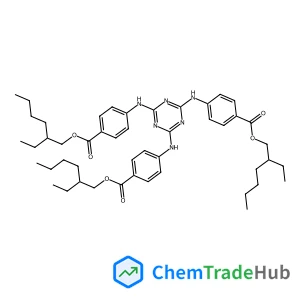
Tris(2-ethylhexyl) 4,4',4''-(1,3,5-triazine-2,4,6-triyltriimino)tribenzoate
CAS番号:
88122-99-0
分子式:
C48H66N6O6
Anna Bukowski, Leonhard Schill, David Nielsen, Susanne Mossin, Anders Riisager, Jakob Albert
Supported vanadium-substituted Keggin polyoxometalates (POMs) were applied as catalysts for the selective catalytic reduction of NO using NH3 as reductant (NH3-SCR). Interestingly, HPA-3 (H6PV3Mo9O40) was found to be the most active catalytic species, and TiO2 (anatase) the most promoting support for the SCR reaction in the temperature range 200–350 °C. Moreover, 10 wt% HPA-3 loading was found to be optimum resulting in nearly complete NO conversion at 350 °C. Characterization by several techniques, including N2-physisorption, NH3-TPD, FTIR, XPS and TEM showed distinctive structural HPA-3 support interactions explaining the beneficial interplay between both parts for the SCR reaction. Furthermore, different catalytically active surface species were identified at various reaction temperatures and SCR conditions by in situ EPR spectroscopy. The study introduces a novel type of heterogeneous supported vanadium-based NH3-SCR catalysts comprising redox-active POMs, which so far mainly have been applied for homogeneously catalyzed reactions.
Hao-Yang Liu, Xiao Li, Zhi-Gang Wang
DOI: 10.1039/D3CS90101G
Enzo Brack, Marc-Georg Willinger, Christophe Copéret
DOI: 10.1039/D3SC04711C
Siyong Shen, Pengwei Sun, Zhi Gu, Yifei Bai, Xianglin Wang
DOI: 10.1039/D2CS00889K
Tatsuya Higaki, Jake C. Russell, Daniel W. Paley, Xavier Roy, Rongchao Jin
DOI: 10.1039/D3SC02753H
María Lago-Silva, Manuel Fernández-Míguez, Rafael Rodríguez, Emilio Quiñoá, Félix Freire
DOI: 10.1039/D3CS00952A
Hao-Yang Liu, Xiao Li, Zhi-Gang Wang
DOI: 10.1039/D3CS00138E
Yudong Xue
DOI: 10.1039/D3CS00706E
Dameng Yang, Nicholas J. Turner
DOI: 10.1039/D3CS00391D
この化合物はCAS番号1142209-81-1であり、GHS分類では corrosive (腐食性物質) と classified (分類物質) として指定され...
2,2-二氟-1,3-ベンゾジオキサン-5-カルボキシlic酸は、CAS番号656-46-2の化合物で、化学式はC8H4F2O4です。この化合物は白色の結晶性粉...
8-氯-4-色原酮(CAS番号: 49701-11-3)の代替品には、他の色原酮類似物や、構造が似ている化合物があります。例えば、8-メチル-4-色原酮や、他の...
エチル6,6-ジメチル-4,5,6,7-テトラヒドロ-1H-インドアゼー-3-カルボキシレートは、CAS番号1233243-56-5を有する化合物です。これは有...
4-叔丁基-6-氯-嘧啶はCAS番号3435-24-3で、GHS分類では毒性物質とみなし、GHSの危険性分類が適用されます。REACH規則では登録が必要で、Eu...
維库溴铵杂质Bは、アンドロステンデンから始まり、一連の合成反応、包括的な選択性と高い収率で合成されます。具体的には、ブロミド化、酸化、ジマーゼ反応、アミド化など...
CAS番号350017-04-8の2-(4-氟苄基)-吡咯烷は、結晶性の白色粉末です。分子量は199.17 g/molで、水に溶けにくいです。化学反応では比較的...
3-喹啉甲醛(2-チロール-8-エチル)は一定の毒性を持つため、取扱には注意が必要です。使用する際は適切な防護具を着用し、密閉容器で保管・搬送し、直接的な接触を...
エチル3-(ヒドロキシメチル)-1H-ピロール-2-カルボキシレートは、室温(25℃)以下で保存し、直射日光を避け、乾燥した環境で保管することが推奨されます。ま...

Reaction Chemistry & Engineering is an interdisciplinary journal reporting cutting-edge research focused on enhancing the understanding and efficiency of reactions. Reaction engineering leverages the interface where fundamental molecular chemistry meets chemical engineering and technology. Challenges in chemistry can be overcome by the application of new technologies, while engineers may find improved solutions for process development from the latest developments in reaction chemistry. Reaction Chemistry & Engineering is a unique forum for researchers whose interests span the broad areas of chemical engineering and chemical sciences to come together in solving problems of importance to wider society. All papers should be written to be approachable by readers across the engineering and chemical sciences. Papers that consider multiple scales, from the laboratory up to and including plant scale, are particularly encouraged.