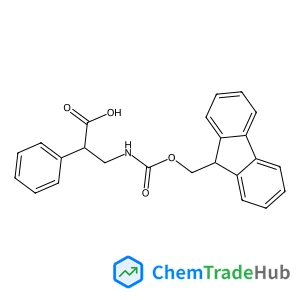
(S)-3-((((9H-Fluoren-9-yl)methoxy)carbonyl)amino)-2-phenylpropanoic acid
CAS番号:
1217663-60-9
分子式:
C24H21NO4
Jian-Shu Wang, Lingyun Yao, Jun Ying, Xiaoling Luo
A palladium-catalyzed regioselective cyclocarbonylation of N-(2-pyridyl)sulfonyl (N-SO2Py)-2-iodoanilines with allenes has been developed. With the assistance of the directing group N-SO2Py, the regioselectivity of arylallenes was reversed and the reaction proceeded well to give various 3-methylene-2,3-dihydroquinolin-4(1H)-ones with up to 95% yield by using benzene-1,3,5-triyl triformate (TFBen) as the CO source. Control experiments and DFT calculations were performed to understand the reaction details and a possible reaction mechanism is proposed accordingly.
Md. Badruz Zaman, David Bardelang, Xiaohua Wu, Dashan Wang, James C. Margeson, Donald M. Leek, John A. Ripmeester, Christopher I. Ratcliffe, Quan Lin, Bai Yang, Kui Yu
DOI: 10.1039/B913914A
Guido Verniest, Karel Piron, Eva Van Hende, Jan Willem Thuring, Gregor Macdonald, Frederik Deroose, Norbert De Kimpe
DOI: 10.1039/C003380D
Jun Yin, Chunyan Chi, Jishan Wu
DOI: 10.1039/C001343A
Gerhard Bringmann, Tobias A. M. Gulder, Andreas Hamm, Michael Goodfellow, Hans-Peter Fiedler
DOI: 10.1039/B910501H
Cai-Feng Wang, Dong-Ping Li, Xin Chen, Xiao-Ming Li, Yi-Zhi Li, Jing-Lin Zuo, Xiao-Zeng You
DOI: 10.1039/B916637H
Mrinmoyee Basu, Suresh Sarkar, Surojit Pande, Subhra Jana, Arun Kumar Sinha, Sougata Sarkar, Mukul Pradhan, Anjali Pal, Tarasankar Pal
DOI: 10.1039/B905718H
Min Jung Kim, Kyung Mi Lee, Arun R. Jagdale, Youngmee Kim, Sung-Jin Kim, Kyung Ho Yoo
DOI: 10.1039/B913809A
Alma R. Morales, Gheorghe Luchita, Ciceron O. Yanez, Mykhailo V. Bondar, Olga V. Przhonska
DOI: 10.1039/B925934A
Min Jung Jou, Xiaoqiang Chen, Ha Na Kim, Hae-Jo Kim, Sang-gi Lee
DOI: 10.1039/B917832E
6- bromo-1-cyclopropyl-1H-benzimidazoleは、抗炎症、抗ウイルス作用を持つことが報告されており、新薬開発の研究対象として注目...
取り扱う際には、防護眼鏡と手袋を使用し、ドラフトチャンバー内で操作することを推奨します。漏洩時には適切な手順で処理し、安全データシートを常に参照してください。
2,2’-ジメチル-3,3’-ビピリジンは、ピリジンと2-メチルアクリルアミドを有機合成反応で合成します。この反応では、ピリジンと2-メチルアクリルアミドを含有...
6-甲基ピリジン-2-ボリック酸は、合成化学、医薬品合成、以及研究用途などに広く使用され、特に組換えDNA技術や分子生物学の研究において重要な役割を果たします。
(R)-3-(1-甲基-2-氧環己基)プロpano酸メチルは一定の安全性がありますが、直接的な皮膚接触や吸入は避けるべきです。使用する際は適切な個々の安全データ...
ketorolacは、密封して遮光容器に保管し、直射日光や高温を避けて保存してください。温度は常温で保存し、湿度をなるべく低く保つことが推奨されます。
L-2,3-二氨基丙酸二盐酸盐は腐食性が強く、皮膚や粘膜に刺激を与える可能性があります。取り扱う際は、防塵マスク、ゴーグル、手袋を使用し、適切な排気設備を使用し...
2-(4-溴ピリジン-2-基)乙腈のCAS番号は312325-73-8です。主に結晶形態で存在し、分子量は159.01 g/molです。この化合物は水に溶けやす...
この化合物は毒性は低いですが、直接的な接触や吸入に注意が必要です。PPE(個人防護具)を着用し、ドラフトチャンバーを使用して操作することを推奨します。また、漏洩...
3-(1-氧代-1,3-二氢-2H-2-异吲哚)丙酸は、薬理学研究や医薬品製造において広く用いられる化合物です。また、工業的な用途でも一部の化学反応の触媒や助剤...

Organic Chemistry Frontiers publishes high-quality research from across organic chemistry. Emphases are placed on studies that make significant contributions to the field of organic chemistry by reporting either new or significantly improved protocols or methodologies. Topics include, but are not limited to the following: Organic synthesis Development of synthetic methodologies Catalysis Natural products Functional organic materials Supramolecular and macromolecular chemistry Physical and computational organic chemistry