












State-of-the-art palladium-catalyzed alkoxycarbonylations
文献情報
出版日
2020-11-19
DOI
10.1039/D0QO01203C
インパクトファクター
5.281
著者
Rui Sang, Yuya Hu, Rauf Razzaq, Ralf Jackstell, Matthias Beller
原文を見る
要旨
Palladium-catalyzed alkoxycarbonylation reactions allow for the efficient conversion of widely available unsaturated compounds, CO and alcohols into the corresponding carboxylic acid derivatives. A driving force for the development of new and improved catalytic methodologies is the design and synthesis of ligands, which fine-tune the properties of the metal center. In general, alternation of the ligand backbone and substituents adjusts the electronic and steric properties of the active catalyst species to control activity and selectivity of a given catalytic process. Therefore, our group has a long-standing interest in ligand developments. In the past decade, several classes of ligands have been developed by us for palladium-catalyzed carbonylation reactions, which are summarized in this article. As an example, mono- and bidentate phosphines with heteroaromatic backbones were prepared to overcome the limitations of known catalyst systems. The common feature of all these ligands is the function of the integrated base, which acts as a proton shuttle for the formation of the palladium hydride and the rate-determining N-assisted alcoholysis. On the other hand, the basic substituent improves the durability of the catalyst via hemilabile coordination to the palladium center in the catalytic cycle.
関連文献
Organocatalytic kinetic resolution via intramolecular aldol reactions: Enantioselective synthesis of both enantiomers of chiral cyclohexenones
Liujuan Chen, Sanzhong Luo, Jiuyuan Li, Xin Li, Jin-Pei Cheng
2010-04-01
Paper
DOI: 10.1039/B927343C
Synthesis of aminomethylated 4-fluoropiperidines and 3-fluoropyrrolidines
Guido Verniest, Karel Piron, Eva Van Hende, Jan Willem Thuring, Gregor Macdonald, Frederik Deroose, Norbert De Kimpe
2010-04-21
Communication
DOI: 10.1039/C003380D
N3-Alkylation during formation of quinazolin-4-ones from condensation of anthranilamides and orthoamides
Amit Nathubhai, Richard Patterson, Timothy J. Woodman, Miranda T. Y. Chui, Hugo H. K. Chung, Stephanie W. S. Lau, Jun Zheng, Matthew D. Lloyd, Andrew S. Thompson, Michael D. Threadgill
2011-05-26
Paper
DOI: 10.1039/C1OB05430A
Simultaneous blue, green, and red emission from diblock copolymer micellar films: a new approach to white-light emission
Ruobing Wang, Juan Peng, Feng Qiu, Yuliang Yang, Zhiyuan Xie
2009-10-15
Communication
DOI: 10.1039/B915378K
Pyrophosphate selective fluorescent chemosensors based on coumarin–DPA–Cu(ii) complexes
Min Jung Kim, Kyung Mi Lee, Arun R. Jagdale, Youngmee Kim, Sung-Jin Kim, Kyung Ho Yoo
2009-10-22
Communication
DOI: 10.1039/B913809A
Studies on the reaction of glutathione and formaldehyde using NMR
Richard J. Hopkinson, Philippa S. Barlow, Christopher J. Schofield, Timothy D. W. Claridge
2010-08-24
Paper
DOI: 10.1039/C0OB00208A
Solution-processable semiconducting thin-film transistors using single-walled carbon nanotubes chemically modified by organic radical initiators
Chun Wei Lee, Xuanding Han, Fuming Chen, Yanping Xu, Yizhong Huang, Mary B. Chan-Park, Peng Chen, Lain-Jong Li
2009-10-27
Communication
DOI: 10.1039/B915508B
Hydroxylation of benzophenone with ammonium phosphomolybdate in the solid state via UV photoactivation
Mrinmoyee Basu, Suresh Sarkar, Surojit Pande, Subhra Jana, Arun Kumar Sinha, Sougata Sarkar, Mukul Pradhan, Anjali Pal, Tarasankar Pal
2009-10-15
Communication
DOI: 10.1039/B905718H
Effect of substituents of alloxazine derivatives on the selectivity and affinity for adenine in AP-site-containing DNA duplexes
Burki Rajendar, Arivazhagan Rajendran, Zhiqiang Ye, Eriko Kanai, Yusuke Sato, Marek Sikorski
2010-08-31
Paper
DOI: 10.1039/C0OB00057D
Silver-catalysed protodecarboxylation of carboxylic acids
Lukas J. Gooßen, Christophe Linder, Nuria Rodríguez, Paul P. Lange, Andreas Fromm
2009-10-28
Communication
DOI: 10.1039/B912509D
こちらもおすすめ
化合物よくある質問
環戊烷-1,3-二甲酸甲酯はどのように合成されますか?
環戊烷-1,3-二甲酸甲酯は、環戊烷と塩酸によるヒンデンブルク反応を経由して合成されます。この反応では、環戊烷が塩酸と作用し、1,3-ジカルボキシ基が導入されま...
2435-36-1Dimethyl 1,3-cyclope...
化合物よくある質問
4-メトキシ-1,2,3-スチアゼ-3,5-ジオンとは何ですか?
4-メトキシ-1,2,3-スチアゼ-3,5-ジオンは、CAS番号107843-77-6の化合物で、(E)-ベンジル3-(3,4-ジヒドロキシフェニル) acry...
107843-77-6(E)-Benzyl 3-(3,4-di...
化合物よくある質問
プロスタグランジンA2について「に適用される法規ガイドラインは何ですか?'
プロスタグランジンA2 (CAS番号: 41691-92-3) は、化学物質の安全管理に関する規制として、GHS (危険物質の国際的ハザード分類・ラベル付けシス...
41691-92-316,16-DIMETHYL PROST...
化合物よくある質問
4-アミノ-1-ナフタレン sulfonic 酸についての物理化学的性質は何ですか?
4-アミノ-1-ナフタレン sulfonic 酸のCAS番号は84-86-6です。この化合物は結晶性で、分子量は212.15 g/molです。アルコールや水など...
84-86-64-Amino-1-naphthalen...
化合物よくある質問
N-GlcNAc-生物素を取り扱う際の実験室安全事項は何ですか?
N-GlcNAc-生物素は吸収性があり、皮膚や目への接触を避けることが重要です。PPE(個体保護具)は使用し、ドラフトチャンバーは必要に応じて使用します。漏洩時...
1272755-69-72-Acetamido-2-deoxy-...
化合物よくある質問
3-アミノメチルフローラノピペリジン-1-カルボニル酸テルブチルエステルとは何ですか?
CAS番号1209781-11-2の3-アミノメチルフローラノピペリジン-1-カルボニル酸テルブチルエステルは、有機化合物の一種で、化学式はC10H17FNO3...
1209781-11-22-Methyl-2-propanyl ...
化合物よくある質問
6-溴-1-甲基-1H-ベンゾ[d][1,2,3]三氮唑はどのように合成されますか?
6- bromo-1-methyl-1H-benzotriazoleは、ブロモフリオリンと1-メチル-1H-ベンゾ[d][1,2,3]三氮唑の反応により合成され...
944718-32-56-Bromo-1-methyl-1H-...
化合物よくある質問
4-硫代尿苷はどのように合成されますか?
4-硫代尿苷は、尿素とD-リボシルヒドロキシアルデヒドを用いてスルホン化反応を経て合成されます。通常は塩酸ヒドロキシチオニルスルホン酸などの触媒を使用し、選択性...
6741-73-71-(4-thio-beta-D-rib...
化合物よくある質問
ブレインナトリユリックペプチド32ラットとは何ですか?
ブレインナトリユリックペプチド32ラット(CAS番号: 133448-20-1)は、心臓で作られるホルモンの一つで、心不全の診断や予後評価に使用されます。
133448-20-1Brain Natriuretic Pe...
化合物よくある質問
1-(3-氮杂啶)-4-羟基哌啶双盐酸盐の物理化学的性質は何ですか?
CAS番号810680-60-5の1-(3-氮杂啶)-4-羟基哌啶双盐酸盐は、白色の結晶性粉末である。分子量は360.84 g/molで、水に溶けやすい。反応活...
810680-60-51-(3-Azetidinyl)-4-p...
掲載誌
Organic Chemistry Frontiers

CiteScore:
7.8
自己引用率:
8.7%
年間論文数:
724
Organic Chemistry Frontiers publishes high-quality research from across organic chemistry. Emphases are placed on studies that make significant contributions to the field of organic chemistry by reporting either new or significantly improved protocols or methodologies. Topics include, but are not limited to the following: Organic synthesis Development of synthetic methodologies Catalysis Natural products Functional organic materials Supramolecular and macromolecular chemistry Physical and computational organic chemistry
おすすめ化合物
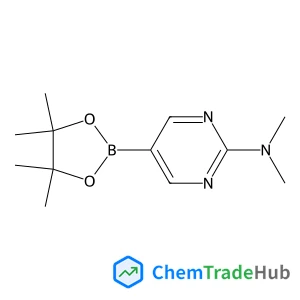
N,N-Dimethyl-5-(4,4,5,5-tetramethyl-1,3,2-dioxaborolan-2-yl)-2-pyrimidinamine
CAS番号:
1032759-30-0
分子式:
C12H20BN3O2
おすすめサプライヤー




免責事項
このページに表示される学術雑誌情報は、参考および研究目的のみを目的としています。当社は雑誌出版社とは提携しておらず、投稿の取り扱いも行っておりません。出版に関するお問い合わせは、各雑誌出版社に直接ご連絡ください。
表示されている情報に誤りがある場合は、support@chemtradehub.com までご連絡ください。迅速に確認し、対応いたします。