












Mapping the resources and approaches facilitating computer-aided synthesis planning
文献情報
出版日
2020-08-28
DOI
10.1039/D0QO00946F
インパクトファクター
5.281
著者
Zheng Wang, Wei Zhao, Gefei Hao, Baoan Song
原文を見る
要旨
Despite continuously significant breakthroughs in academia, organic synthesis remains the rate-limiting step everywhere, especially in a research environment where budget, manpower, and materials are increasingly restricted. Computer-aided synthesis planning (CASP) is a promising area of research with potential to have a tremendous impact on drug discovery, industrial chemistry, and materials science. Recently, there has been a boom in the growth of synthesis data and the application of artificial intelligence (AI) in CASP has been revitalized. However, a study of the available resources and approaches that can facilitate AI-driven organic synthesis has not been performed. This review critically examines the state of resources and approaches necessary in CASP, including big data, algorithms, and their features, advantages, limitations, and programming barriers. We conclude by outlining routes to lower the threshold for CASP research, as well as addressing research questions for the present and forecasting their role in next-generation CASP systems.
関連文献
Site-specific incorporation of perylene into an N-terminally modified light-harvesting complex II‡
Kalina Peneva, Kristina Gundlach, Andreas Herrmann, Harald Paulsen, Klaus Müllen
2010-09-06
Communication
DOI: 10.1039/C0OB00492H
Synthesis of oligoribonucleotides with phosphonate-modified linkages
Ondřej Páv, Ivana Košiová, Ivan Barvík, Radek Pohl, Miloš Buděšínský, Ivan Rosenberg
2011-06-15
Paper
DOI: 10.1039/C1OB05488K
Molecular recognition of cationic phenothiazinium and phenoxazinium dyes with π-extended 2′-deoxyadenosine nucleotides
Karina Mondragón-Vásquez, Hugo Morales-Rojas
2009-10-06
Communication
DOI: 10.1039/B913315A
Combination of chiroptical, absorption and fluorescence spectroscopic methods reveals multiple, hydrophobicity-driven human serum albumin binding of the antimalarial atovaquone and related hydroxynaphthoquinone compounds
Ferenc Zsila, Ilona Fitos
2010-08-24
Paper
DOI: 10.1039/C0OB00124D
Lamellar transition-metal molybdate–CTA mesostructured composites (metal = Ni, Co): one-pot synthesis and application in treatment of acid fuchsine
Hong-Bin Yao, Xiao-Bo Li, Shu-Juan Liu, Shu-Hong Yu
2009-10-06
Communication
DOI: 10.1039/B914329G
Intrinsic acidity and electrophilicity of gaseous propargyl/allenyl carbocations
Priscila M. Lalli, Yuri E. Corilo, Patrícia V. Abdelnur, Marcos N. Eberlin
2010-03-29
Paper
DOI: 10.1039/C001985B
Salt, pH and thermoresponsive supramolecular hydrogel of N-(4-n-tetradecyloxybenzoyl)-l-carnosine
Amrita Pal, Saurabh Shrivastava, Joykrishna Dey
2009-10-06
Communication
DOI: 10.1039/B914665B
Pyrophosphate selective fluorescent chemosensors based on coumarin–DPA–Cu(ii) complexes
Min Jung Kim, Kyung Mi Lee, Arun R. Jagdale, Youngmee Kim, Sung-Jin Kim, Kyung Ho Yoo
2009-10-22
Communication
DOI: 10.1039/B913809A
Abiesatrines A–J: anti-inflammatory and antitumor triterpenoids from Abies georgei Orr
Su-Mei Li, Liang Wu, Yong-Li Li, Lin Feng, Yun-Heng Shen, Jun-Mian Tian, Jian Tang, Ning Wang, Yonghong Liu, Wei-Dong Zhang
2010-04-07
Paper
DOI: 10.1039/C001885F
こちらもおすすめ
化合物よくある質問
環戊烷-1,3-二甲酸甲酯はどのように合成されますか?
環戊烷-1,3-二甲酸甲酯は、環戊烷と塩酸によるヒンデンブルク反応を経由して合成されます。この反応では、環戊烷が塩酸と作用し、1,3-ジカルボキシ基が導入されま...
2435-36-1Dimethyl 1,3-cyclope...
化合物よくある質問
4-メトキシ-1,2,3-スチアゼ-3,5-ジオンとは何ですか?
4-メトキシ-1,2,3-スチアゼ-3,5-ジオンは、CAS番号107843-77-6の化合物で、(E)-ベンジル3-(3,4-ジヒドロキシフェニル) acry...
107843-77-6(E)-Benzyl 3-(3,4-di...
化合物よくある質問
プロスタグランジンA2について「に適用される法規ガイドラインは何ですか?'
プロスタグランジンA2 (CAS番号: 41691-92-3) は、化学物質の安全管理に関する規制として、GHS (危険物質の国際的ハザード分類・ラベル付けシス...
41691-92-316,16-DIMETHYL PROST...
化合物よくある質問
4-アミノ-1-ナフタレン sulfonic 酸についての物理化学的性質は何ですか?
4-アミノ-1-ナフタレン sulfonic 酸のCAS番号は84-86-6です。この化合物は結晶性で、分子量は212.15 g/molです。アルコールや水など...
84-86-64-Amino-1-naphthalen...
化合物よくある質問
N-GlcNAc-生物素を取り扱う際の実験室安全事項は何ですか?
N-GlcNAc-生物素は吸収性があり、皮膚や目への接触を避けることが重要です。PPE(個体保護具)は使用し、ドラフトチャンバーは必要に応じて使用します。漏洩時...
1272755-69-72-Acetamido-2-deoxy-...
化合物よくある質問
3-アミノメチルフローラノピペリジン-1-カルボニル酸テルブチルエステルとは何ですか?
CAS番号1209781-11-2の3-アミノメチルフローラノピペリジン-1-カルボニル酸テルブチルエステルは、有機化合物の一種で、化学式はC10H17FNO3...
1209781-11-22-Methyl-2-propanyl ...
化合物よくある質問
6-溴-1-甲基-1H-ベンゾ[d][1,2,3]三氮唑はどのように合成されますか?
6- bromo-1-methyl-1H-benzotriazoleは、ブロモフリオリンと1-メチル-1H-ベンゾ[d][1,2,3]三氮唑の反応により合成され...
944718-32-56-Bromo-1-methyl-1H-...
化合物よくある質問
4-硫代尿苷はどのように合成されますか?
4-硫代尿苷は、尿素とD-リボシルヒドロキシアルデヒドを用いてスルホン化反応を経て合成されます。通常は塩酸ヒドロキシチオニルスルホン酸などの触媒を使用し、選択性...
6741-73-71-(4-thio-beta-D-rib...
化合物よくある質問
ブレインナトリユリックペプチド32ラットとは何ですか?
ブレインナトリユリックペプチド32ラット(CAS番号: 133448-20-1)は、心臓で作られるホルモンの一つで、心不全の診断や予後評価に使用されます。
133448-20-1Brain Natriuretic Pe...
化合物よくある質問
1-(3-氮杂啶)-4-羟基哌啶双盐酸盐の物理化学的性質は何ですか?
CAS番号810680-60-5の1-(3-氮杂啶)-4-羟基哌啶双盐酸盐は、白色の結晶性粉末である。分子量は360.84 g/molで、水に溶けやすい。反応活...
810680-60-51-(3-Azetidinyl)-4-p...
掲載誌
Organic Chemistry Frontiers

CiteScore:
7.8
自己引用率:
8.7%
年間論文数:
724
Organic Chemistry Frontiers publishes high-quality research from across organic chemistry. Emphases are placed on studies that make significant contributions to the field of organic chemistry by reporting either new or significantly improved protocols or methodologies. Topics include, but are not limited to the following: Organic synthesis Development of synthetic methodologies Catalysis Natural products Functional organic materials Supramolecular and macromolecular chemistry Physical and computational organic chemistry
おすすめ化合物
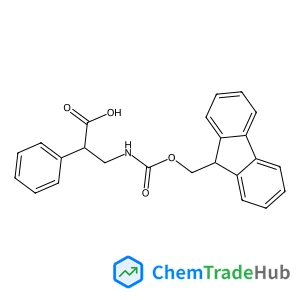
(S)-3-((((9H-Fluoren-9-yl)methoxy)carbonyl)amino)-2-phenylpropanoic acid
CAS番号:
1217663-60-9
分子式:
C24H21NO4
おすすめサプライヤー



免責事項
このページに表示される学術雑誌情報は、参考および研究目的のみを目的としています。当社は雑誌出版社とは提携しておらず、投稿の取り扱いも行っておりません。出版に関するお問い合わせは、各雑誌出版社に直接ご連絡ください。
表示されている情報に誤りがある場合は、support@chemtradehub.com までご連絡ください。迅速に確認し、対応いたします。