












Organic micro/nanoscale materials for photonic barcodes
文献情報
出版日
2020-08-04
DOI
10.1039/D0QO00613K
インパクトファクター
5.281
著者
Yue Hou, Zhenhua Gao, Yong Sheng Zhao, Yongli Yan
原文を見る
要旨
Photonic barcodes have attracted extensive attention due to their promising applications in multiplexed high throughput bioassays, item tracking, information security, etc. Organic luminescent materials, capable of assembling into various micro/nanostructures as a result of their outstanding processability, afford a fundamental model for designing novel micro/nanoscale photonic barcodes. In this highlight, we review recent advances in micro/nanoscale photonic barcodes based on organic materials. This highlight starts by introducing the significance of tiny photonic barcodes and discussing why organics have become dominant. Then we present the research progress on organic photonic barcodes in terms of a series of strategies including graphical encoding, spectroscopic encoding and a combination of them both. In the following part, we focus on the construction of covert photonic barcodes based on near-infrared luminescence and responsive excited state processes, which have shown great potential in advanced anti-counterfeiting. Finally, we present our views on the current challenges and the future development of organic micro/nanoscale photonic barcodes. We believe that a comprehensive understanding on this topic would significantly contribute to the advancement of organic photonic barcodes for a broad range of applications.
関連文献
Structural influence of proteins upon adsorption to MoS2 nanomaterials: comparison of MoS2 force field parameters
Zonglin Gu, Phil De Luna, Zaixing Yang
2016-12-15
Paper
DOI: 10.1039/C6CP05260F
An unexpected bridge between chemical bonding indicators and electrical conductivity through the localization tensor
Ángel Martín Pendás, José Manuel Guevara-Vela, Daniel Menéndez Crespo, Aurora Costales, Evelio Francisco
2016-12-12
Paper
DOI: 10.1039/C6CP07617C
Molecular qubits based on potentially nuclear-spin-free nickel ions
K. Bader, S. H. Schlindwein, D. Gudat
2016-12-21
Paper
DOI: 10.1039/C6CP08161D
A new potential for methylammonium lead iodide
C. M. Handley, C. L. Freeman
2016-12-08
Paper
DOI: 10.1039/C6CP05829A
Structural phase transitions of (Bi1−xSbx)2(Te1−ySey)3 compounds under high pressure and the influence of the atomic radius on the compression processes of tetradymites
Zhenhai Yu, Yong Wang, John Schneeloch, Chunyu Li, Ruidan Zhong, Zhiguo Liu, Genda Gu
2016-12-14
Paper
DOI: 10.1039/C6CP07324G
Inorganically coated colloidal quantum dots in polar solvents using a microemulsion-assisted method
Facundo C. Herrera, Martín Mizrahi, Cristina Navío, Ramón Bernardo-Gavito, Daniel Granados, Félix G. Requejo
2016-12-08
Paper
DOI: 10.1039/C6CP06982G
The impact of the structuring of hydrotropes in water on the mesoscale solubilisation of a third hydrophobic component
Thomas Buchecker, Sebastian Krickl, Robert Winkler, Isabelle Grillo, Pierre Bauduin, Didier Touraud, Arno Pfitzner, Werner Kunz
2016-11-30
Paper
DOI: 10.1039/C6CP06696H
Enhanced electrooxidation of glucose at nano-chitosan–NiOOH modified GC electrode: fuel blends and hydrocarbon impurities
Christina Roth
2016-12-22
Paper
DOI: 10.1039/C6CP08360A
こちらもおすすめ
化合物よくある質問
4'-ブロモビフェニル-3-メトークシーディ.ActionBarはどのように保存すればよいですか?
4'-ブロモビフェニル-3-メトークシーディ.ActionBarは、冷暗所で、直射日光を避け、密栓の容器に保存し、遠隔場所に保管してください。温度は常温(0〜2...
149506-25-24'-Bromo-biphenyl-3-...
2947-60-6(3-Methylphenyl)acet...
化合物よくある質問
2-異丙基フェニルヒドラジン塩酸塩とは何ですか?
2-異丙基フェニルヒドラジン塩酸塩は、CAS番号58928-82-8を有する化合物で、構造式はC11H14N2HClです。これは塩基性化合物であり、水に溶けやす...
58928-82-8(2-Isopropylphenyl)h...
化合物よくある質問
5-(4-クロロフェニル)-4H-1,2,4-三氮唑-3-アミンを取り扱う際の実験室安全事項は何ですか?
5-(4-クロロフェニル)-4H-1,2,4-三氮唑-3-アミンは取り扱いに注意が必要です。PPEとして防塵マスク、ゴーグル、手袋を使用し、ドラフトチャンバーを...
98554-00-85-(4-Chlorophenyl)-1...
化合物よくある質問
去甲基雷贝拉唑硫醚はどのように合成されますか?
去甲基雷贝拉唑硫醚は、ベンジミダゾール硫化物と3-メチル-4-ピリジノールの反応によって合成されます。具体的には、2-チオキシドベンジミダゾールと3-メチル-4...
117976-91-73-({2-[(1H-Benzimida...
化合物よくある質問
2-ブロモ-5-フロロ-N-(2-フェノールメチル)ベンゼンウレアは安全ですか?
2-ブロモ-5-フロロ-N-(2-フェノールメチル)ベンゼンウレアは、毒性や刺激性の実験データに基づき、適切な取扱いと防護措置を講じることで安全に使用できます。...
923722-86-52-Bromo-5-fluoro-N-(...
化合物よくある質問
対甲苯磺酸酯-四聚乙二醇-四氢吡喃醚の物理化学的性質は何ですか?
対甲苯磺酸酯-四聚乙二醇-四氢吡喃醚のCAS番号は86259-89-4です。この化合物は無色の液体で、分子量は約724.8です。高濃度では溶血性が報告されており...
86259-89-42-(2-{2-[2-(Tetrahyd...
化合物よくある質問
2-(3-(二氟甲基)-4-氟苯基)-4,4,5,5-四甲基-1,3,2-二噁硼戊環はどのように保存すればよいですか?
2-(3-(二氟甲基)-4-氟苯基)-4,4,5,5-四甲基-1,3,2-二噁硼戊環は、室温で暗い場所に保管し、直射日光から遠ざけ、容器は密閉状態で保存してくだ...
445303-65-12-[3-(difluoromethyl...
化合物よくある質問
6-アミノ-5-クロロ-2-シクロプロピルピリミジンカルボン酸の代替品はありますか?
この化合物の代替品には、ピロリミジン酸やその類似物、またピロリミジンカルボン酸の他の異性体があります。これらの代替品は、特定の化学反応や目的に応じて選択すること...
858956-08-86-Amino-5-chloro-2-c...
化合物よくある質問
5-クロロベンゾ[1,3]二オキセイン-4-アミンに適用される法規ガイドラインは何ですか?
5-クロロベンゾ[1,3]二オキセイン-4-アミンはCAS番号379228-45-2に該当します。この化合物はGHS分類でH314(接触により急性毒性がある)と...
379228-45-25-Chloro-1,3-benzodi...
掲載誌
Organic Chemistry Frontiers

CiteScore:
7.8
自己引用率:
8.7%
年間論文数:
724
Organic Chemistry Frontiers publishes high-quality research from across organic chemistry. Emphases are placed on studies that make significant contributions to the field of organic chemistry by reporting either new or significantly improved protocols or methodologies. Topics include, but are not limited to the following: Organic synthesis Development of synthetic methodologies Catalysis Natural products Functional organic materials Supramolecular and macromolecular chemistry Physical and computational organic chemistry
おすすめ化合物
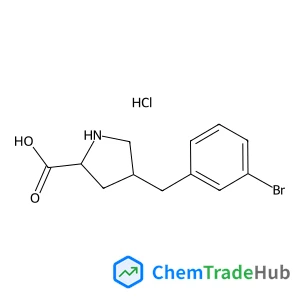
(2S,4R)-4-(3-Bromobenzyl)pyrrolidine-2-carboxylic acid hydrochloride
CAS番号:
1049734-10-2
分子式:
C12H15BrClNO2
おすすめサプライヤー





免責事項
このページに表示される学術雑誌情報は、参考および研究目的のみを目的としています。当社は雑誌出版社とは提携しておらず、投稿の取り扱いも行っておりません。出版に関するお問い合わせは、各雑誌出版社に直接ご連絡ください。
表示されている情報に誤りがある場合は、support@chemtradehub.com までご連絡ください。迅速に確認し、対応いたします。