












Rapid production of block copolymer nano-objects via continuous-flow ultrafast RAFT dispersion polymerisation
文献情報
出版日
2020-04-29
DOI
10.1039/D0PY00276C
インパクトファクター
5.582
著者
Sam Parkinson, Stephen T. Knox, Richard A. Bourne, Nicholas J. Warren
原文を見る
要旨
Ultrafast RAFT polymerisation is exploited under dispersion polymerisation conditions for the synthesis of poly(dimethylacrylamide)-b-poly(diacetoneacrylamide) (PDMAmx-b-PDAAmy) diblock copolymer nanoparticles. This process is conducted within continuous-flow reactors, which are well suited to fast reactions and can easily dissipate exotherms making the process potentially scalable. Transient kinetic profiles obtained in-line via low-field flow nuclear magnetic resonance spectroscopy (flow-NMR) confirmed the rapid rate of polymerisation whilst still maintaining pseudo first order kinetics. Gel permeation chromatography (GPC) reported molar mass dispersities, Đ < 1.3 for a series of PDMAmx-b-PDAAmy diblock copolymers (x = 46, or 113; y = 50, 75, 100, 150 and 200) confirming control over molecular weight was maintained. Particle characterisation by dynamic light scattering (DLS) and transmission electron microscopy (TEM) indicated successful preparation of spheres and a majority worm phase at 90 °C but the formation of vesicular morphologies was only possible at 70 °C. To maintain the rapid rate of reaction at this lower temperature, initiator concentration was increased which was also required to overcome the gradual ingress of oxygen into the PFA tubing which was quenching the reaction at low radical concentrations. Ill-defined morphologies observed at PDAAm DPs close to the worm-vesicle boundary, combined with a peak in molar mass dispersity suggested poor mixing prevented an efficient morphological transition for these samples. However, by targeting higher PDAAm DPs, the additional monomer present during the transition plasticises the chains to facilitate formation of vesicles at PDAAm DPs of ≥300.
関連文献
De novo molecular drug design benchmarking
Lauren L. Grant, Clarissa S. Sit
2021-06-03
Review Article
DOI: 10.1039/D1MD00074H
Cyclisation strategies for stabilising peptides with irregular conformations
Quynh Ngoc Vu, Reginald Young, Haritha Krishna Sudhakar, Tianyi Gao, Tiancheng Huang, Yaw Sing Tan, Yu Heng Lau
2021-04-28
Review Article
DOI: 10.1039/D1MD00098E
Selective degradation-inducing probes for studying cereblon (CRBN) biology
2021-07-06
Research Article
DOI: 10.1039/D0MD00382D
Pharmacological inhibition of NF-κB-inducing kinase (NIK) with small molecules for the treatment of human diseases
Feilong Zhou, Jin-Ming Yang
2021-01-22
Review Article
DOI: 10.1039/D0MD00361A
The role of small molecules in cell and gene therapy
Lewis L. Brayshaw, Carlos Martinez-Fleites, Takis Athanasopoulos, Thomas Southgate, Laurent Jespers, Christopher Herring
2020-12-24
Review Article
DOI: 10.1039/D0MD00221F
Proline pre-conditioning of cell monolayers increases post-thaw recovery and viability by distinct mechanisms to other osmolytes‡
Trisha L. Bailey, Juan Ramon Hernandez-Fernaud
2021-05-18
Research Article
DOI: 10.1039/D1MD00078K
Indole – a promising pharmacophore in recent antiviral drug discovery
Atukuri Dorababu
2020-11-06
Review Article
DOI: 10.1039/D0MD00288G
Phthalimide analogs for antimalarial drug discovery
Charu Upadhyay, Poonam, Sumit Kumar, Brijesh Rathi
2021-08-13
Review Article
DOI: 10.1039/D1MD00244A
Amino alcohol acrylonitriles as broad spectrum and tumour selective cytotoxic agents
Jennifer R. Baker, Cecilia C. Russell, Jayne Gilbert, Adam McCluskey, Jennette A. Sakoff
2021-03-09
Research Article
DOI: 10.1039/D1MD00021G
Synthesis and evaluation of pyridine-derived bedaquiline analogues containing modifications at the A-ring subunit
Lisa Barbaro, Gayathri Nagalingam, James A. Triccas, Jonathan B. Baell, Daniel L. Priebbenow
2021-05-07
Research Article
DOI: 10.1039/D1MD00063B
こちらもおすすめ
化合物よくある質問
カルボニル基が付いた5-氰基-1-{[(2-メチル-2-プロpanyl)オキシ]カーボンイル}1H-吲哚-2-イリド-2-ボリン酸はどのように保存すればよいですか?
カルボニル基が付いた5-氰基-1-{[(2-メチル-2-プロpanyl)オキシ]カーボンイル}1H-吲哚-2-イリド-2-ボリン酸は、直射日光を避けて室温(15...
475102-15-9(5-Cyano-1-{[(2-meth...
化合物よくある質問
tert-ブチル2-クロロメチルピリジン-3-基炭酸エステルの市場動向や研究トレンドはどうですか?
この化合物は合成化学分野において、特にピリジン化合物の合成や改良に用いられます。最近の研究では、ピリジン化合物の新規合成法や特性の改良が注目されています。市場動...
1203498-98-9tert-Butyl 2-chloro-...
化合物よくある質問
聚二季戊四醇六丙烯酸酯はどの業界で使用されていますか?
聚二季戊四醇六丙烯酸酯は、医薬品、ポリマー、センサー、半導体などの業界で広く使用されています。特にポリマー業界では硬化剤として、医薬分野では医療機器の製造に使用...
29570-58-93-(Acryloyloxy)-2-({...
化合物よくある質問
1-氯-5-硝基异喹啉の市場動向や研究トレンドはどうですか?
1-氯-5-硝基异喹啉は、薬理学や合成化学の研究分野で注目されています。市場動向としては、その生物学的な活性や合成可能性を評価する研究が増えています。また、代替...
58142-97-51-Chloro-5-nitroisoq...
化合物よくある質問
2-チロール-5-メチルスルフェニル-3-trifルオルメチルベンゼンはどのように合成されますか?
2-チロール-5-メチルスルフェニル-3-trifルオルメチルベンゼンは、トリフルオロメチル化反応と硫化反応を経て合成されます。通常、トリフルオロメチル化剤と硫...
957066-04-51-Chloro-4-(methylsu...
化合物よくある質問
p-トールイルマグネシウムブロミドの物理化学的性質は何ですか?
p-トールイルマグネシウムブロミドのCAS番号は4294-57-9です。この化合物は白色の結晶性粉末で、分子量は204.32です。溶剤中で良好に溶解しますが、水...
4294-57-9p-Tolylmagnesium bro...
化合物よくある質問
1-(5-甲基-2-硫化素基)プロパン-1-酮の市場動向や研究トレンドはどうですか?
1-(5-甲基-2-硫化素基)プロパン-1-酮の市場動向は、化学産業全体の需要に影響を受けますが、最近では pharmaceutical 分野での応用が注目され...
59303-13-81-(5-Methyl-2-thieny...
化合物よくある質問
十一碳烯酰甘氨酸を取り扱う際の実験室安全事項は何ですか?
十一碳烯酰甘氨酸は吸入や皮膚から吸収されることがあり、取り扱う際には防塵マスクと手袋を使用してください。ドラフトチャンバーを用いて漏洩を処理し、適切なSDS(S...
54301-26-7N-10-Undecenoylglyci...
化合物よくある質問
1H,1H-全氟-3,6-二氧杂葵-1-醇を取り扱う際の実験室安全事項は何ですか?
この化合物は吸入や皮膚吸収による毒性があるため、防塵マスク、ゴーグル、防護手袋を使用する必要があります。ドラフトチャンバーでの操作が必要です。漏洩時には即座に換...
152914-73-32,2-Difluoro-2-[1,1,...
化合物よくある質問
3-(4-(フルオロメチルオキシ)フェニル)-1,2,4-オキサジアゾール-5-カルボハイドライドは安全ですか?
安全性は化合物の使用方法によります。直接的な毒性は報告されていませんが、吸入や皮膚接触には注意が必要です。適切な防護服を着用し、換気を図ることを推奨します。
883028-82-83-(4-(Trifluorometho...
掲載誌
Polymer Chemistry

CiteScore:
8.6
自己引用率:
7.3%
年間論文数:
457
Polymer Chemistry welcomes submissions in all areas of polymer science that have a strong focus on macromolecular chemistry. Manuscripts may cover a broad range of fields, yet no direct application focus is required.
おすすめ化合物
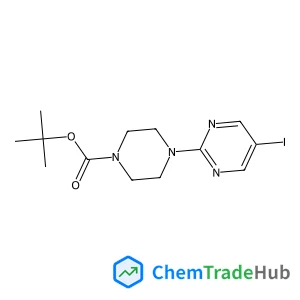
2-Methyl-2-propanyl 4-(5-iodo-2-pyrimidinyl)-1-piperazinecarboxylate
CAS番号:
1027616-32-5
分子式:
C13H19IN4O2
おすすめサプライヤー






免責事項
このページに表示される学術雑誌情報は、参考および研究目的のみを目的としています。当社は雑誌出版社とは提携しておらず、投稿の取り扱いも行っておりません。出版に関するお問い合わせは、各雑誌出版社に直接ご連絡ください。
表示されている情報に誤りがある場合は、support@chemtradehub.com までご連絡ください。迅速に確認し、対応いたします。