












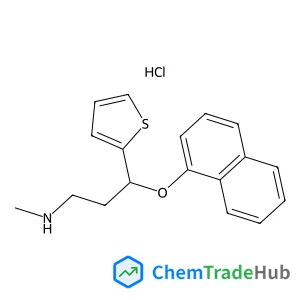
N-Methyl-3-(1-naphthyloxy)-3-(2-thienyl)-1-propanamine hydrochloride (1:1)
CAS番号:
1188266-11-6
分子式:
C18H20ClNOS
Yahe Wu, Yan Ji
The combination of dynamic covalent chemistry (DCC) with polymeric materials has sparked numerous innovations over the past two decades. One outstanding branch is the application in polymer actuators. Substantial progress has been made in this area regarding novel stimuli-responsive functions, such as intriguing responsiveness, reprogrammable functions, recyclability, and self-healability, more efficient actuator fabrication, new advanced actuation systems, etc. Through reasonable system design and function matching, different DCC strategies have been continuously discovered and employed, creating a variety of polymer actuators with covalent adaptable networks (CANs), which have been smashing the stereotypes of the materials that have already been studied for several decades such as shape memory polymers (SMPs) and liquid crystalline elastomers (LCEs). This review aims to overview the strategies for building polymer actuators based on CANs, how they function, and the advances induced by the introduction of CANs. An outline of CANs, DCC and the strategies on network design will be given at first. Further, we summarize the essential impacts inaugurated by CANs in different kinds of polymer actuators and shape the possible future directions in this sustainably growing field.
Jingwen Xiong, Zongzhi Li, Jihua Tan, Shaomin Ji, Jianwei Sun, Xianwei Li, Yanping Huo
DOI: 10.1039/C8AN00940F
Philip J. R. Roche, Mohamed Najih, Seung S. Lee, Lenore K. Beitel, Matthew L. Carnevale, Andrew G. Kirk
DOI: 10.1039/C7AN00304H
Joannie Desroches, Audrey Laurence, Michael Pinto, Marie-Andrée Tremblay, Kevin Petrecca, Frédéric Leblond
DOI: 10.1039/C6AN02061E
Krisda Sudprasert, Ratthasart Amarit, Armote Somboonkaew, Boonsong Sutapun, Apirom Vongsakulyanon, Wuttigrai Seedacoon, Pimpun Kitpoka, Mongkol Kunakorn
DOI: 10.1039/C7AN00027H
Takao Ono, Takanori Ichiki
DOI: 10.1039/C8AN01152D
Huihui Mao, Guanghua Luo, Yuxia Zhan, Jun Zhang, Shuang Yao, Yang Yu
DOI: 10.1039/C8AN90083C
Lok Nath Neupane, Pramod Kumar Mehta, Semin Oh, See-Hyoung Park, Keun-Hyeung Lee
DOI: 10.1039/C8AN01221K
G. R. Lloyd, J. Nallala, M. Isabelle, L. M. Almond, N. A. Shepherd, C. A. Kendall, A. C. Shore, N. Stone
DOI: 10.1039/C6AN01871H
3-イチチルビフェニルは、ビフェニルとイチプロピオニトリルを回収率約90%で反応させて合成されます。触媒は通常、亜リチウムホウ素を用います。
8-溴-5-三氟甲基喹啉は、5-トリフルオロメチル-2-メチル-1,3-ベンゼンジオールをブロモエタノールと反応させて生成します。この反応は塩基性条件下で行われ...
ジメチル4-(4,4,5,5-テトラメチル-1,3,2-ドioxaborolan-2-基)-2,6-ピリジンジカルボイル酸フェニルアミニドの代替品としては、4-...
N-(3,5-ヘキサクロロ-4-ピリドインイル)-8-メチオキシ-5-キノリンカーボン酸の市場動向は、主に産業用途での需要により影響を受けます。研究トレンドとし...
イソステアロイルグリセリルは一般的に安全性が高いとされていますが、過度な使用や個人差により皮�owsん炎などの反応が起こる可能性があります。使用前に医師に相談す...
1-(二苯甲基)-3,3-二氟-氮杂环丁烷の市場動向は、医薬品や合成化学の研究分野で注目を集めています。新興研究は、該当化合物の合成改良と生体内での作用メカニズ...
3-チオフェンスチオールのCAS番号は7774-73-4です。結晶性の白色粉末で、分子量は122.17です。この化合物は水に微溶解し、エタノールやジクロロメタン...
2-Methyl-2-propanyl (2S)-2-(aminomethyl)-1-piperidinecarboxylateは一定の安全性基準を満たしていま...
CAS番号1316822-90-8の化合物は安全性に関しては評価が不足していますが、一般的には生物学的に活性な物質であり、取り扱いには適切な安全防護措置が必要で...
Tert-butyl 2-(2-羟基乙基)哌嗪-1-羧酸は、冷暗所で保存し、直射日光から遠ざけてください。容器は密閉し、高湿度や高温を避けて保管してください。

Polymer Chemistry welcomes submissions in all areas of polymer science that have a strong focus on macromolecular chemistry. Manuscripts may cover a broad range of fields, yet no direct application focus is required.
![1-{3-[4-Amino-3-(4-phenoxyphenyl)-1H-pyrazolo[3,4-d]pyrimidin-1-yl]-1-piperidinyl}-2,3-dihydroxy-1-propanone structure](https://static.chemtradehub.com/structs/122/1226872-27-0-e037.webp "1-{3-[4-Amino-3-(4-phenoxyphenyl)-1H-pyrazolo[3,4-d]pyrimidin-1-yl]-1-piperidinyl}-2,3-dihydroxy-1-propanone structure")
![(2R,6S)-6-[(Benzyloxy)methyl]-4-{[(2-methyl-2-propanyl)oxy]carbonyl}-2-morpholinecarboxylic acid structure](https://static.chemtradehub.com/structs/109/1093085-91-6-3382.webp "(2R,6S)-6-[(Benzyloxy)methyl]-4-{[(2-methyl-2-propanyl)oxy]carbonyl}-2-morpholinecarboxylic acid structure")


