












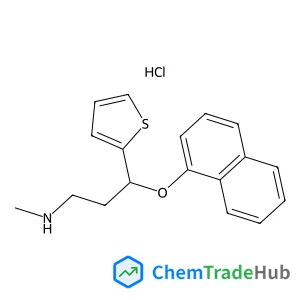
N-Methyl-3-(1-naphthyloxy)-3-(2-thienyl)-1-propanamine hydrochloride (1:1)
CAS番号:
1188266-11-6
分子式:
C18H20ClNOS
Jingwen Xiong, Zongzhi Li, Jihua Tan, Shaomin Ji, Jianwei Sun, Xianwei Li, Yanping Huo
Two novel highly selective quinoline-based fluorescent probes (1 and 2) with an aggregation induced emission (AIE) feature have been designed and synthesized for the rapid analysis of Cu2+ ions in aqueous media and on paper strips with a fluorescence quenching mechanism. Moreover, probes 1 and 2 exhibit excellent sensitivity and anti-interference for Cu2+ detection, and the detection limits are as low as 1.3 × 10⁻⁸ M and 8.5 × 10⁻⁸ M, respectively, which are much lower than the allowable standard of Cu2+ (∼20 μM) in drinking water (EPA). More importantly, these two probes were successfully applied for the determination of Cu2+ in real aqueous samples and fabrication of simple device test strips for rapid and on-site detection of Cu2+ ions. Interestingly, they can also be regenerated by adding an excess of S2−. Additionally, the crystallographic structure of probe 1 was confirmed through a single crystal X-ray study. Job's plot analysis and ESI-MS spectroscopic studies reflect the 1 : 1 complexation of the 1–Cu2+ and 2–Cu2+ complexes. Furthermore, DFT/TDDFT calculations were performed in order to help in understanding the electronic properties of the complexes and the chelation-induced quenching mechanism.
Sharon Ruthstein
DOI: 10.1039/C3CP50533B
Xiao Lin, Zhi-Tao Wang, Igor Lyubinetsky, Bruce D. Kay, Zdenek Dohnálek
DOI: 10.1039/C3CP44040K
Jan-Michael Mewes, Andreas Dreuw
DOI: 10.1039/C3CP44338H
Ping Wu, Pan Du, Hui Zhang, Chenxin Cai
DOI: 10.1039/C3CP50900A
Haoguang Li, Mickael Rivallan, Frederic Thibault-Starzyk, Arnaud Travert
DOI: 10.1039/C3CP50442E
Terry D. Humphries, Derek Birkmire, Bjørn C. Hauback, G. Sean McGrady, Craig M. Jensen
DOI: 10.1039/C3CP50777G
Arnošt Mládek, Miroslav Krepl, Michal Otyepka, Pavel Banáš, Marie Zgarbová, Petr Jurečka
DOI: 10.1039/C3CP44383C
Zhuang Liu, Hao Zhang, Jinghong Li, Junhong Chen
DOI: 10.1039/C3CP50647A
Chuan Shi, Christopher P. O'Grady, Andrew A. Peterson, Heine A. Hansen
DOI: 10.1039/C3CP50645B
3-イチチルビフェニルは、ビフェニルとイチプロピオニトリルを回収率約90%で反応させて合成されます。触媒は通常、亜リチウムホウ素を用います。
8-溴-5-三氟甲基喹啉は、5-トリフルオロメチル-2-メチル-1,3-ベンゼンジオールをブロモエタノールと反応させて生成します。この反応は塩基性条件下で行われ...
ジメチル4-(4,4,5,5-テトラメチル-1,3,2-ドioxaborolan-2-基)-2,6-ピリジンジカルボイル酸フェニルアミニドの代替品としては、4-...
N-(3,5-ヘキサクロロ-4-ピリドインイル)-8-メチオキシ-5-キノリンカーボン酸の市場動向は、主に産業用途での需要により影響を受けます。研究トレンドとし...
イソステアロイルグリセリルは一般的に安全性が高いとされていますが、過度な使用や個人差により皮�owsん炎などの反応が起こる可能性があります。使用前に医師に相談す...
1-(二苯甲基)-3,3-二氟-氮杂环丁烷の市場動向は、医薬品や合成化学の研究分野で注目を集めています。新興研究は、該当化合物の合成改良と生体内での作用メカニズ...
3-チオフェンスチオールのCAS番号は7774-73-4です。結晶性の白色粉末で、分子量は122.17です。この化合物は水に微溶解し、エタノールやジクロロメタン...
2-Methyl-2-propanyl (2S)-2-(aminomethyl)-1-piperidinecarboxylateは一定の安全性基準を満たしていま...
CAS番号1316822-90-8の化合物は安全性に関しては評価が不足していますが、一般的には生物学的に活性な物質であり、取り扱いには適切な安全防護措置が必要で...
Tert-butyl 2-(2-羟基乙基)哌嗪-1-羧酸は、冷暗所で保存し、直射日光から遠ざけてください。容器は密閉し、高湿度や高温を避けて保管してください。

Analyst publishes analytical and bioanalytical research that reports premier fundamental discoveries and inventions, and the applications of those discoveries, unconfined by traditional discipline barriers.

![1-[6-(1H-Imidazol-1-yl)-3-pyridinyl]methanamine structure](https://static.chemtradehub.com/structs/914/914637-08-4-8825.webp "1-[6-(1H-Imidazol-1-yl)-3-pyridinyl]methanamine structure")
![1-{3-[4-Amino-3-(4-phenoxyphenyl)-1H-pyrazolo[3,4-d]pyrimidin-1-yl]-1-piperidinyl}-2,3-dihydroxy-1-propanone structure](https://static.chemtradehub.com/structs/122/1226872-27-0-e037.webp "1-{3-[4-Amino-3-(4-phenoxyphenyl)-1H-pyrazolo[3,4-d]pyrimidin-1-yl]-1-piperidinyl}-2,3-dihydroxy-1-propanone structure")
![1-(1-Benzyl-1,2,3,6-tetrahydropyridin-4-yl)-1H-benzo[d]imidazol-2(3H)-one structure](https://static.chemtradehub.com/structs/603/60373-71-9-7dfb.webp "1-(1-Benzyl-1,2,3,6-tetrahydropyridin-4-yl)-1H-benzo[d]imidazol-2(3H)-one structure")





