


Effect of pH on the chemical modification of quercetin and structurally related flavonoids characterized by optical (UV-visible and Raman) spectroscopy
文献情報
出版日
2014-04-25
DOI
10.1039/C4CP00864B
インパクトファクター
3.676
著者
Z. Jurasekova, C. Domingo, J. V. Garcia-Ramos, S. Sanchez-Cortes
原文を見る
要旨
In this work we report the study of the chemical modifications undergone by flavonoids, especially by quercetin (QUC), under alkaline conditions by UV-visible absorption, Raman and surface-enhanced Raman scattering (SERS) spectroscopy, the study was performed in aqueous solution and also on Ag nanoparticles (AgNPs). Several processes are involved in the effect of alkaline pH both in solution and on AgNPs: autoxidation affecting mainly the C-ring of the molecule and giving rise to the molecular fragmentation leading to simpler molecular products, and/or the dimerization and further polymerization leading to species with a higher molecular weight. In addition, there exists a clear structure–instability correlation concerning mainly particular groups in the molecule: the C3–OH group in the C-ring, the catechol moiety in the B-ring and the C2C3 bond also existing in the C-ring. QUC possesses all these groups and exhibits high instability in alkaline solution. The SERS spectra registered at different pH revealed a change in the dimerization protocol of QUC going from the A- and C-rings-like-condensation to B-ring-like-condensation. Increasing the knowledge of the chemical properties of these compounds and determining the structure–activity relationship under specific environmental factors allow us to improve their beneficial properties for health as well as the preservation of Cultural Heritage objects, for example, by preventing their degradation.
おすすめジャーナル

Journal of the American Chemical Society

Chemistry of Natural Compounds

Carbon

Canadian Metallurgical Quarterly

Journal of the Chinese Chemical Society

Australian Journal of Chemistry

Chemical & Pharmaceutical Bulletin

Chemistry of Heterocyclic Compounds

Chemical Reviews

Bulletin of the Chemical Society of Japan
関連文献
The role of an unintentional carbon dopant in resolving the controversial conductivity aspects in BiFeO3
Shaan Ameer, Kajal Jindal, Monika Tomar, Pradip K. Jha, Vinay Gupta
2020-04-27
Paper
DOI: 10.1039/C9CP06614D
Negative magnetization, complex magnetic ordering and applications of Cr-doped Co2TiO4
Q. S. Fu, X. H. Chen, C. Chakrabarti, C. L. Li, J. Zheng, P. J. Wang, H. X. Yin, Y. Qiu, B. Meng, S. L. Yuan
2020-02-28
Paper
DOI: 10.1039/C9CP06444C
Penning spectroscopy and structure of acetylene oligomers in He nanodroplets
S. Mandal, R. Gopal, M. Shcherbinin, A. D’Elia, H. Srinivas, R. Richter, B. Bapat, S. R. Krishnan, V. Sharma
2020-04-21
Paper
DOI: 10.1039/D0CP00689K
The effect of pulse duration on nanoparticle generation in pulsed laser ablation in liquids: insights from large-scale atomistic simulations
Maxim V. Shugaev, Chengping Wu, Leonid V. Zhigilei
2020-03-06
Paper
DOI: 10.1039/D0CP00608D
Kinked row-induced chirality driven by molecule–substrate interactions
Yannick J. Dappe, Oleksiy L. Kapitanchuk, Delphine Coursault, Emmanuelle Lacaze
2020-02-21
Paper
DOI: 10.1039/C9CP06519A
The statistical molecular fragmentation model compared to experimental plasma induced hydrocarbon decays
Stéphane Pasquiers, Nicole Blin-Simiand, Lionel Magne, Nguyen-Thi Van-Oanh, Sébastien Thomas
2020-03-20
Paper
DOI: 10.1039/C9CP06958E
Time-resolved formation of excited atomic and molecular states in XUV-induced nanoplasmas in ammonia clusters
Rupert Michiels, Aaron C. LaForge, Matthias Bohlen, Carlo Callegari, Andrew Clark, Aaron von Conta, Marcello Coreno, Michele Di Fraia, Marcel Drabbels, Paola Finetti, Martin Huppert, Veronica Oliver, Oksana Plekan, Kevin C. Prince, Stefano Stranges, Vít Svoboda, Hans Jakob Wörner, Frank Stienkemeier
2020-03-26
Paper
DOI: 10.1039/D0CP00669F
Charge transfer in steam purified arc discharge single walled carbon nanotubes filled with lutetium halides
Ana Santidrián, Magdalena Kierkowicz, Elzbieta Pach, Denisa Darvasiová, Belén Ballesteros, Gerard Tobias, Martin Kalbáč
2020-04-23
Paper
DOI: 10.1039/D0CP01408G
Gas phase reactions of iodide and bromide anions with ozone: evidence for stepwise and reversible reactions‡
Mahendra Bhujel, David L. Marshall, Alan T. Maccarone, Benjamin I. McKinnon, Adam J. Trevitt, Gabriel da Silva, Stephen J. Blanksby, Berwyck L. J. Poad
2020-04-27
Paper
DOI: 10.1039/D0CP01498B
Effect of the supramolecular interactions on the nanostructure of halloysite/biopolymer hybrids: a comprehensive study by SANS, fluorescence correlation spectroscopy and electric birefringence
Michael Gradzielski
2020-03-16
Paper
DOI: 10.1039/D0CP01076F
こちらもおすすめ
化合物よくある質問
2-ヒドロキシ-5-ニトロベンジンブロモイドの代替品はありますか?
2-ヒドロキシ-5-ニトロベンジンブロモイドは特定の化学反応に適しているため、代替品は限られています。しかし、同様の構造を持つ2-ヒドロキシ-4-ニトロベンジン...
772-33-82-(Bromomethyl)-4-ni...
化合物よくある質問
N-(2-ブロモフェニル)-1-チロール-3-オキソ-3-(ピペリジニル)プロペン-2-イル)ベンゼンアミドを取り扱う際の実験室安全事項は何ですか?
N-(2-ブロモフェニル)-1-チロール-3-オキソ-3-(ピペリジニル)プロペン-2-イル)ベンゼンアミドは有毒で、皮膚や粘膜に刺激を与える可能性があります。...
1800044-77-2N-[(1Z)-1-(2-Bromoph...
化合物よくある質問
1,3プロパンジオール,2-[2-(2アミノ-6クロロ-9Hピリミジン-9-イル)エチル-1,1,2,2-D4]-2,3-ジアセタートの市場動向や研究トレンドはどうですか?
この化合物は、新規治療薬の開発に注目されています。市場では、その有効性と安全性が評価され、研究分野では、分子生物学と医薬化学の新たな発見が期待されています。
1020718-81-31,3-Propanediol, 2-[...
579-44-2Ethanone, 2-hydroxy-...
化合物よくある質問
Succinimidyl-alanyl-phenylalanyl-prolyl-phenylalanine 4-nitroanilide はどの業界で使用されていますか?
Succinimidyl-alanyl-phenylalanyl-prolyl-phenylalanine 4-nitroanilide は主に医薬品開発やポ...
128802-73-3succinimidyl-alanyl-...
化合物よくある質問
メチル6-アミノ-5-クロロピリジン-2-カーボイル酸について、適用される法規ガイドラインは何ですか?
メチル6-アミノ-5-クロロピリジン-2-カーボイル酸(CAS番号: 1256794-05-4)の使用には、GHS( Globally Harmonized S...
1256794-05-4Methyl 6-amino-5-chl...
化合物よくある質問
エチル4-(シクロ Pentagonyl)アミノ-2-メチル硫化基ピリミジン-5-カルボキシレートを取り扱う際の実験室安全事項は何ですか?
取り扱いには、耐薬品性の容器を使用し、通気性の良い場所で操作することを推奨します。漏れ時は、SDS(安全データシート)を参照して適切な措置を取ること。手洗いと洗...
211245-62-4ethyl 4-(cyclopentyl...
化合物よくある質問
(S)-3-ベンZYルピペリジン塩酸塩とは何ですか?
(S)-3-ベンZYルピペリジン塩酸塩は、CAS番号1258940-00-9で表される化合物です。これは、(S)-3-苯基哌啶的盐酸盐であり、主に医薬品の原料と...
1258940-00-9(S)-3-Phenylpiperidi...
化合物よくある質問
3,5-二甲基金剛胺の主な用途は何ですか?
3,5-二甲基金剛胺は、主に医薬品の原料として使用され、また抗うつ薬や抗アルツハイマー薬の開発に利用されます。さらに、化粧品や食品添加物の製造でも重要な役割を果...
19988-45-52-(2,3-Dihydroxyphen...
化合物よくある質問
ビス(4-メチル-2-ペンチル)フェニルカルボン酸エステルの代替品はありますか?
ビス(4-メチル-2-ペンチル)フェニルカルボン酸エステル (CAS番号: 1398066-13-1) の代替品には、ビス(2-エチルヘキシル)フェノールカルボ...
1398066-13-1Bis(4-methyl-2-penty...
掲載誌
Physical Chemistry Chemical Physics

CiteScore:
5.5
自己引用率:
10.3%
年間論文数:
3036
Physical Chemistry Chemical Physics (PCCP) is an international journal co-owned by 19 physical chemistry and physics societies from around the world. This journal publishes original, cutting-edge research in physical chemistry, chemical physics and biophysical chemistry. To be suitable for publication in PCCP, articles must include significant innovation and/or insight into physical chemistry; this is the most important criterion that reviewers and Editors will judge against when evaluating submissions. The journal has a broad scope and welcomes contributions spanning experiment, theory, computation and data science. Topical coverage includes spectroscopy, dynamics, kinetics, statistical mechanics, thermodynamics, electrochemistry, catalysis, surface science, quantum mechanics, quantum computing and machine learning. Interdisciplinary research areas such as polymers and soft matter, materials, nanoscience, energy, surfaces/interfaces, and biophysical chemistry are welcomed if they demonstrate significant innovation and/or insight into physical chemistry. Joined experimental/theoretical studies are particularly appreciated when complementary and based on up-to-date approaches.
おすすめ化合物
![1-[3-(4-Morpholinylsulfonyl)phenyl]methanamine structure](https://static.chemtradehub.com/structs/933/933989-32-3-51af.webp "1-[3-(4-Morpholinylsulfonyl)phenyl]methanamine structure")
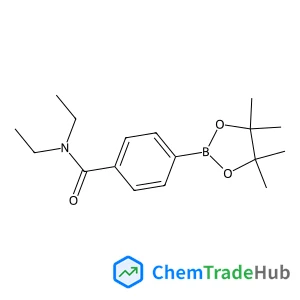
N,N-Diethyl-4-(4,4,5,5-tetramethyl-1,3,2-dioxaborolan-2-yl)benzamide
CAS番号:
325142-99-2
分子式:
C17H26BNO3
おすすめサプライヤー






免責事項
このページに表示される学術雑誌情報は、参考および研究目的のみを目的としています。当社は雑誌出版社とは提携しておらず、投稿の取り扱いも行っておりません。出版に関するお問い合わせは、各雑誌出版社に直接ご連絡ください。
表示されている情報に誤りがある場合は、support@chemtradehub.com までご連絡ください。迅速に確認し、対応いたします。