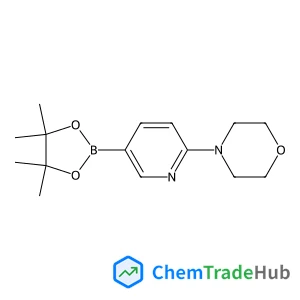
4-(5-(4,4,5,5-tetramethyl-1,3,2-dioxaborolan-2-yl)pyridin-2-yl)morpholine
CAS番号:
485799-04-0
分子式:
C15H23BN2O3
Jingyu Li, Chi Zhang, Peng-Fei Liu
The Heusler alloys CoFeRGa (R = Ti, V, Cr, Mn, Cu, and Nb) have similar chemical compositions, but exhibit remarkably distinct electronic structures, magnetism and transport properties. These structures cover an extensive range of spin gapless semiconductors, half-metals, semiconductors and metals with either ferromagnetic, ferrimagnetic, antiferromagnetic, or nonmagnetic states. The Heusler alloys have three types of structures, namely, type-I, type-II, and type-III. By means of first-principles calculation combined with the Boltzmann equation within the consideration of spin-freedom, we explore the transport feature of the most stable structure (type-I). In addition, we provide evidence that all the considered materials are mechanically and dynamically stable, possessing high strength and toughness to resist compression and tensile strain. Moreover, the distinct electronic (metallic, insulating, and half-metallic) properties and magnetic behaviors originate mainly from a cooperative electron transfer and electronic structures have been verified by our calculation. Finally, we found that the tunable electronic structure with varied atomic numbers has significant influence on the spin-Seebeck effect. Correspondingly, the calculated spin-Seebeck coefficient of CoFeCrGa is −60.29 μV K−1 at 300 K, which is larger than that of other quaternary Heusler compounds. Our results provide a band-engineering platform to design Heusler structures with different electronic behaviors in isomorphic compounds, which provide the way for accelerating the pre-screening of materials to advance and for using the quaternary Heusler compounds for potential applications in spin caloritronic devices.
Ran Liu, Jonathon Duay, Timothy Lane
DOI: 10.1039/B918589P
Ryo Akiyama, Yasuhito Karino, Hokuto Obama, Ayako Yoshifuku
DOI: 10.1039/B921314G
Etienne Snoeck, Cinzia Giannini, Fabia Gozzo, Mar Garcia-Hernandez
DOI: 10.1039/B821964H
P. Liu, H. Cui, C. X. Wang, G. W. Yang
DOI: 10.1039/B918759F
Christof Christophis
DOI: 10.1039/B924304F
Yann R. Chemla
DOI: 10.1039/B920234J
Stefano Agnoli, T. Onur Menteş, Miguel A. Niño, Andrea Locatelli, Gaetano Granozzi
DOI: 10.1039/B821339A
Donghai Mei, Qingfeng Ge, Ja Hun Kwak, Do Heui Kim, Christelle Verrier, Janos Szanyi, Charles H. F. Peden
DOI: 10.1039/B819347A
CAS番号66981-77-9の噻奈普汀乙酯は、結晶性白色粉末であり、分子量は476.9 g/molです。この化合物は水に溶けにくく、一般的には有機溶媒で溶解し...
アミピシリン不純物Fは、CAS番号124774-48-7の化合物です。これは、抗生物質アミピシリンの生産過程で生成される不純物の一つであり、(4S)-2-({[...
イリジウム(I)ヘキサフルオロフォスファートの代替品として、他の有機金属化合物や非有機金属化合物が使用されることがあります。具体的には、ダイゾニウム塩や他の金属...
含有3-(苯氧基甲基)苯硼酸频那醇酯の廃棄物は、安全な方法で処理する必要があります。まず、廃棄物を適切な容器に収集し、避けて保管します。次に、専門の廃棄処理業者...
取り扱う際は、密閉のゴーグルと手袋を着用することが推奨されます。ドラフトチャンバーを使用し、漏洩時には速やかに取り扱いを中止し、適切な排気設備を使用してください...
3α-アセトキノイドコレステロールエステルは、常温から低温(0-5℃)の暗所で保存し、密閉容器に入れることで安定性を保つことが推奨されます。また、湿気や酸素から...
2-ぶンジロキシ-4-(トリフルオロメチル)フェノルビノン酸は、化学合成の触媒としての使用や、医薬品の合成材料としての役割があります。また、特定の合成路線で使用...
(2S,3R)-2-氨基-3-甲基丁二酸は、2-ヒドロキシ-3-メチル丁酸とアミノ化反応を行うことで合成されます。触媒としてジクロロメタンが使用され、選択性と収...
この化合物は常温で避けてください。直射日光を避け、密閉容器で保存し、湿気を防水の容器に入れて保管してください。

Physical Chemistry Chemical Physics (PCCP) is an international journal co-owned by 19 physical chemistry and physics societies from around the world. This journal publishes original, cutting-edge research in physical chemistry, chemical physics and biophysical chemistry. To be suitable for publication in PCCP, articles must include significant innovation and/or insight into physical chemistry; this is the most important criterion that reviewers and Editors will judge against when evaluating submissions. The journal has a broad scope and welcomes contributions spanning experiment, theory, computation and data science. Topical coverage includes spectroscopy, dynamics, kinetics, statistical mechanics, thermodynamics, electrochemistry, catalysis, surface science, quantum mechanics, quantum computing and machine learning. Interdisciplinary research areas such as polymers and soft matter, materials, nanoscience, energy, surfaces/interfaces, and biophysical chemistry are welcomed if they demonstrate significant innovation and/or insight into physical chemistry. Joined experimental/theoretical studies are particularly appreciated when complementary and based on up-to-date approaches.
![N-[(5,6-Dichloro-1H-benzimidazol-2-yl)methyl]-9-(1-methyl-1H-pyrazol-4-yl)-2-(4-morpholinyl)-9H-purin-6-amine structure](https://static.chemtradehub.com/structs/238/2387704-62-1-25f4.webp "N-[(5,6-Dichloro-1H-benzimidazol-2-yl)methyl]-9-(1-methyl-1H-pyrazol-4-yl)-2-(4-morpholinyl)-9H-purin-6-amine structure")